

Key Takeaways
- License gate: a TLC driver license costs roughly $700–$800 all-in — $252 application, $34 drug test, $90.25 fingerprinting, $245–$250 course, $49 exam — and every step must finish within 90 days or the application is denied with no refund.
- Insurance floor: the black car you drive must sit behind at least $100,000/$300,000 in liability coverage — the TLC’s hard minimum for 1–7 passenger for-hire vehicles, verified on the agency’s published schedule.
- Real pay: the BLS puts May 2025 median pay at $42,100 for taxi drivers and $37,290 for chauffeurs, with the top 10 percent of taxi drivers clearing $75,800 — and the 2025–35 job outlook at 9 percent, well above average.
- Honest trade-off: unpaid queue time at JFK and LGA can turn the highest-advertised per-trip option into the lowest-paying hour of your week — the flashiest surge number is rarely the best hourly deal.
- Fee fact: the Port Authority now charges $3.50 per for-hire pickup and drop-off at JFK, LGA, and EWR (raised March 15, 2026) — a line item drivers feel whenever bases or platforms pass it through.
- Lease math: yellow-cab weekly lease caps are $690 for day shifts and $797 for night shifts, with maintenance and collision coverage included — you start earning only after the lease is covered.
Written by David Williams, New York transportation writer covering the tri-state ground-transportation beat. Fact-checked by Alex Freeman, Editor-in-Chief. Last verified October 9, 2026.
Airport Driver Jobs: 7 Honest 2026 Paths at JFK, LGA, and EWR
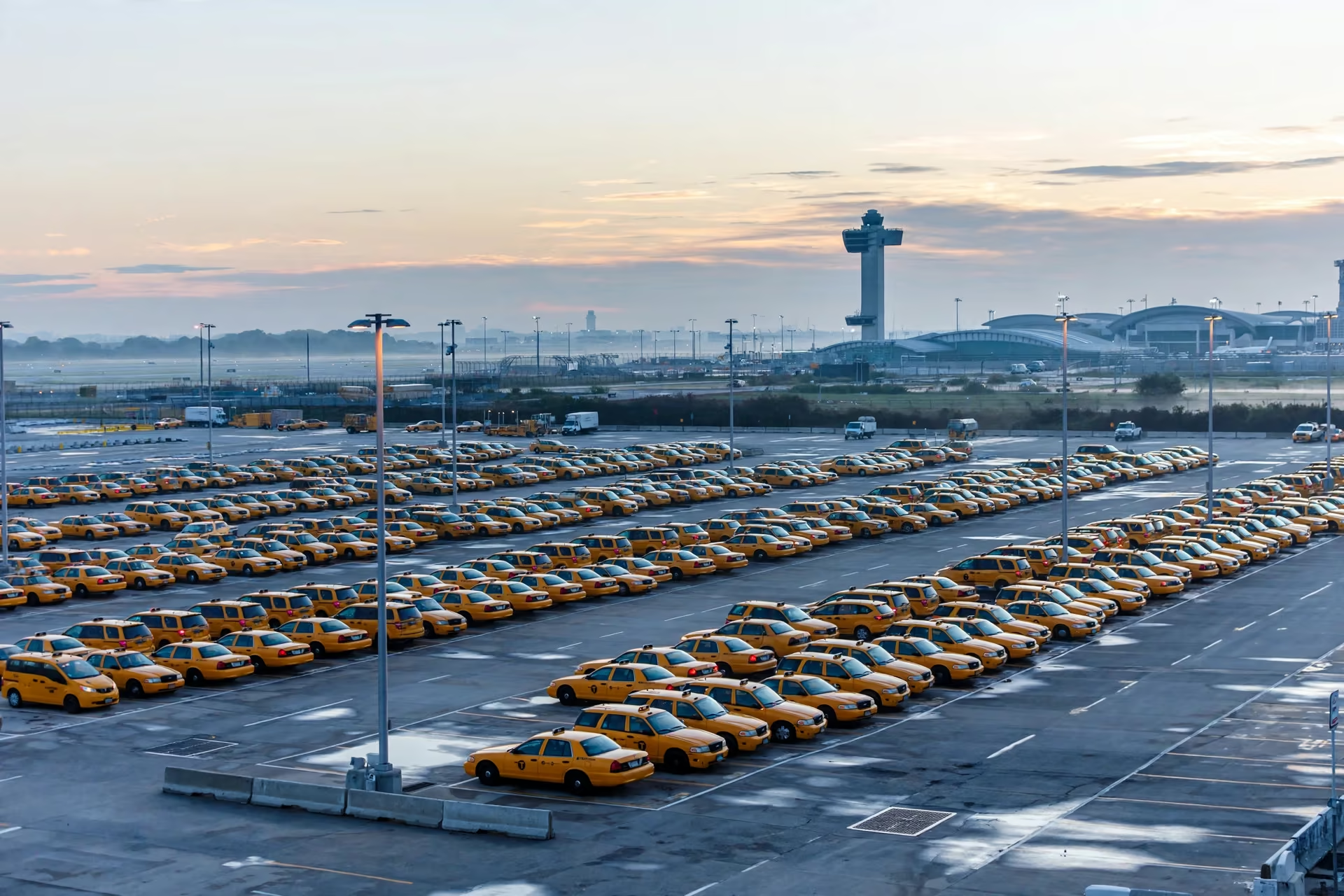
At five in the morning the JFK taxi hold lot is already full — row after row of yellow cabs idling under the control tower lights, hundreds of drivers waiting for a dispatch board to call their number. Every one of them paid to be there: license fees, a lease, the car — and none of them is earning a cent yet. That lot is the honest starting point for airport driver jobs in New York: a living that begins long before the first fare.
The job looks simple from the terminal curb: drive people to and from the airport. But the reality is a tightly regulated market where the TLC license gates nearly everything in airport driver jobs, lease math decides your real hourly pay, and unpaid waiting time quietly taxes every shift. Understand that machinery before you pay a dollar, and the difference between a career and an expensive lesson becomes obvious.
So what are the actual paths — and which ones pay? This guide breaks down the real routes at JFK, LGA, and EWR: what each costs to start, what it realistically pays, and the traps nobody advertises. The first question is what the phrase even covers.
What Airport Driver Jobs Actually Cover
airport driver jobs is an umbrella term for several distinct kinds of work around New York’s airports. A yellow-cab driver takes street hails and runs the regulated $70 flat between JFK and Manhattan. An app-based FHV driver takes Uber or Lyft dispatches on a TLC license with a TLC-plated car.
A black car driver runs prearranged trips through a TLC-licensed base — no hails, no app surge, dispatch by phone or system, with the vehicle classes a TLC base typically operates listed in our fleet overview. A shuttle driver runs hotel or corporate loops; a private chauffeur handles scheduled airport pickups for repeat clients. All of them converge on the same terminals, but the rules, the pay structure, and the daily rhythm differ completely.
The gate that covers nearly all of this work is the TLC driver license. Without it you cannot legally drive a taxi, a black car, a limousine, or an ambulette anywhere in the five boroughs — and you cannot touch airport driver jobs at JFK, LGA, or EWR without the right license on both the driver and the vehicle.
The Real Cost of Airport Driver Jobs: Getting In and Getting Paid
Before the first fare, airport driver jobs cost money — and the biggest line item is the license itself. The TLC application fee is $252, and the full package (drug test, fingerprints, the 3-day course, the exam, WAV training, defensive driving) lands around $700–$800 out of pocket, per the TLC’s published fee table.
Then comes the vehicle question, which is really a business-model question. Each row below shows one path into airport driver jobs: what you pay to start, what the arrangement includes, how exposed your income is to demand swings, whether pay is fixed per job, whether it is TLC-licensed, and the realistic annual range drawn from BLS wage data and industry structure. Riders see the other side of this math — how hourly and flat limousine rates are built — but this table is about your side of the meter.
| Option | Base Rate | What’s Included | Surge Risk | Fixed Quote? | TLC Licensed? | Realistic Range |
|---|---|---|---|---|---|---|
| App-based FHV driver | ~$700–$800 licensing + TLC-plated car arrangement | App dispatch, flexible hours, no dispatcher | High — income follows surges; unpaid lot waits | No | Yes (driver + vehicle) | $28k–$45k/yr |
| Yellow-cab lease driver | ~$700–$800 licensing + weekly lease up to $690 day / $797 night (TLC caps) | Maintenance, insurance, collision coverage inside the lease | Medium — meter and flag follow street demand | No (metered; $70 JFK flat) | Yes (medallion) | $30k–$50k/yr net of lease |
| Black-car base affiliate driver | ~$700–$800 licensing + base affiliation and dispatch arrangement | Prearranged dispatches, scheduled airport runs, base back-office | Low — pay set per job or commission | Usually yes (per job) | Yes (driver + vehicle + base) | $35k–$55k/yr |
| Airport/hotel shuttle driver | ~$700–$800 licensing; hired by a shuttle company | Set shifts, hourly wage, no vehicle cost | Low — paid by the hour | Yes (hourly) | Yes | $28k–$40k/yr |
| App-based FHV driver | ~$700–$800 licensing + TLC-plated car arrangement | App dispatch, flexible hours, no dispatcher | High — income follows surges; unpaid lot waits | No | Yes (driver + vehicle) | $28k–$45k/yr |
| Yellow-cab lease driver | ~$700–$800 licensing + weekly lease up to $690 day / $797 night (TLC caps) | Maintenance, insurance, collision coverage inside the lease | Medium — meter and flag follow street demand | No (metered; $70 JFK flat) | Yes (medallion) | $30k–$50k/yr net of lease |
| Neighborhood livery base driver | ~$700–$800 licensing + base affiliation | Local dispatch, airport runs, flexible shifts | Medium — depends on the base’s book | Sometimes | Yes (driver + vehicle + base) | $32k–$48k/yr |
| Black-car base affiliate driver | ~$700–$800 licensing + base affiliation and dispatch arrangement | Prearranged dispatches, scheduled airport runs, base back-office | Low — pay set per job or commission | Usually yes (per job) | Yes (driver + vehicle + base) | $35k–$55k/yr |
| Corporate airport chauffeur | ~$700–$800 licensing + professional vehicle and presentation standards | Repeat corporate clients, scheduled pickups, tips | Low | Yes | Yes | $40k–$62k/yr |
| Owner-operator (own TLC-plated vehicle) | ~$700–$800 licensing + vehicle purchase and TLC plating | Keep the full fare, multiple base affiliations, set own schedule | Low–Medium — fixed by your book | Yes | Yes (driver + vehicle) | $45k–$70k/yr |
The counterintuitive finding: the path with the flashiest per-trip numbers in airport driver jobs usually pays the least per hour. An app driver chasing a $60 surge fare can burn 90 unpaid minutes in the JFK hold lot — the surge looks big, but the hourly math collapses once the waiting is counted. A black-car driver on a scheduled $80 airport run with a prearranged return trip can earn more in the same window, with zero lottery involved.
So which fits whom? If you want maximum flexibility and already have a TLC-plated car, app-based airport driver jobs make sense — just budget honestly for dead time.
If you want predictable shifts and a vehicle handed to you, the yellow-cab lease is the honest workhorse; you start earning the moment you cover the lease. If you want the top of the pay range, airport chauffeur jobs nyc are where it lives: the corporate chauffeur path pays best but demands the most professionalism — suit, flight tracking, client relationships.
What the Job Feels Like: Drivers on the Ground
airport driver jobs stories from the curb share one theme: the waiting is the job. Veteran FHV drivers describe learning which hours at Terminal 4 actually produce fares and which hours just burn fuel — a kind of local knowledge no training course teaches.
Ask any jfk airport taxi driver and you will hear the same thing: the JFK-to-Manhattan run is the shift’s anchor — a $70 flat plus surcharges, a known quantity in a night of meter gambles. And black-car drivers consistently mention the dispatcher relationship — a good dispatcher at a busy base is worth more than a good car, because steady prearranged airport driver jobs beat random luck every time.

How to Become a Black Car Driver in NYC: The Checklist
If you are serious about airport driver jobs, run this checklist before spending anything. It covers the published tlc driver license requirements one by one — the practical answer to how to become a black car driver nyc — and the 90-day clock starts the day you apply. For context on the work itself, see the airport services black-car bases run day to day.
- ☐ Hold a valid driver’s license (any U.S. state) for at least one year, with a Social Security number and no debts owed to the TLC, DMV, or Department of Finance.
- ☐ File the TLC driver license application and pay the $252 fee — every step must be done within 90 days or the application is denied with no refund.
- ☐ Pass the DOT drug test at LabCorp ($34) and complete fingerprinting and photo at IdentoGO ($90.25, service code 15425Y).
- ☐ Complete the 3-day (24-hour) TLC education course ($245–$250), the WAV/passenger-assistance training ($50–$125), and a NYS DMV defensive driving course ($25–$75), then pass the TLC exam ($49 per attempt).
- ☐ Watch the 10-minute Sex Trafficking Awareness video and clear all outstanding parking and traffic tickets.
- ☐ Arrange a TLC-plated vehicle and a TLC-licensed base to dispatch you — a black car cannot legally take street hails, and every vehicle must carry at least $100,000/$300,000 in liability coverage.
- ☐ Verify your license status on the TLC’s license-check tool before your first shift — and re-verify any base that dispatches you.
The Industry in Honest Terms
airport driver jobs sit inside a market where every player has a real strength and a real weakness. App companies offer unmatched flexibility and instant dispatch — but they also set the prices, take their cut, and leave the waiting time on you. Traditional bases offer scheduled, prearranged airport work with human dispatchers — but the good shifts go to drivers who have earned trust, and the slow weeks still hurt.
The regulators are not standing still. The Port Authority’s 2026 budget funds “Operation Legal Ride,” an enforcement push against unlicensed solicitation at all three airports — good news for licensed drivers tired of gypsy cabs poaching fares at arrivals. And the TLC’s Critical Driver Program keeps monitoring driving records after licensing, which means a clean record is a career asset, not just an application requirement.
One Fee That Shapes Everything
One verifiable data point ties it together: the Port Authority now charges $3.50 per for-hire pickup and drop-off at JFK, LGA, and EWR, up from $2.50 on March 15, 2026, per the agency’s 2026 budget and capital plan. Drivers feel it when bases and platforms pass it through — another reminder that airport driver jobs economics are built from small line items, not headline fares.
Cross-Hudson runs work the same way; see what cross-Hudson transfers actually pay, using a Jersey City run as the example.
The Bottom Line: Is an Airport Driver Job Worth It?
airport driver jobs are worth it when you enter with the math done: license costs amortized, vehicle arrangement chosen for your schedule, and eyes open about unpaid waiting time. They are a trap when you enter on the fantasy of surge screenshots — the BLS median is a living, not a windfall, and the top 10 percent who clear $75,800 earned it through hours, strategy, and client relationships. For a look at the premium end of the market, see how hourly limo work in NYC is structured.
The honest edge in this market is boring: a TLC license kept clean, a dispatcher who knows your name, and the discipline to count your real hourly rate — paid and unpaid time together — before chasing any single fare. The Bureau’s national figures, from the BLS Occupational Outlook Handbook, are the right benchmark; drivers who track that number tend to outlast the ones who don’t.
If you are deciding this week, do one neutral thing before anything else: price the full license package and one vehicle arrangement against the BLS ranges above, then talk to three working drivers at the airport you would actually serve. Their answers will tell you more than any advertisement — including this one.
Video topic brief (placeholder — no video produced): “The Real Hourly Math of Airport Driving” (60–120 seconds): a numbers-driven explainer following one driver’s week — TLC licensing costs amortized, yellow-cab lease math, one app surge chase versus one scheduled airport run, and the unpaid wait time that decides the real hourly rate. No promises of riches; close on the licensing checklist. Production pending owner review per the Pictory workflow.
Infographic data brief (placeholder — not yet rendered): “Getting Licensed to Drive NYC Airports” — bar chart of TLC startup costs ($252 application, $34 drug test, $90.25 fingerprinting, $245–$250 course, $49 exam, $50–$125 WAV training, $25–$75 defensive driving); BLS pay ladder (chauffeurs $28,090–$55,070, median $37,290; taxi drivers $34,650–$75,800, median $42,100); yellow-cab lease caps ($690 weekly day / $797 weekly night). Design note: single accent color, no faces, source lines under each chart.
How much does it cost to get a TLC driver license?
Around $700 to $800 all-in, based on the TLC’s published fee table: $252 for the application, $34 for the DOT drug test at LabCorp, $90.25 for fingerprints and photo, $245 to $250 for the 3-day course, $49 per exam attempt, $50 to $125 for WAV training, and $25 to $75 for defensive driving. Every step must be finished within 90 days of applying, the fees are non-refundable, and drug testing repeats on an annual basis afterward. Budgeting the full amount before you start is the smartest first move in airport driver jobs.
How long does it take to get licensed for airport work?
Most applicants finish in four to eight weeks, but the hard deadline is 90 days from the application date — miss it and the application is denied with no refund. The slow steps are usually the background check and the course schedule. Apply only when you can finish the course, the drug test, and the fingerprinting within the same three months, because patience at this stage pays for itself across a career in airport driver jobs.
Do you need your own car to drive at NYC airports?
No, but you need access to a TLC-plated vehicle. The three common routes are leasing a medallion taxi (weekly caps of $690 for day shifts and $797 for night shifts), affiliating with a black-car base that dispatches you, or buying and TLC-plating your own car. Whatever the route, the vehicle needs its own TLC license and at least $100,000/$300,000 in liability coverage. Leasing avoids the capital cost, but it means you pay before your first fare — the defining trade-off of airport driver jobs.
How much do airport drivers really earn in New York?
The Bureau of Labor Statistics reports a May 2025 median of $42,100 for taxi drivers and $37,290 for chauffeurs, with the top 10 percent of taxi drivers above $75,800; the New York metro taxi-driver average was $35,820 in the 2023 metro survey. Treat platform screenshots with suspicion. Real airport driver jobs pay is an hourly rate after unpaid waiting, lease, fuel, and commissions are subtracted.
Can Uber and Lyft drivers pick up at JFK, LGA, and EWR?
Yes, if the driver holds a TLC driver license and drives a TLC-plated vehicle — the app alone is not a license. Street hails and curbside solicitation by for-hire drivers are illegal; pickups must be app-arranged. The Port Authority also charges a $3.50 ground transportation access fee on every for-hire pickup and drop-off at all three airports, which flows into the fare passengers pay. Knowing these rules is part of surviving in airport driver jobs.
What is the difference between driving a yellow cab and a black car?
A yellow cab works street hails under a medallion with regulated lease caps and a $70 flat fare between JFK and Manhattan. A black car works prearranged trips dispatched by a TLC-licensed base, with no street hails allowed and pay set per job or by commission. Cabs suit drivers who want walk-up demand; black cars suit drivers who want scheduled work and repeat clients. Both require the same TLC driver license, so the choice is about temperament, not paperwork — a key decision in airport driver jobs.
What insurance must a black car carry in New York City?
The TLC requires a minimum of $100,000 per person and $300,000 per occurrence in liability coverage for 1-to-7-passenger black cars and livery vehicles, plus $10,000 in property damage and $100,000 in personal injury protection. Luxury limousines sit on a higher tier. An operator who cannot show these numbers is not someone to drive for — it is the clearest license check in airport driver jobs.
Sources
- NYC Taxi and Limousine Commission — Get a TLC Driver’s License (fee table, education requirements, 90-day rule): nyc.gov/site/tlc/drivers/get-a-tlc-drivers-license.page
- NYC Taxi and Limousine Commission — Get a For-Hire Vehicle License (plate process, minimum insurance levels): nyc.gov/site/tlc/vehicles/get-a-for-hire-vehicle-license.page
- NYC Taxi and Limousine Commission — Standard Lease Cap Rules, §58-21(c)(1) (weekly and shift lease caps): nyc.gov/assets/tlc/downloads/pdf/archived_public_notices/lease_cap_rules_passed.pdf
- NYC Taxi and Limousine Commission — Licensing and Standards (applicant vetting process): nyc.gov/site/tlc/about/licensing-and-standards.page
- NYC Taxi and Limousine Commission — Renew a TLC Driver’s License (defensive-driving validity, drug-test timing): nyc.gov/site/tlc/drivers/renew-a-tlc-drivers-license.page
- U.S. Bureau of Labor Statistics — Taxi Drivers, Shuttle Drivers, and Chauffeurs, Occupational Outlook Handbook (May 2025 pay, job outlook 2025–35): bls.gov/ooh/transportation-and-material-moving/taxi-drivers-and-chauffeurs.htm
- U.S. Bureau of Labor Statistics — Occupational Employment and Wage Statistics, May 2023, Taxi Drivers (New York-Newark-Jersey City metro wage): bls.gov/oes/2023/may/oes533054.htm
- Port Authority of New York & New Jersey — 2026 Budget and 2026–2035 Capital Plan (FHV access fee $3.50 from March 15, 2026; Operation Legal Ride): panynj.gov/content/dam/corporate/budgets-pdfs/2026-budget.pdf
- Port Authority of New York & New Jersey — JFK Schedule of Charges, Ground Transportation Airport Access Fees (April 2023 fee history): panynj.gov/content/dam/airports/pdfs/JFK_Schedule_of_Charges_Updated_April2023.pdf
Methodology: licensing fees, insurance minimums, and lease caps were read from NYC TLC and Port Authority of NY & NJ pages on October 9, 2026; earnings figures are from the U.S. Bureau of Labor Statistics. Ranges are realistic estimates drawn from those sources, not guarantees. Spot an error? Call +1-646-214-4828 and we will correct it. Prices and regulations verified as of October 9, 2026 and subject to change.