
Key Takeaways
- TSA’s rule of thumb: arrive at least 2 hours before scheduled boarding for domestic flights, 3 hours for international — at JFK, LGA, or EWR during peak hours, the full buffer gets used.
- Most airlines close checked-bag drop 45–60 minutes before domestic departures, and the gate itself 10–15 minutes before departure — the Dasher’s margin is thinner than it looks.
- TSA PreCheck costs about $78 for a five-year enrollment and keeps shoes, jackets, and laptops in place at 200+ airports — amortized, the cheapest per-trip system among all the airport stereotypes.
- A lounge day pass (often around $50) beats terminal food, drink, and Wi-Fi prices on any layover over about three hours — and loses badly on a 45-minute turn.
- Honest trade-off: the TLC’s $70 flat fare makes a yellow cab JFK–Manhattan immune to surge pricing, while app-based rides surge exactly when the Dasher needs them most; the cheapest floor is AirTrain ($8.75) plus subway ($3.00) — if you’re traveling light.
- The counterintuitive math of airport stereotypes: the cheapest-looking type — the Dasher, $0 planned spend — carries the biggest tail risk, since one missed flight can cost hundreds; the indulgent-looking Lounge Lizard is often the cheapest comfortable seat in a four-hour delay.
Written by Sarah Thompson, Content Writer, JetBlack Transportation. Fact-checked by Alex Freeman, Editor-in-Chief. Last verified 2026-10-09. Editorial corrections: use the contact page — never reuse an unverified email from an old article.
Airport Stereotypes: The 10 Traveler Types in Every Terminal
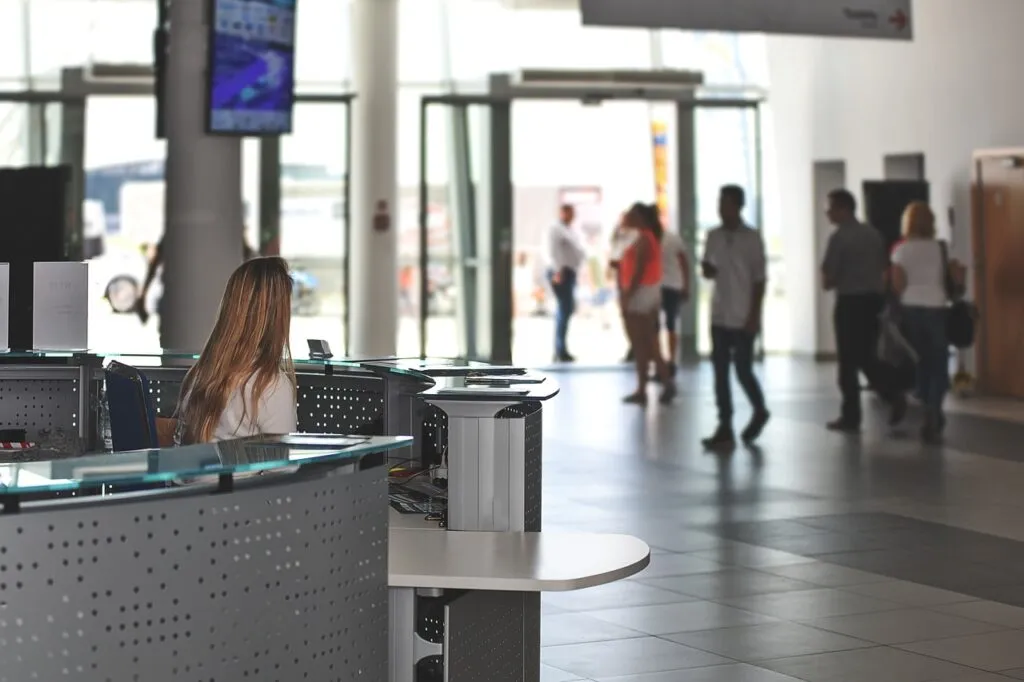
Terminal 4 at JFK, 6:40 on a Friday morning: a sprinter past the Hudson News, a man asleep across three seats, a family staging an operation around a stroller. Every airport runs the same cast of characters.
Walk any terminal — JFK, LGA, EWR, or a regional field in Ohio — and the lineup repeats itself: the sprinter, the three-hours-early coffee reader, the family negotiating with a car seat. These airport stereotypes are funny because they are true, and each one teaches a lesson: what to do — or never do — next trip.
Nobody is exactly one type — you are the Early Bird on the way to a wedding and the Dasher on the way home, which is why airport stereotypes work as a field guide, not a verdict.
1. The Early Bird
Three hours early, coffee and paperback at the gate. In the taxonomy of airport stereotypes, the Early Bird is the one everyone mocks — and secretly envies.
What they get right: the TSA’s two hours domestic, three international.
The survival tip: arrive early, clear security, then enjoy the terminal.
2. The Dasher
The Dasher reaches the gate as the agent is closing it. In the taxonomy of airport stereotypes, the Dasher is the cautionary tale.
What they teach: the cutoff math — most airlines close bag drop 45 to 60 minutes before domestic departures, the gate itself 10 to 15 minutes before. The gap between “boarding” and “doors closed” is smaller than they think.
The survival tip: carry-on only, mobile boarding pass, PreCheck — so security is a non-event.
3. The Overpacker
Two checked bags, a carry-on, and a personal item for a three-day trip. Among airport stereotypes, this one owns the check-in counter.
What they teach: the TSA’s first packing rule is to start with an empty bag. Know the 3-1-1 rule cold: 3.4-ounce containers, one quart-size bag, one per passenger.
The survival tip: pack the bag, then remove a third of it. Skip that and you become the priciest habit among all the airport stereotypes: repacking at the counter while the line grows.
4. The Lounge Lizard
The Lounge Lizard treats the airport like a members’ club with airplanes. Of all the airport stereotypes, the one with the best snacks.
What they get right: the terminal is nicer from inside a lounge — quieter, real food, Wi-Fi. JFK alone has around twenty lounges, and most big airports sell day passes. The Lounge Lizard did the math: a $50-ish day pass against terminal prices for a meal, two drinks, and Wi-Fi — and the lounge wins on layovers over three hours.
The survival tip: no elite status needed — check day-pass availability before you fly and compare it against your terminal spend.
5. The Gate Camper
The Gate Camper is already standing in the boarding lane, bag in hand, in Group 9, blocking Groups 1 through 8. Among airport stereotypes, the most universally recognized.
What they teach: overhead bin anxiety is real — nobody wants to gate-check a carry-on. But boarding order is boarding order.
The survival tip: board with your actual group — wheels first, handle out.
6. The Snack Hoarder
The Snack Hoarder boards with a tote bag holding a full meal and a water bottle to fill past security. While everyone else pays $18 for a terminal bowl, they eat better for a tenth. Of all the airport stereotypes, this is the one to copy without shame.
What they get right: solid food sails through security. Only liquids, gels, and aerosols face the 3.4-ounce limit.
The survival tip: pack the meal, bring the empty bottle, buy one coffee.
7. The Barefoot Philosopher
Shoes off at the gate. Feet up on the empty seat.
The Barefoot Philosopher treats the airport like a living room, the rest of the terminal like an audience. In the taxonomy of airport stereotypes, this one generates the strongest opinions.What they teach, accidentally: security bins are handled by thousands of hands. Shared spaces have a social contract.
The survival tip: wear slip-ons for the checkpoint and keep your feet to yourself.
8. The Duty-Free Tourist
The Duty-Free Tourist treats the shop like a theme park. Of all the airport stereotypes, this one spends the most money per minute in the terminal.
What they teach: duty-free is not automatically a deal — prices sit against a tax-free baseline, not the street price back home. Price-check before you fly.
The survival tip: duty-free is great for forgotten gifts and local specialties you cannot get at home. Customs allowances still apply when you land.
9. The First-Timer
Wide eyes, printed itinerary, asking strangers whether this is the security line. The First-Timer might be a teenager flying alone or a grandparent visiting family. Among airport stereotypes, the only one everyone roots for.
What they teach: the airport is designed for them — consistent signage, real help desks, staff who answer the same questions all day. The TSA’s own app shows live checkpoint wait estimates.
The survival tip: ask early and ask staff — they would rather answer now than solve a missed flight later.
10. The Road Warrior
Laptop open, boarding while finishing an email. The Road Warrior flies weekly and has a Known Traveler Number memorized. Of all the airport stereotypes, this one has the smoothest airport day — and the most to teach.
What they get right: trusted traveler programs are the best investment for frequent flyers. TSA PreCheck — about $78 for five years — keeps shoes, jackets, and laptops in place at 200+ airports.
The survival tip: steal the Road Warrior’s systems. PreCheck if you fly even a few times a year, carry-on only when you can.
The Real Cost of Airport Stereotypes: What Each Traveler Type Actually Spends
So which of these airport stereotypes costs the least per trip? Sticker price and real cost are different numbers.
Below: typical spend, what’s included, peak-travel risk, whether the cost is fixed, and the realistic range. All figures are hedged typical ranges.
| Option | Typical Airport Spend | What’s Included | Peak Travel Risk | Fixed Cost? | Realistic Range |
|---|---|---|---|---|---|
| Barefoot Philosopher | $0 | Comfort is free | Social, not financial | Yes | $0 |
| Gate Camper | $0 | A lane position that buys nothing | Forced gate-check | Yes | $0–$30 |
| First-Timer | $0–$10 | Free help desks and signage | Panic buys at triple price | Yes | $0–$15 |
| Early Bird | $5–$10 | Coffee and unhurried time | Boredom shopping | No | $5–$25 |
| Snack Hoarder | $8–$12 | Home-packed meal, one coffee | Almost none | No | $8–$15 |
| Road Warrior | ~$15/trip | PreCheck (~$78/5 yrs), carry-on only | Very low — systems absorb variance | Yes, amortized | ~$10–$20/trip |
| Overpacker | $35–$45 | One checked bag each way | Second-bag/overweight fees | No | $35–$100+ |
| Lounge Lizard | ~$50 | Day pass: food, drinks, Wi-Fi | $50 for a 45-minute visit | Yes, per visit | $45–$75 |
| Duty-Free Tourist | $40–$150+ | Impulse perfume, chocolate, bottles | “Deals” that aren’t | No | $25–$200+ |
| Dasher | $0 planned | Adrenaline, free of charge | One missed flight; rebooking to hundreds | No | $0–$300+ — the priciest tail risk of all the airport stereotypes |
The counterintuitive finding: the Dasher’s $0 of planned spend carries the biggest tail risk — one missed flight costs hundreds. The Lounge Lizard’s ~$50 day pass is the cheapest comfortable hour of a four-hour delay. And the Road Warrior’s ~$78 PreCheck amortizes to a few dollars per trip.
Three Composite Stories From the Departure Gate
Illustrative composites — not interviews, not data. The airport stereotypes above aren’t abstract; here’s how they play out.
The EWR commuter. A consultant flew out of Newark, arriving 70 minutes out against the TSA’s two-hour guidance — until one PATH delay plus a standard-security line turned a routine morning into a missed flight, and a rebooking costlier than a year of arriving early.
The LGA family. Two parents, three kids, four bags for a four-day trip. A $100 overweight fee at the LaGuardia counter taught them the remove-a-third rule in one expensive lesson.
The JFK convert. A skeptic who called lounges a scam did the math during a five-hour Terminal 4 delay: about $50 for the day pass against a $22 burger, two $9 coffees, and paid Wi-Fi — a Lounge Lizard on long layovers ever since.
The Anti-Stereotype Checklist: Steal the Best Habits
Run through this before every trip and dodge the worst of the airport stereotypes.
- Work backward from the TSA’s 2-hour domestic / 3-hour international rule — add 30 minutes at JFK, LGA, or EWR at peak.
- Start with an empty bag, apply the remove-a-third test, and pack liquids in 3-1-1 formation — 3.4-ounce containers, one quart-size bag — and bring an empty water bottle.
- Check in exactly 24 hours ahead when boarding position follows check-in order.
- Fly even three times a year? Price out TSA PreCheck — about $78 for five years, the cheapest per-trip upgrade in the terminal.
- On layovers over three hours, compare a lounge day pass (often around $50) against your real terminal spend.
- Confirm your ID is REAL ID-compliant — required at TSA checkpoints since May 7, 2025. Decide your airport ride before you land: the TLC’s $70 JFK–Manhattan flat fare never surges.
The Terminal Economy, Honestly: Who Profits From Each Traveler Type
What the airport stereotypes framing skips: the terminal is a shopping mall with gates, engineered to separate you from your money while you wait.
The honest ground-transport trade-offs, without the spin:
- Yellow cab: strength — the JFK–Manhattan flat fare never surges; weakness — surcharges, tolls, and tip push the real total toward $85–$105.
- Rideshare: strength — door-to-door with live tracking; weakness — prices surge exactly when you need a car.
- AirTrain plus subway: strength — $8.75 plus $3.00, the cheapest honest floor out of JFK; weakness — stairs, transfers, and heavy luggage.
- Pre-booked car service: strength — a fixed quote, no line, no surge; weakness — you had to arrange it before landing.
The one number here set by a regulator: the TLC’s $70 flat fare between JFK and Manhattan, either direction. Add the mandatory surcharges — $0.50 MTA, $1.00 improvement, $2.00 JFK airport access, $2.50 state congestion, $0.75 congestion-pricing toll — and you land at $76.75 before tolls and tip. Our honest breakdown of the TLC’s $70 JFK flat fare walks the full stack; our JFK-to-Manhattan cost comparison puts every option side by side.
The One Stereotype Worth Copying Outright
If you take one thing from this field guide to airport stereotypes, take the Early Bird’s buffer and the Snack Hoarder’s tote bag. Arrive with time to spare, eat food you chose.
And the stereotype the airport never shows you: the traveler whose ride is already waiting — the one part of the day you can fully control.
Our JFK transportation guide covers the options honestly; the JetBlack services list covers what a pre-booked car actually includes. Whichever type you are, be the Early Bird on the road.
Video: The 10 Airport Traveler Types in 90 Seconds
Production placeholder — video topic brief (temporary):
- Format: a 90-second cut (vertical + horizontal), cold open on the Dasher sprint, about 7 seconds per traveler type, closing on the Early Bird’s buffer and the Snack Hoarder’s tote bag.
- Talent and footage: real travelers in a real terminal, no staged stock; on-screen text names each type.
- Neutral close: one line inviting viewers to name their own type — no booking call to action, no invented statistics, timing claims matching the TSA guidance above.
Infographic: The Terminal Spend Map
Production placeholder — data brief and design note (temporary):
- Data brief: the COST table’s ten traveler types ranked by typical per-trip spend, bars labeled with hedged typical ranges (all marked typical/illustrative); a callout for the counterintuitive finding — the cheapest-looking type carries the biggest tail risk.
- Design note: vertical mobile-first, dark terminal palette with amber accents, keyword-led title, alt text per img_alt metadata.
FAQ
What are the most common airport stereotypes?
The ten types in this guide: the Early Bird, the Dasher, the Overpacker, the Lounge Lizard, the Gate Camper, the Snack Hoarder, the Barefoot Philosopher, the Duty-Free Tourist, the First-Timer, and the Road Warrior. Most travelers are a mix — Early Bird on the outbound, Dasher on the way home.
How early should I really get to the airport?
Follow the TSA guidance: at least two hours before your flight’s scheduled boarding time for domestic flights, three hours for international. At large airports during peak hours, that buffer gets used — the Early Bird stereotype exists because the math keeps working out.
Can I bring food through airport security?
Yes — solid foods like sandwiches, fruit, chips, and snacks pass through security without issue. Only liquids, gels, and aerosols face the 3-1-1 rule: containers of 3.4 ounces or less in one quart-size bag. Bring an empty water bottle and fill it past the checkpoint.
Do airport lounges actually save money?
Sometimes. A day pass, often around $50, can beat terminal prices for a meal, drinks, and Wi-Fi on a layover of three-plus hours — but on a short hop with a quick turnaround, it rarely pays. Do the math against what you would actually spend in the terminal.
What is the single biggest airport mistake travelers make?
Betting the whole trip on the Dasher’s gamble: cutting arrival so close that one slow shuttle, one long security line, or one gate change turns a tight connection into a missed flight. Buffer time is the cheapest travel insurance there is.
Sources
- Transportation Security Administration — Travel Tips 2025 — arrive at least two hours before scheduled boarding time (domestic), three hours for international; 3-1-1 liquids rule (3.4 oz containers, one quart bag); start packing with an empty bag; REAL ID required at checkpoints since May 7, 2025; MyTSA app wait estimates. Accessed October 2026.
- Simple Flying — the “airport theory” trend — the social-media debate over whether the standard two/three-hour arrival guidance is overkill; most airports and airlines hold the 2-hour domestic / 3-hour international line. Accessed October 2026.
- Port Authority of New York & New Jersey — JFK summer travel traffic-management plan — ride-app and car-service pickup relocations during peak construction; AirTrain JFK free between terminals and the Lefferts Blvd wait lot. Accessed October 2026.
- JetBlack — honest breakdown of the TLC’s $70 JFK flat fare — surcharge stack (MTA, improvement, airport access, congestion), realistic all-in totals, competitor rate comparisons. Internal reference; accessed October 2026.
- JetBlack — JFK-to-Manhattan cost comparison — AirTrain $8.75 + subway $3.00 floor, taxi vs. rideshare vs. pre-booked side by side. Internal reference; accessed October 2026.
- JetBlack — JFK transportation guide — ground-transport options from JFK covered honestly (internal cross-link; this page does not duplicate it). Accessed October 2026.
- JetBlack — services list — full service list and booking reference. Accessed October 2026.
Methodology: traveler-behavior observations are editorial archetypes, not statistical claims; TSA timing guidance from tsa.gov, verified 2026-10-09; lounge and amenity prices hedged as typical ranges, not operator quotes. Corrections: use the contact page.