
Bus to NY From Boston: The 2026 Guide to Operators, Fares, and Which Bus to Take
Taking the bus to NY from Boston is the oldest budget trick in the Northeast corridor, and it still works. For about the price of a sandwich and a coffee, you can ride from South Station in Boston to Midtown Manhattan in roughly four and a half hours — no airport security, no surge pricing, no hunting for parking in the city. The route is one of the busiest intercity bus corridors in the country, which means you get real choice: a half-dozen operators, departures nearly every hour, and fares that reward anyone who books more than a day ahead.
This guide covers the corridor as it runs in 2026: who operates it, what it costs, where the buses actually pick you up, what the ride is like, and when you’d be better off on the train or behind the wheel instead.
Why the Bus Still Wins the Boston–New York Corridor
On paper, the train should own this trip. In practice, the bus to NY from Boston keeps winning on the two things most travelers actually care about: price and frequency.
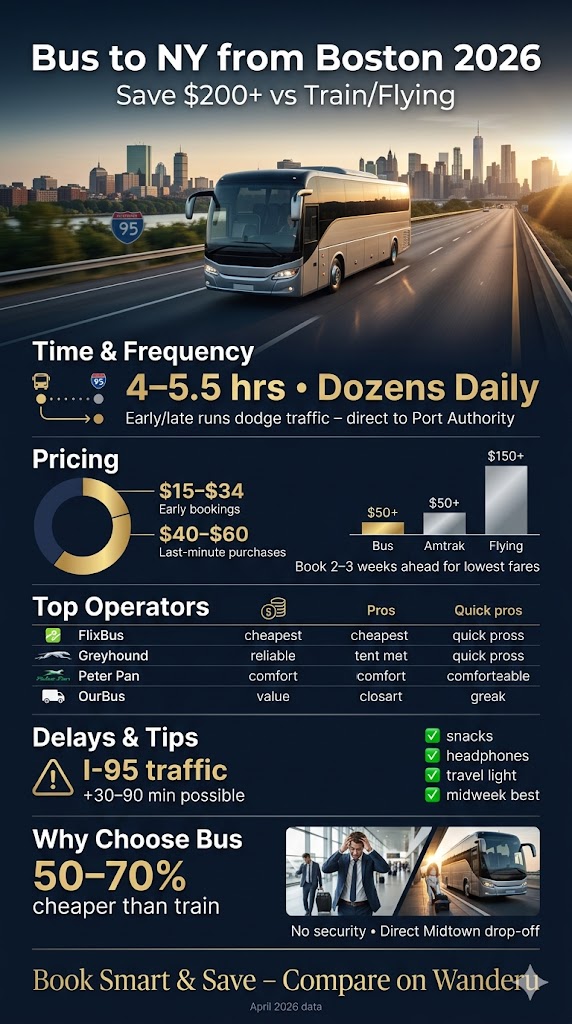
Price first. A bus ticket booked a week or two out typically runs $20 to $45 one way. Amtrak’s Northeast Regional on the same corridor often starts in the $30s if you book early — and climbs past $100 as the travel date approaches. Acela is faster at about three and a half hours, but starts around $115. The bus is the only option where procrastination doesn’t fully punish you; even walk-up fares usually stay under $60.
Frequency second. Between Greyhound, FlixBus, Peter Pan, Megabus, and OurBus, there are departures from South Station nearly every hour from early morning until late at night. You don’t plan your day around the bus — the bus fits around your day. Miss one and another is coming.
Then there’s the hidden math of flying. Yes, the flight itself is about 75 minutes. But getting to Logan, clearing security, the flight, then getting from LaGuardia or JFK into Manhattan turns it into a four-to-five-hour door-to-door trip anyway — usually at several times the bus fare. For a 216-mile corridor, the plane rarely makes sense unless you’re connecting onward.
The Operators Running Bus to NY From Boston in 2026
Six names cover nearly every bus to NY from Boston departure. They share the same highways but differ on pickup points, pricing games, and onboard feel.
Greyhound. The legacy carrier on this route. Greyhound runs out of the Port Authority Bus Terminal on the New York end and South Station on the Boston end, with some trips also stopping at the George Washington Bridge bus station. Figure four and a half to five hours, with onboard WiFi, power outlets, and a restroom. Advance fares often start under $40; they climb toward walk-up prices on busy travel days.
FlixBus. Greyhound’s sister brand in the US market and now the highest-frequency operator on the corridor — roughly 34 departures a day across its combined FlixBus, Greyhound, and Lucky Star liveries. Buses leave from Midtown curbside stops (Penn Station area, 31st Street, Hudson Yards) rather than the Port Authority, and arrive at South Station. Same product as Greyhound — WiFi, outlets, restroom — with the same dynamic pricing: cheap early, expensive late. FlixBus took over the former BoltBus gates at South Station, which tells you something about how the market consolidated.
Peter Pan Bus Lines. The New England specialist. Peter Pan runs Port Authority to South Station, with departures every hour or two through much of the day — and select trips continue straight to Boston Logan Airport, which is genuinely useful if you’re catching a flight. Advance fares are frequently in the $10–$50 band. Among the major operators, Peter Pan consistently earns the best passenger ratings on this route — around 4.0 out of 5 across thousands of reviews — with the strongest marks for WiFi and punctuality.
Megabus. The discount play. Megabus uses curbside stops instead of terminals — Midtown pickups around 31st Street and Chinatown stops on Allen Street. Booked well ahead, one-way fares can dip under $20; they rise sharply as the bus fills. Trips run about four to four and a half hours into South Station. Some departures are operated by Peter Pan under a partnership the two companies struck a few years back — the branding on your confirmation email matters less than the departure time.
OurBus. A smaller network carrier that competes directly with Megabus on price. OurBus departs from East 38th Street in Midtown and the Port Authority, arriving at South Station and Back Bay (39 Dalton Street). Typical ride time is just over four hours.
Lucky Star and GO Buses. The niche players. Lucky Star is a veteran of the old Chinatown bus wars, running between Canal Street in Manhattan and South Station — now operating in partnership with FlixBus. GO Buses serves the suburbs instead of downtown Boston, departing from the Alewife Red Line station in Cambridge and the Riverside Green Line station in Newton, arriving near Penn Station in New York. If you live in Cambridge or Newton, GO Buses can save you the trip into South Station entirely.
One name you should not book: BoltBus. The orange buses were folded into Greyhound in 2021 and the brand was retired. If you see BoltBus tickets for sale anywhere, something is off — book with Greyhound or FlixBus instead.
What the Bus to NY From Boston Costs
The pricing pattern is the same across every operator on this route: book early and you pay $20 to $40; book the morning of and you can pay double. The cheapest advance fares — the sub-$20 Megabus and FlixBus seats — go to whoever books first, usually two or more weeks out. The average one-way fare across all operators lands around $50.
Friday afternoons, Sunday evenings, and holiday weekends are the expensive windows. They sell out first and price highest. If your schedule is flexible, a Tuesday or Wednesday departure can cost half of what the same seat costs on a Friday. Students and frequent riders should check each operator’s loyalty or student-discount programs — they’re real money on a route you ride monthly.
Watch the fees. FlixBus and Greyhound add a few dollars in booking or transaction fees at checkout — usually around $4. It’s not a dealbreaker, but it’s why the fare you saw on the search page isn’t quite the fare you pay. Compare the all-in total, not the headline number.
Schedules and How Long the Trip Takes
Plan on four and a half to five hours gate to gate. The fastest scheduled runs advertise around four hours and ten minutes; traffic through Connecticut and into Manhattan routinely stretches that. Friday afternoons and Sunday evenings are the slowest windows — the I-95 corridor earns its reputation.
On the bus to NY from Boston, departures run from roughly 7:00 a.m. to 1:30 a.m. across the combined operators, so early-morning and late-night options both exist.
One honest caveat: buses are at the mercy of traffic in a way trains aren’t. If you have a hard deadline in New York — a flight, a meeting you can’t miss — build in an hour of buffer or take Amtrak. The bus is the best value on the corridor, not the most predictable.
Where You Board and Where You Land
In Boston, nearly everything starts at the South Station Bus Terminal — the bus level above the train station, with seating, food, and restrooms while you wait. A few operators add secondary pickups in Cambridge and Brookline, and GO Buses runs from Alewife and Riverside for the suburbs.
In New York, your arrival point depends on the operator, and it matters more than people expect:
- Port Authority Bus Terminal (Greyhound, Peter Pan, some OurBus) — the big one at 42nd Street and 8th Avenue, with subway connections to everywhere in minutes.
- Midtown curbside stops (FlixBus, Megabus) — typically 31st Street near Penn Station or the Hudson Yards area. No terminal amenities, but you’re on the sidewalk and moving.
- Chinatown (Lucky Star, some Megabus) — Canal Street and Allen Street stops. Convenient if that’s your neighborhood; otherwise factor in the crosstown trip.
- George Washington Bridge Bus Station (select Greyhound) — useful for upper Manhattan and the Bronx, less so for Midtown.
When you’re comparing a bus to NY from Boston against the train, remember the train drops you at Penn Station or Moynihan in Midtown; a curbside or Port Authority bus arrival is nearly as convenient. Only Chinatown and GWB arrivals add meaningful transfer time.
Onboard: WiFi, Seats, Outlets, Restrooms
The modern intercity coach is a long way from the stereotype. Every major operator running the bus to NY from Boston offers free WiFi, power outlets at the seats, reclining seats with reasonable legroom, and an onboard restroom. Peter Pan’s coaches get the best passenger marks for WiFi reliability on this corridor — worth knowing if you plan to work the whole way down.
Set expectations honestly, though. Bus WiFi is cellular-based, which means it slows to a crawl on the stretches of I-95 with weak coverage and when forty passengers are streaming at once. Download what you need before boarding. The restrooms are fine for a four-hour trip but small; most riders just wait for the destination.
Seat selection varies: some operators assign seats at booking, others are first-come, so arrive at the gate early if you’re traveling together.
Booking Tips That Actually Save Money
None of this is complicated, but most people booking a bus to NY from Boston leave money on the table:
- Book two weeks out when you can. That’s where the $10–$25 fares live. Inside 48 hours, you’re paying the operator’s price, not yours.
- Compare the all-in total. Operator sites, aggregators, and apps all show slightly different inventory and fees. Two minutes of comparison routinely saves $5–$15.
- Travel Tuesday through Thursday. Midweek departures are consistently the cheapest seats on the corridor.
- Sign up for fare alerts and loyalty programs. If you ride Boston–New York monthly, the points and member fares compound fast.
- Check the cancellation policy before you buy the cheapest fare. The lowest fares are usually non-refundable. If your plans might shift, the flexible fare is worth the few extra dollars.
- Screenshot your confirmation. Curbside pickups have no terminal staff to help if your phone dies — a screenshot of the QR code is your backup.
The Alternatives: Amtrak, Driving, and Flying
The bus to NY from Boston is the value pick, but it’s not always the right pick.
Amtrak’s Northeast Regional takes about four to four and a half hours — essentially the same as the bus — with far more legroom, a café car, big windows, and no traffic risk. Booked early, saver fares can start in the $30s; booked late, they climb past $100. If comfort matters more than the fare difference, the train wins. Acela shaves the trip to about three and a half hours from around $115 — the business traveler’s choice.
Driving the 216 miles takes three and a half to four and a half hours on I-95, and makes sense for groups splitting costs or trips with multiple stops. Solo, the math falls apart fast: gas, tolls through Connecticut and New York, and Manhattan parking — which can run $50+ a day — usually exceed two bus tickets before you’ve left the driveway.
Flying is the worst value on this corridor for most travelers. The 75-minute flight hides two airport transfers, security, and baggage waits. Door to door, it’s four to five hours — the same as the bus — at several times the price. Only worth it when you’re connecting to another flight at Logan or JFK.
Coming the other direction? Our companion guide covers the bus from NYC to Boston with the same operator-by-operator breakdown. And if you’re weighing a private ride for a group, a door-to-door car service skips the terminals entirely — worth pricing against five or six bus tickets.
FAQ
How long is the bus to NY from Boston?
Scheduled trip times run 4 hours 10 minutes to 5 hours 30 minutes, with most operators advertising around 4.5 hours. Real-world time depends on traffic — Friday afternoons and Sunday evenings through Connecticut and into Manhattan are the slowest windows. Build in an hour of buffer if you have a hard deadline.
How much does the bus to NY from Boston cost?
Advance fares typically run $20 to $45 one way, with the cheapest seats under $20 when booked two or more weeks ahead. Walk-up and peak-travel fares climb toward $50–$60. The average one-way fare across operators is around $50. Booking early is the single biggest lever on price.
Where do Boston to New York buses depart from?
Nearly all departures leave from the South Station Bus Terminal in downtown Boston, with a few operators adding pickups in Cambridge and Brookline. GO Buses serves the suburbs from Alewife station in Cambridge and Riverside station in Newton instead of downtown.
Where do Boston to New York buses arrive in NYC?
It depends on the operator: Greyhound and Peter Pan use the Port Authority Bus Terminal at 42nd and 8th; FlixBus and Megabus use Midtown curbside stops near Penn Station and Hudson Yards; Lucky Star and some Megabus trips stop in Chinatown; select Greyhound trips stop at the George Washington Bridge Bus Station.
Is BoltBus still running between Boston and New York?
No. BoltBus ceased operations in July 2021 and its services were absorbed by Greyhound. Don’t buy BoltBus tickets from any third-party site — book with Greyhound, FlixBus, Peter Pan, Megabus, or OurBus instead.
Is the bus or Amtrak better from Boston to New York?
The bus wins on price and frequency; Amtrak wins on comfort and reliability. Northeast Regional takes about the same four to four and a half hours with far more legroom and no traffic risk, but advance saver fares start in the $30s and climb past $100 close to departure. If the fare difference is small and comfort matters, take the train.
Sources
- Greyhound — Boston to New York schedules and fares (official operator site: departure times, advance pricing)
- Amtrak — Northeast Regional and Acela, Boston South Station to New York Moynihan (official schedules and fare bands)
- Busbud — Boston to New York City bus comparison (average journey time 4h 35m, operator ratings including Peter Pan 4.0/5)
- New England Travel Planner — Boston–New York bus operators guide (departure windows, curbside stop locations, fare notes)
- Wikipedia — BoltBus (ceased operations July 1, 2021; services absorbed by Greyhound)