
Cab Fare from LGA to Manhattan: The 2026 Meter Guide
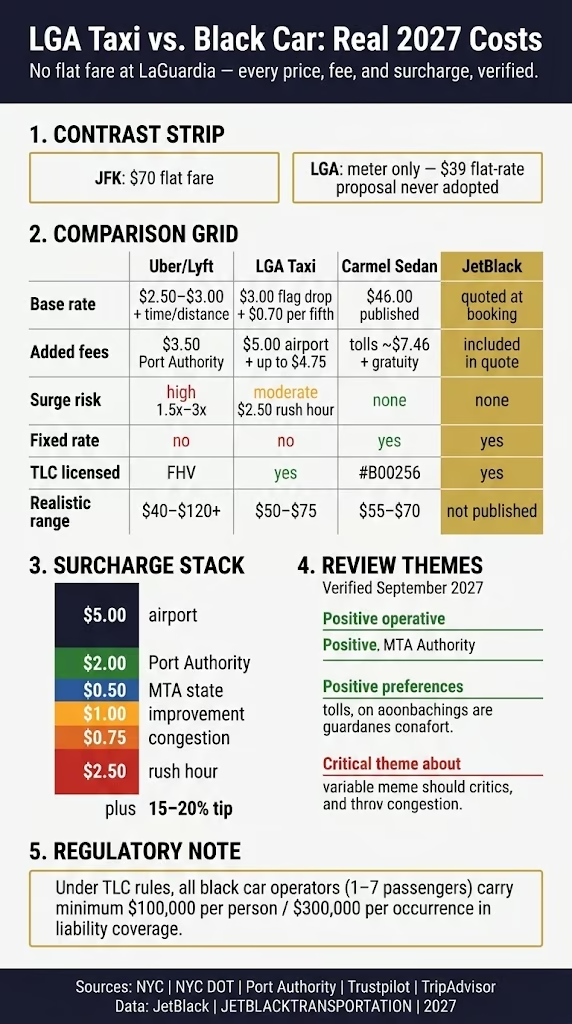
The cab fare from LGA to Manhattan is the one New York airport fare with no flat rate and no simple answer — and that is exactly why travelers keep searching for it. Unlike JFK, where a $70 flat fare settles the question before you get in, every yellow-cab ride from LaGuardia to Manhattan runs on the meter. What you pay depends on your exact destination, the traffic on the way, and the time of day. This guide breaks down how the meter counts, every surcharge on the receipt, what real trips total, and when a fixed-fare car service beats the cab.
LaGuardia sits in East Elmhurst, Queens — about eight miles from Midtown as the crow flies, and anywhere from 20 minutes to over an hour by road depending on when you land. The airport’s terminals (B, C, and D, plus the smaller Marine Air Terminal) all have marked taxi stands at arrivals level. Knowing the fare structure before you join the line is the difference between a routine ride and an unpleasant surprise.
No Flat Fare: Why LGA Is Metered
The TLC’s $70 flat fare is a JFK-only deal, created for the city’s longest standard airport run. LaGuardia never got one. Every cab fare from LGA to Manhattan is charged at Rate #01 — the standard city meter — which means your airport ride follows exactly the same rules as a crosstown trip.
That surprises people because the two airports feel interchangeable. They are not, at least for taxi pricing. A JFK-to-Manhattan ride costs the same $70 at 3 a.m. and 6 p.m. An LGA-to-Manhattan ride at 6 p.m. in gridlock can cost half again what the same ride costs at midnight with empty roads. The meter is honest; it is just not predictable. If you want a number locked in before you land, that is what fixed-fare car service from LGA to Manhattan is for — one quoted price regardless of traffic.
How the Meter Counts
The Taxi & Limousine Commission’s fare schedule works the same whether you are going to Times Square or Tribeca:
- $3.00 the moment you get in — the initial charge.
- $0.70 for every fifth of a mile while moving faster than 12 mph — $3.50 per mile of open road.
- $0.70 for every 60 seconds when stopped or crawling below 12 mph — the waiting rate replaces the distance rate; you never pay both at once.
The practical version: moving traffic buys you miles, standstill traffic buys you minutes at 70 cents each. A ten-minute dead stop on the Grand Central Parkway costs $7.00 — the same as two miles of clear road. On the LGA run, where the last two miles into Manhattan are often the slowest, the waiting rate is where the fare grows.
Three things cost nothing extra, by law: additional passengers, luggage, and paying by credit card. A cab with four riders and four suitcases meters exactly the same as a solo traveler with a backpack. Our guide to taxis at LaGuardia covers where the stands are and how the pickup line works at each terminal.
Every Surcharge on the Receipt
On top of the meter, the TLC stacks a short list of surcharges. Two apply to every trip, always:
- $0.50 MTA state surcharge.
- $1.00 improvement surcharge.
Two depend on timing:
- $1.00 overnight surcharge — trips starting between 8:00 p.m. and 6:00 a.m.
- $2.50 rush-hour surcharge — trips starting on non-holiday weekdays between 4:00 and 8:00 p.m.
And two depend on geography — both of which an LGA-to-Manhattan trip triggers, because every route into Manhattan crosses below 96th Street:
- $2.50 New York State congestion surcharge (trips touching Manhattan below 96th Street).
- $0.75 MTA congestion toll (trips in Manhattan below 60th Street).
So before the meter even starts counting miles, a daytime LGA-to-Manhattan cab carries $4.75 in fixed surcharges ($0.50 + $1.00 + $2.50 + $0.75). A red-eye adds the $1.00 overnight surcharge; a 6 p.m. weekday pickup adds the $2.50 rush surcharge instead. Then come tolls — if your route uses one — and tip, which is customary at 15–20 percent. The full schedule is published on the TLC’s official taxi fare page.
What Real Trips Total: Three Worked Examples
Distances below are approximate road mileages ; the meter math uses the current TLC rates. All examples assume moving traffic, no tolls, and add the $4.75 daytime surcharge stack.
Midtown East (around 59th & Lexington) — about 8–9 miles. The classic LGA run, usually via the Queensboro Bridge (no toll) or the Queens–Midtown Tunnel (tolled). Meter: roughly $31–$35. With surcharges: about $36–$40 before tip, mid-$40s with a 20% tip. This is the trip where the meter is kindest — short, and the free bridge keeps tolls at zero if the driver takes it.
Times Square / Theater District — about 9–10 miles. Slightly longer, and the final approach through Midtown is where the waiting rate kicks in. Meter: roughly $35–$39. With surcharges: about $40–$44 before tip, around $50 with tip. In rush hour, add the $2.50 surcharge and however many 70-cent minutes the traffic donates.
Lower Manhattan (Financial District) — about 11–13 miles. The long one: down the FDR or through the tunnel, then into downtown. Meter: roughly $42–$49. With surcharges: about $47–$54 before tip, low $60s with tip. Late at night this run is fast and the meter stays low; at 5:30 p.m. it is the most expensive version of this trip.
The pattern: LGA-to-Manhattan metered fares cluster in the high $30s to low $50s before tip in normal traffic — meaningfully less than JFK’s $70 flat fare, because the distance is shorter. The meter only beats the flat fare while traffic cooperates.
The Route Matters More Than You Think
Your driver chooses the route, but knowing the options keeps everyone honest:
Queensboro Bridge (the “59th Street Bridge”). No toll, drops you at 59th Street. Best for the Upper East Side, Midtown East, and anywhere north of about 42nd Street. When traffic is light, this is the fastest and cheapest path.
Queens–Midtown Tunnel. Tolled, drops you at 34th–37th Streets. Better for Midtown West, Times Square, and Penn Station area — but you pay the toll and the tunnel approach can jam.
RFK (Triboro) Bridge. Tolled, and usually only sensible for the Upper West Side or Harlem, where it feeds the FDR or Harlem River Drive.
A driver who takes the tolled tunnel to a destination two blocks from the free bridge owes you an explanation. The toll difference is real money, and on the meter you are the one paying it. You are allowed to request the bridge — politely, before you leave the airport.

When the Cab Loses: Rideshare, Car Service, and the Free Bus
The yellow cab is the default, not always the best value. The alternatives, honestly assessed:
Pre-booked car service. One fixed quote, no meter, no surge. On the LGA run the fixed fare usually lands near or slightly above a good metered cab ride — the premium buys certainty, a guaranteed vehicle class, flight tracking, and a driver waiting at arrivals instead of a taxi line. For early-morning flights and tight schedules, certainty is worth more than the few dollars a meter might save.
Rideshare. Uber and Lyft pick up at designated areas at LGA. Off-peak they often undercut the meter; during a flight bank with surge pricing they can double it. Check the app price before you commit — if it shows a multiplier, the taxi line is right there.
The free bus + subway. The Q70 LaGuardia Link bus is free and connects the terminals to the Jackson Heights–Roosevelt Avenue subway station (7, E, F, M, R trains); the M60 SBS bus runs to Harlem and Upper Manhattan . Total cost: one $3.00 subway fare. Total time: 45–70 minutes depending on your Manhattan destination. It is the budget champion and the comfort loser — fine with a backpack, miserable with three suitcases.
There is no AirTrain at LaGuardia. Anyone telling you otherwise is working from old plans — the proposed AirTrain was shelved, and buses are the current connection .
FAQ
How much is a taxi from LGA to Manhattan?
There is no flat fare — the meter runs. Expect roughly $36–$54 before tip in normal traffic depending on your Manhattan destination, plus any tolls. Rush hour and gridlock push it higher; the meter charges $0.70 per minute when crawling.
Is there a flat rate from LaGuardia to Manhattan?
No. The TLC’s $70 flat fare applies only to JFK–Manhattan trips. LGA rides are fully metered at the standard city rate.
Which is cheaper from LGA — taxi or Uber?
It depends on the hour. Off-peak, rideshare often undercuts the meter; during surge periods after flight banks, the yellow cab’s regulated meter is usually cheaper. Compare the app price against a ~$40–55 metered estimate before choosing.
Do taxis from LGA charge extra for luggage or extra passengers?
No. TLC rules prohibit extra charges for additional passengers, luggage, or credit-card payment. The meter is the same whether one person rides or four do.
What is the cheapest way from LGA to Manhattan?
The free Q70 bus to the Jackson Heights subway station, then the subway into Manhattan for a $3.00 fare. Budget 45–70 minutes and travel light.
Sources
- NYC Taxi & Limousine Commission — Taxi Fare: the full metered-rate schedule and surcharge list (Rate #01, $3.00 initial charge, $0.70 units, all surcharges).
- JetBlack — car service from LGA to Manhattan: fixed-fare private alternative on the same route.
- JetBlack — taxis at LaGuardia: terminal taxi-stand locations and pickup-line logistics.