

Key Takeaways
- No-surcharge rule: every NYC rideshare, livery, black car, and limousine service must provide a wheelchair-accessible vehicle when you request one — and charge the same fare as a non-accessible trip. A ramp fee is a TLC violation; report it to 311.
- Cheapest honest ride: Accessible Dispatch, run by the TLC, sends an accessible yellow or green taxi anywhere in the five boroughs at the metered fare. Request it free through the Accessible Dispatch NYC app, online, at 646-599-9999, or 311.
- Price inverts here: the metered taxi is the cheapest legal option but often the hardest to get same-day at peak hours. The pre-booked accessible black car — the “expensive” option on paper — is frequently the only ride that arrives with a trained driver and proper securement.
- The stretch-limo truth: a true wheelchair-accessible stretch limousine barely exists — real handicap accessible limos are ramp-equipped minivans or SUVs. The genuine luxury product is an executive van or SUV with a trained chauffeur.
- Book 24–48 hours ahead: give the dispatcher your chair’s type, size, and weight, say whether you will ride in the chair or transfer, and get ramp access plus a fixed written quote confirmed before the day.
Written by Sarah Thompson, New York transportation writer covering accessible ground transportation. Fact-checked by Alex Freeman, Editor-in-Chief. Last verified October 9, 2026.
Handicap Accessible Limos: 7 Honest 2026 Facts Before You Book
The stretch limousine arrived outside the Midtown hotel at six, gleaming and right on time. Then the driver popped the trunk — and the bride’s 78-year-old grandmother, who travels in a power chair, watched from the lobby as the family understood there was no ramp, no lift, and no way in. The wedding photos went on without her.
That family had done everything right except one thing: they booked handicap accessible limos the way you would book any limo — by the look of the car. In New York, the accessible-vehicle market does not work that way, and the rules that protect riders only help if you know them before the car arrives.
This is the chauffeured guide — booking handicap accessible limos with a driver in New York City. What the TLC requires, what the options honestly cost in 2026, and how to make sure the vehicle that shows up has a ramp and a driver who knows how to work it.
What handicap accessible limos Actually Are — and What They Are Not
A booking for handicap accessible limos is, in industry terms, a chauffeured wheelchair-accessible vehicle (WAV) request: a TLC-licensed base sends a ramp- or lift-equipped vehicle with a lowered floor and wheelchair securement, driven by a chauffeur. New York’s Taxi and Limousine Commission puts the obligation in plain words: all rideshare, livery, black car, and limousine services are required to provide a wheelchair accessible vehicle when requested. The same page settles the money question: you will pay the same fare as a non-accessible trip from the same car service.
A surcharge for the ramp is not a fee — it is a violation. The TLC asks riders to report refused accessible rides to 311, and that complaint channel is the reason the rule has teeth.
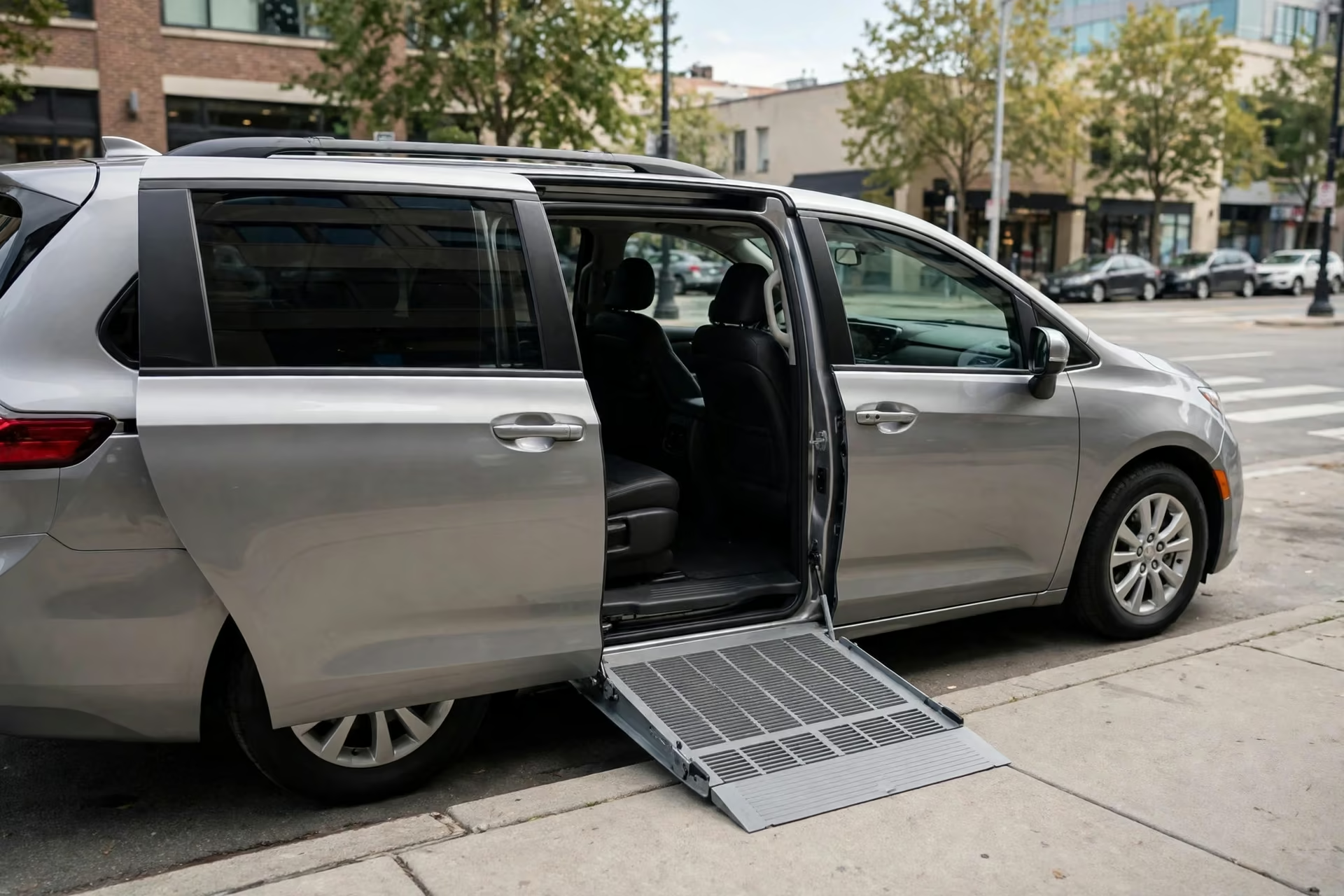
Here is the honest vehicle reality behind most handicap accessible limos listings: true wheelchair-accessible vehicles are ramp-equipped minivans or SUVs with lowered floors. A wheelchair-accessible stretch limo barely exists — a stretched chassis and a deployable ramp with proper headroom do not mix, and almost no operator runs one. The real accessible luxury product is an executive van or SUV with a trained driver, proper tie-downs, and room to ride in the chair.
One language note, because it matters: “handicap” survives mainly as the search term — it is the word riders type, so it anchors this guide’s title and keyword phrases. The industry itself moved to “wheelchair-accessible” and “accessible” years ago, and that is the language in the rest of this article. Nobody searching the old term needs correcting; the current terms are simply what dispatchers and the TLC use.
Across the five boroughs, the practical difference is the booking, not the badge on the door. Request the WAV explicitly when booking handicap accessible limos — “accessible vehicle” alone can be misheard — and confirm the ramp in writing. What arrives should be a van or SUV you can roll into, not a sedan with good intentions.
What handicap accessible limos Cost in 2026: The Honest Table
So why does the cheapest legal ride so often leave you stranded? Because price and reliability invert in accessible transport: the metered accessible taxi — zero legal surcharge — is the hardest to secure same-day at peak hours, while the pre-booked accessible black car, the “expensive” option on paper, is frequently the only ride that actually arrives with a driver trained to secure a chair.
The table below orders every realistic handicap accessible limos option by total cost, cheapest first. Rows marked “quoted per trip” are not a dodge — accessible black-car rates are set per trip, and inventing a number here would be dishonest.
| Option | Base Rate | What’s Included | Surge Risk | Fixed Quote? | TLC Licensed? | Realistic Range |
|---|---|---|---|---|---|---|
| Access-A-Ride paratransit | MTA-set per-trip fare | ADA paratransit for eligible riders; advance booking | None | Published fare | N/A (public transit) | Lowest cost; fare set by MTA |
| Accessible Dispatch taxi (TLC) | Metered taxi fare | TLC-managed dispatch, five boroughs, no extra costs | None — metered | No (metered) | Yes | Meter + standard surcharges |
| Arro / Curb / Myle e-hail | Metered taxi fare | App-dispatched accessible taxi; street-hail allowed | Low — metered | No (metered) | Yes | Meter + standard surcharges |
| UberWAV / Lyft Access | Dynamic app quote | App ride with accessible-vehicle option | Medium–high at peak | Upfront price only | Yes (for-hire vehicle) | App quote; varies with demand |
| Self-drive WAV rental | ~$100–200/day | Ramp-equipped minivan/SUV, ~150 free miles/day | None (daily rate) | Daily rate at booking | N/A (self-drive) | ~$100–200/day plus fuel |
| Pre-booked accessible black car | Quoted per trip | Chauffeured ramp-equipped van/SUV; trained driver; securement | None on confirmed quote | Yes — confirm in writing | Yes (verify at tlc.nyc.gov) | Quoted per trip — never estimated |
When does the pre-booked car earn its money? When certainty is the product: a JFK arrival at midnight, a wedding party that cannot wait curbside, a rider who needs a trained driver — not just a ramp. And for handicap accessible limos, certainty is usually the whole point of booking.
When is it overkill? A midday Midtown trip where Accessible Dispatch has time to reach you costs the meter and nothing more. The honest math on handicap accessible limos, then: you are rarely paying for the vehicle — you are paying for the guarantee that the right vehicle, with the right driver, arrives at the right hour.
Accessible Airport Transfer NYC: How Riders Actually Experience It
Ask people who book handicap accessible limos in New York regularly and three patterns come up again and again. The stories below are composites drawn from common rider experiences — no single account quoted, no names attached.
A daughter meeting her father’s flight at JFK on a Friday evening requested an Accessible Dispatch taxi when the plane landed — and waited the better part of an hour while peak demand swallowed the accessible fleet. Her lesson, now permanent: request the night before for airport pickups, not at touchdown.
An executive assistant in Manhattan booked handicap accessible limos for a client visiting in a power chair, with a 7 a.m. run to EWR. The driver arrived early, deployed the ramp, secured the chair with tie-downs, and the meeting started on time. Her verdict: the expensive option was the only one that treated the trip as certain.
A couple planning a Queens wedding was quoted an “accessible stretch limousine” — and on the day, a standard stretch arrived with no ramp. They had never asked for a photo of the actual vehicle. Their advice now: if a company claims an accessible stretch, ask for a dated photo of the ramp before you pay a deposit.

The thread connecting all three: the booking conversation matters more than the brochure. A ramp you confirmed beats luxury you assumed — every time.
How to Book handicap accessible limos That Actually Show Up
Booking handicap accessible limos well is a script, not a hope. Say the words “wheelchair-accessible vehicle” — WAV for short — the moment the dispatcher answers, because “accessible” alone gets misheard and “a big car” gets you a Suburban with no ramp, anywhere in the five boroughs.
Run this checklist on every handicap accessible limos booking — two minutes here prevents a ruined evening:
- ☐ Say WAV explicitly, then describe the chair: manual or power, weight, and folded or unfolded dimensions.
- ☐ State ride-in-chair or transfer — the vehicle setup differs, and the driver needs to know which.
- ☐ Give the pickup reality: stairs, elevator, curb cut, or a lobby the driver can pull up to.
- ☐ Count companions: a WAV van seats fellow riders alongside the chair — confirm the total headcount.
- ☐ Ask ramp or lift, and confirm which one is actually fitted to the vehicle being sent.
- ☐ Get the fixed quote in writing — vehicle class, tolls, tip policy, waiting time — before you confirm.
- ☐ For taxis, use Accessible Dispatch: the app, mtm.webbooker.icabbi.com, 646-599-9999, or 311 — free to request, metered fare.
- ☐ For app rides, choose the WAV or Access option in Arro, Curb, Myle, Uber, or Lyft — and screenshot the confirmation.
- ☐ Request 24–48 hours ahead for any pre-booked car; same-day accessible black-car supply is genuinely thin.
- ☐ Verify the base: TLC-licensed operators carry at least $100,000/$300,000 in liability coverage, checkable at tlc.nyc.gov.
- ☐ If a driver refuses the accessible ride, note the base name and time — then report it to 311.
Traveling with children as well as a wheelchair? The restraint rules are a separate subject — our guide to airport taxis with car seats covers that side, and car-seat rides to the airport handles the family logistics.
Wheelchair Accessible Taxi NYC vs Accessible Black Car NYC: The Market in Honest Terms
Here is the accessible market without the brochure language — every player in the handicap accessible limos space has a genuine strength and a genuine weakness. Start with the public option: Accessible Dispatch is TLC-managed, free to request, and charges the metered taxi fare with no extra costs — the honest cheapest way to move across the five boroughs.
Its weakness is supply at peak: Friday evenings and rainy rush hours stretch waits, which is exactly when travelers need certainty most. UberWAV and Lyft’s Access mode win on app convenience — request from the curb, track the car, pay in-app — but their weakness mirrors it: waits lengthen and cancellations rise precisely when accessible vehicles are scarcest.
Dedicated WAV black-car bases sell the opposite trade: a pre-booked, chauffeured vehicle with a driver trained to deploy the ramp and secure the chair, most serving JFK, LGA, and EWR on pre-booked airport runs. Their weakness is lead time and thin same-day supply — this is a scheduled service wearing a limousine’s clothes, not a taxi.
Self-drive WAV rental — MobilityWorks-style rentals run about $100–200 per day with roughly 150 free miles — is the independence option: your schedule, your route. The trade is plain: you drive, and you handle the chair. Our wheelchair car rental guide covers the self-drive side in full, since this article stays with chauffeured bookings.
Access-A-Ride, the MTA’s ADA paratransit service, is the specialist: built for eligible riders who can plan around its schedule. Eligibility and advance booking are the gates — it is a program, not a hail.
One verifiable market fact: the TLC’s February 2026 license review kept new for-hire vehicle licenses restricted to wheelchair-accessible vehicles — the latest turn of a policy whose roots run back to the WAV exemption from the FHV cap in 2019 TLC testimony. Our guide to disability transportation in NYC covers the rest — buses, subways, and ferries included.
Two numbers worth carrying when booking handicap accessible limos: TLC-licensed black-car operators must hold at least $100,000/$300,000 in liability insurance, and congestion surcharges run $0.75 per black-car trip — $1.50 on high-volume apps — inside Manhattan’s zone. Operators who skip these rules compete on price by skipping your protections.
The Honest Bottom Line on handicap accessible limos
New York already grants the right: request a wheelchair-accessible vehicle from any car service and the TLC says it must come, at the same fare. That right is what separates handicap accessible limos from ordinary luxury bookings — the accessible vehicle is not an upgrade you negotiate, it is the rule. The gap was never the law; it is supply, timing, and knowing which questions turn a booking into a guarantee.
So take the one neutral tip this whole guide earns: request the WAV the moment your flight, hotel, or event is booked — not the morning of. Lead time is the entire game in accessible transport, and everything else is detail — in Manhattan or anywhere else in the five boroughs.
A final note on the vehicle question: if what you need is a ramp and a trained driver, book the executive van and skip the stretch-limo search. The luxury that matters here is arrival — certain, dignified, and on time.
Video brief: 3-minute explainer, “Handicap Accessible Limos in NYC: What the TLC Actually Requires.” Opening: the wedding-lobby scene (staged, no real riders). Beats: (1) the TLC must-provide rule shown on screen verbatim; (2) a ramp-deployment demo on a WAV minivan; (3) the cost table as motion graphics; (4) the dispatcher script as captions. Voiceover: calm, plain-spoken; ends on the lead-time tip. Placeholder only — no video produced for this draft.
Infographic brief: vertical “cheat sheet,” 800×2000px. Top: the two TLC rules as pull-quotes. Middle: cost ladder from Access-A-Ride paratransit to the pre-booked WAV black car. Bottom: 6-step dispatcher script flowchart. Design note: JetBlack navy + gold palette, tabular numerals, high-contrast type, wheelchair-symbol iconography (no clip-art stretch limos), sources line at foot (TLC, MOPD). Placeholder only — no infographic produced for this draft.
Design note: hero image must show the actual product — a ramp-deployed WAV minivan, empty, daytime — never a standard stretch limousine, which would misrepresent what accessible bookings deliver.
Do NYC car services charge extra for a wheelchair-accessible vehicle?
No. The TLC requires every rideshare, livery, black car, and limousine service to provide a wheelchair-accessible vehicle when requested — and states plainly that you will pay the same fare as a non-accessible trip from the same car service. Any extra charge for the ramp is a rule violation; note the company name and report it to 311.
Is there really a wheelchair-accessible stretch limousine?
Essentially, no. True wheelchair-accessible vehicles are ramp-equipped minivans or SUVs with lowered floors, and a stretched chassis rarely accommodates a proper ramp. When companies advertise handicap accessible limos, the genuine luxury product is an executive van or SUV with a trained chauffeur — ask for a photo of the actual ramp before paying a deposit.
How far ahead should I request a wheelchair-accessible vehicle?
For a pre-booked accessible black car, request 24 to 48 hours ahead — same-day WAV supply is genuinely thin. Accessible Dispatch taxis can be requested same-day through the app, online, at 646-599-9999, or 311, but expect longer waits at peak hours.
Can I stay in my wheelchair during the ride?
Yes. A proper WAV carries wheelchair securement — tie-downs or a docking system — and the driver should secure the chair before moving. Tell the dispatcher whether you will ride in the chair or transfer to a seat, since the setup differs.
Can I bring my service dog in an accessible vehicle?
Yes. Service dogs are welcome in all vehicles under the city’s accessible-transportation rules — taxis, for-hire cars, and pre-booked accessible vehicles alike. No extra fee, no separate booking.
What exactly should I tell the dispatcher when I request a WAV?
Four things: your chair’s type, weight, and dimensions; whether you ride in the chair or transfer; how many companions travel with you; and the pickup reality — stairs, elevator, or curb. Then confirm ramp or lift, and get the fixed quote in writing — standard practice for handicap accessible limos.
What should I do if a driver refuses my accessible ride?
Note the company or base name, the time, and the pickup address — then report it to 311. The TLC treats refusal of a requested wheelchair-accessible vehicle as a violation, and reports are how the rule gets enforced.
Sources
- NYC Taxi and Limousine Commission — Find an Accessible Ride: the must-provide rule for wheelchair-accessible vehicles, the same-fare rule, and reporting refused rides to 311.
- NYC Mayor’s Office for People with Disabilities — Transportation: Accessible Dispatch request channels (app, online, 646-599-9999, 311), e-hail apps Arro, Curb, and Myle, and service-dog policy.
- NYC Taxi and Limousine Commission — 2019 testimony on for-hire vehicle regulation: the historical basis for exempting wheelchair-accessible vehicles from the FHV license cap.
- TLC license review, February 2026: new for-hire vehicle licenses restricted to wheelchair-accessible vehicles [secondary: .com articles citing the TLC review].
- JetBlack Transportation — wheelchair car rental guide: self-drive WAV rental context, including MobilityWorks-style daily rates of roughly $100–200 with about 150 free miles [secondary: .com article].
- TLC for-hire operating rules: black-car liability insurance minimums of $100,000/$300,000; congestion surcharges of $0.75 per black-car trip and $1.50 on high-volume apps (handbook context).
Methodology: TLC and city rules in this guide were verified against official nyc.gov pages on October 9, 2026; market descriptions reflect New York’s accessible-transportation market as of that date. Rider experiences are pattern-based composites, not individual review quotes. Cost figures marked as estimates move with operators — confirm every number in writing before you travel. Found an error? Call +1-646-214-4828 and we will correct it. Prices and regulations verified as of October 9, 2026 and subject to change.