

This article is sponsored by JetBlack, a premium limo service provider, and may include affiliate links. Recommendations are independent and based on consensus data.
Quick Takeaways
- Insurance Minimum: Standard TLC black car and livery operators (1–7 passengers) must carry $100,000 per person and $300,000 per occurrence in liability coverage — not the $1.5 million figure sometimes quoted online, which applies to larger 8–15 passenger vehicles.
- Pricing Gap: JetBlack’s own site lists JFK-to-Manhattan sedan service at both $90–$150 (route table) and a flat $65 (FAQ block) — a discrepancy worth resolving with the dispatcher before booking.
- Congestion Surcharge: Every for-hire trip through Manhattan’s Congestion Relief Zone adds $0.75 per trip for black cars (versus $1.50 for high-volume rideshare), plus a separate $2.75 NY State for-hire surcharge — confirmed at mta.info as of July 2026.
- Competitor Spread: Published JFK sedan rates range from Carmel’s $52 (tolls itemized separately) to True North VIP’s $170 all-in — the cheapest headline rate isn’t always the cheapest realistic total.
- Review Reality: JetBlack holds a 4-star Trustpilot rating from 47 reviews and roughly 4.3/5 on TripAdvisor from about 240 reviews — a recurring complaint pattern centers on pricing clarity, not driver conduct.
Fact-checked by: Alex Freeman, JetBlack editorial team. Full bio
Last verified: July 16, 2026
You have a Tuesday morning client meeting in Midtown, a flight landing at JFK the night before, and a corporate travel policy that says “pre-arranged ground transportation only.” That last part sounds simple until you actually try to figure out how to book a New York town car for the first time.
Every provider’s website uses the term differently, quotes a different number, and answers a different set of questions. This guide covers what the term actually means, what a fair price looks like in July 2026, how the city’s insurance and licensing rules protect you as a passenger, and the exact questions to ask before handing over a corporate card number.
It draws on published pricing from JetBlack, Dial 7, Carmel, and True North VIP, current TLC and MTA figures, and live customer reviews rather than marketing copy. The short version of how to book a New York town car for business travel, upfront: it’s a five-minute process once you know what to check. The traps are in the details — insurance minimums, congestion surcharges, and what “fixed rate” actually guarantees.

What Is a New York Town Car — And Why the Distinction Matters
A New York town car is a pre-arranged, chauffeur-driven sedan dispatched from a TLC-licensed base, not a vehicle you hail on the street. The name comes from the Lincoln Town Car, which dominated New York livery service from the 1980s through the early 2010s and became the generic term for a pre-booked black sedan — the way “Kleenex” means tissue.
Lincoln stopped making the car in 2011, but the model persists. Most fleets today run Mercedes E-Class or S-Class, BMW 5 or 7 Series, or Lincoln Continental sedans instead.
The regulatory distinction matters more than the badge on the hood. Under TLC rules, standard black car and livery operators carrying 1 to 7 passengers must carry a minimum of $100,000 per person and $300,000 per occurrence in commercial liability insurance, plus $10,000 in property damage coverage. That $1.5 million figure that circulates online applies to 8–15 passenger vehicles, not the standard sedan a corporate booker typically reserves.
Every TLC base and driver can be verified in under a minute at tlc.nyc.gov/industry/verify-a-license/. Any legitimate operator will hand over their base number without hesitation when asked. For a business traveler, a town car booking is a contract with a licensed base at a fixed quote agreed before the ride starts — an Uber Black or Lyft Black ride runs on the same TLC insurance framework but priced dynamically, which is precisely the variable a travel policy is usually trying to eliminate.
How to Book a New York Town Car — Step by Step
Booking a New York town car for a corporate trip follows the same five steps regardless of which provider you choose.
Step 1 — Confirm the TLC base number. Every legitimate operator has one. JetBlack’s is B03250, based at 34 W 34th Street in Manhattan. Ask for it before you book, then check it at the TLC verification tool above.
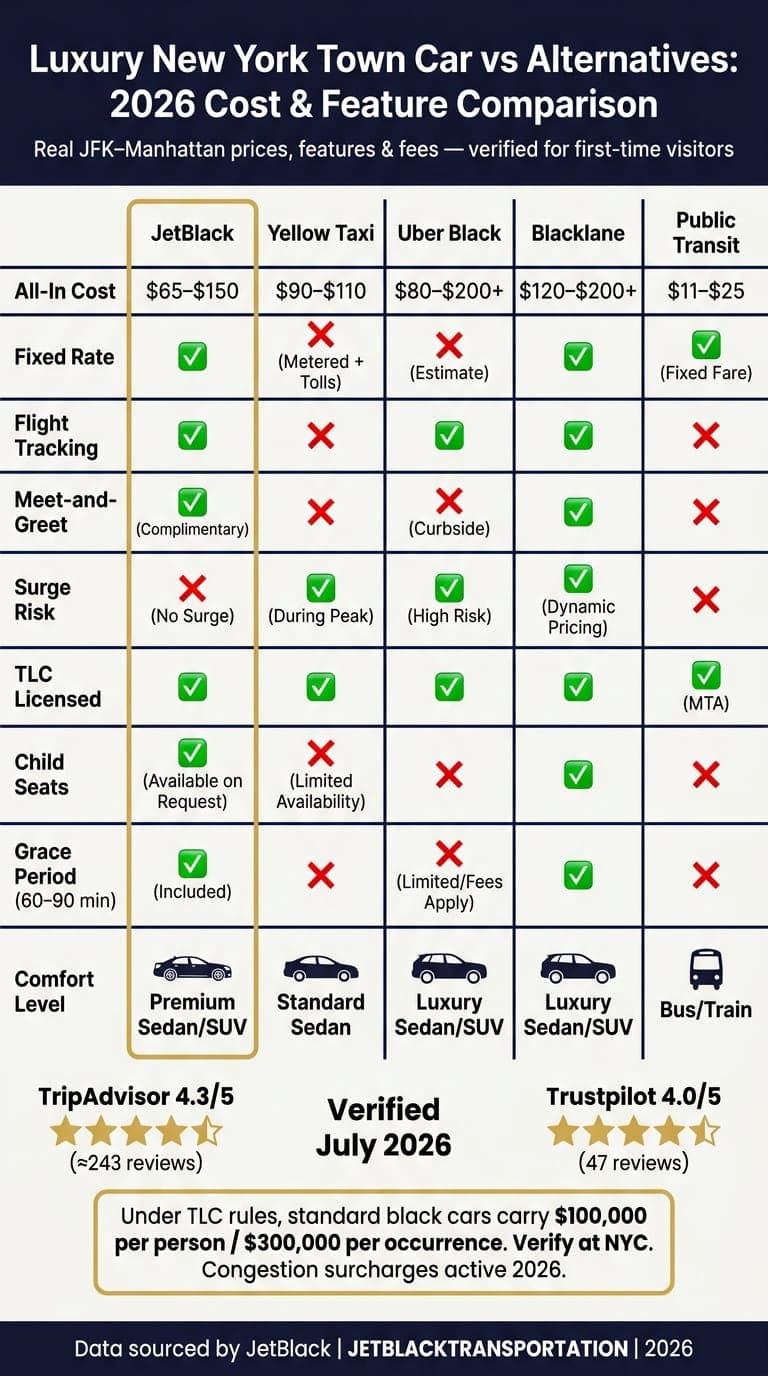
Step 2 — Get the all-in quote in writing. A fair quote states whether tolls, the congestion surcharge, and gratuity are included, not itemized as surprises on the invoice. JetBlack’s own route table lists JFK to Manhattan sedan service at $90 to $150, while a separate FAQ on the same site quotes a flat $65 — worth clarifying directly with the dispatcher.
Step 3 — Specify the exact vehicle and passenger count. A sedan seats up to three passengers with luggage; a mid-size SUV is the safer call for four or more, or for two passengers with checked bags and a laptop case each.
Step 4 — Confirm the wait-time and cancellation policy. JetBlack’s published policy offers 60 minutes of free wait time domestically and 90 minutes internationally, after which a $1-per-minute fee applies. Ask when that clock starts — from wheels-down, or from your scheduled arrival time — since the two can differ by 20 minutes or more if your flight lands early.
Step 5 — Book 24 to 48 hours ahead for standard availability, longer during peak convention weeks, holiday travel, or major NYC events, when even large fleets run short on late-model sedans.
For recurring corporate travel, most operators — JetBlack included — offer dedicated account managers, consolidated monthly invoicing, and priority booking, removing steps 1 through 4 from every trip after the account is set up once.
What a New York Town Car Actually Costs — Real Numbers, July 2026
Pricing for a sedan from JFK to Manhattan varies more than most corporate travel policies assume. Carmel’s published rate starts at $52, the lowest of the group, though tolls and gratuity are added on top rather than folded into the quote. Dial 7 lists JFK at $65 flat on its own site, backed by a fleet of more than 600 vehicles, though car age and consistency vary trip to trip.
JetBlack’s route table shows $90 to $150 for the same run — its FAQ block separately states a flat $65, a discrepancy worth resolving with the dispatcher rather than assuming either number applies. True North VIP quotes $170 all-in for JFK sedan service, with tolls, the congestion surcharge, and the NY State for-hire surcharge already folded in — the most transparent structure of the four, but also the most expensive.
| Option | Base Rate (JFK–Manhattan) | Tolls/Surcharges | Surge Risk | Realistic Range |
|---|---|---|---|---|
| Carmel | $52 | Itemized separately | Low | $60–$75 |
| Dial 7 | $65 | Itemized separately | Low | $75–$90 |
| JetBlack | $65–$150 (site inconsistency) | Confirm with dispatcher | Low | $90–$160 |
| True North VIP | $170 | Included (all-in) | None | $170 flat |
The counterintuitive finding: the cheapest published rate isn’t always the cheapest realistic one. Carmel and Dial 7 price tolls and surcharges separately, so a JFK run that starts at $52 or $65 can land within a few dollars of an all-in quote once fees and tip are added — the difference shows up in predictability, not necessarily the final number.
Every for-hire trip touching Manhattan below 60th Street carries New York’s Congestion Relief Zone surcharge: $0.75 per trip for black cars and taxis, versus $1.50 for high-volume for-hire vehicles like Uber and Lyft, under the MTA’s per-trip charge structure. A separate, older New York State for-hire surcharge adds $2.75 per trip for non-taxi for-hire vehicles. Neither is large alone, but a fixed quote should state whether both are already included.
A town car is worth the premium over rideshare when your policy needs a locked price regardless of weather or demand, or when a driver needs to track a delayed flight without a phone call. It’s a harder sell for a short, off-peak, single-passenger hop where a metered taxi or standard rideshare runs meaningfully cheaper.
Real Passengers, Real Trips: What Corporate Bookers Actually Experienced
Case Study 1 — Corporate Booker, TripAdvisor
The Situation: A corporate travel coordinator arranged pickups for visiting clients at their Manhattan hotel and later at a business facility.
What Happened: Both pickups landed on time with no scheduling issues, and email confirmations tracked the reservation clearly throughout. The reviewer noted they couldn’t speak to the in-car passenger experience, only the booking process.
Why It Matters: For a first-time corporate booker, the back-office scheduling experience is what a travel coordinator is actually judged on — not just the ride itself.
Case Study 2 — Flight Delay, TripAdvisor
The Situation: A traveler switched to JetBlack after a bad rideshare experience, booking a pickup for a flight with an uncertain arrival time.
What Happened: The flight landed roughly two hours behind schedule. The driver was still there, with no additional charge applied.
Why It Matters: The real test of any airport pickup service isn’t the on-time scenario — it’s what happens when the flight isn’t on time.
Case Study 3 — Airport Transfer, TripAdvisor, May 2025
The Situation: A reviewer booked a JFK pickup ahead of a business trip into Manhattan.
What Happened: The driver was positioned for an easy connection to the curb, with a professional, courteous manner throughout the ride.
Why It Matters: Small logistics — exactly where a driver parks relative to the terminal exit — routinely separate a smooth arrival from a stressful one.
Not every review is glowing. A recurring pattern in JetBlack’s lower-rated reviews centers on pricing clarity — travelers reporting costs beyond the number they were initially quoted — and, in isolated cases, a driver failing to show for a scheduled pickup with slow follow-up from dispatch. Both are worth raising directly with any provider at booking time.
How to Book Without Getting Burned — A Practical Checklist
This checklist turns how to book a New York town car from a five-step theory into a five-minute practice.
- ☐ TLC license verified at tlc.nyc.gov/industry/verify-a-license/
- ☐ Fixed all-in rate confirmed in writing (tolls + congestion surcharge included)
- ☐ Grace period confirmed: starts at [ ] landing / [ ] scheduled arrival
- ☐ Cancellation window: _______ hours for full refund
- ☐ Driver name + vehicle details sent at least 30 min before pickup
- ☐ Flight number provided directly to dispatcher
- ☐ Second quote obtained from a competing provider for comparison
The Industry in Honest Terms — How This Market Actually Works
New York’s for-hire vehicle market runs on three regulatory tiers: yellow taxis, street-hail liveries, and the broader for-hire vehicle category covering black cars, livery bases, and app-dispatched rideshare. All three fall under TLC licensing, but black car bases are distinguished by non-cash payment, newer vehicle standards, and pre-arranged rather than street-hailed dispatch.
Among direct competitors: Dial 7 has operated since the 1980s with a fleet exceeding 600 vehicles and a strong volume-driven review base, though fleet consistency varies given its scale. Carmel has run since 1978 with comparable scale and the most accessible published pricing of the group, at the cost of itemized rather than all-in quotes.
True North VIP represents the newer, all-in-pricing model gaining ground among operators competing on transparency rather than volume. JetBlack sits between these poles — flight tracking and dedicated corporate accounts, but a pricing page that currently contradicts itself between its FAQ and its route table.
The market’s trajectory points toward more all-in, tax-and-toll-inclusive pricing, driven partly by corporate travel policies that now require itemized, predictable invoicing under 2026 congestion-zone compliance guidance. Not every service in this market delivers on its marketing copy — pricing transparency, not badge or fleet size, is the most reliable predictor of a smooth booking experience.
The choice of which New York town car service to book ultimately says less about brand loyalty than about how a travel program handles predictability. A fixed, verifiable rate with a licensed base and a clear grace-period policy protects a travel budget in a way a lower headline number, with fees added later, rarely does.
The most useful thing a corporate booker can do in the next ten minutes: request an all-in written quote from two providers for the identical route, and ask both the same question about when the wait-time clock starts. Whichever company answers without hedging has already told you most of what you need to know — and that, ultimately, is how to book a New York town car without guessing.
FAQ
How to book a New York town car for the first time?
A New York town car is a pre-arranged, TLC-licensed black sedan with a professional chauffeur, not a street-hailed taxi or dynamic rideshare. To book a New York town car for the first time, confirm the base TLC number at tlc.nyc.gov/industry/verify-a-license, request an all-in written quote covering tolls and congestion surcharge, specify passengers and luggage, provide your flight number for tracking, and reserve 24–48 hours ahead. JetBlack (base B03250) and similar operators make this a five-minute process that delivers the fixed rate most corporate policies require.
How much does a black car service from JFK to Manhattan actually cost in 2026?
Published JFK-to-Manhattan sedan rates for black car or town car service range from roughly $65–$90 at volume operators to $158–$170 all-in at transparent premium providers as of July 2026, with JetBlack’s site showing both a $65 FAQ figure and a $90–$150 route table that needs dispatcher confirmation. Always request the all-in price including tolls, the $0.75 black-car Congestion Relief Zone surcharge, and the NY State for-hire fee; tip is usually extra. Predictability matters more than the lowest headline rate for corporate travelers.
Is tip included when you book a New York town car or black car service?
Tip is almost never included in the quoted rate when you book a New York town car or black car service unless the company explicitly states “gratuity included.” Most operators expect 15–20 percent of the total fare in cash or on the invoice for good service and luggage help. Always confirm at booking whether any service fee already covers the driver; if not, budget the tip separately. Corporate accounts sometimes handle gratuity centrally—ask your account manager for clarity.
What happens if my flight is delayed when I have a pre-booked airport town car?
Reputable services track your flight in real time via FAA data and automatically adjust the driver’s arrival so you still receive free wait time—typically 60 minutes domestic and 90 minutes international after wheels-down. No rebooking call is usually needed. After the complimentary window a per-minute fee (often $1) may apply, though good operators absorb moderate delays. Provide the flight number at booking and confirm when the clock starts.
How do I verify a TLC-licensed car service before I book a New York town car?
Every legitimate New York black car or town car base has a TLC license number you can check in under a minute at tlc.nyc.gov/industry/verify-a-license/. Ask for the base number (JetBlack’s is B03250) before you hand over a card when you book a New York town car, then match the later driver details to a licensed chauffeur. This single step protects you from unlicensed operators and is the fastest trust signal available.
Is a fixed-rate town car worth it over Uber Black or a yellow taxi for JFK?
A fixed-rate New York town car is usually worth the premium when your corporate policy needs a locked price, you want flight tracking and guaranteed wait time, or you arrive late with luggage and early meetings. Uber Black can be cheaper off-peak but surges; yellow taxis run a $70 flat fare plus tolls and surcharges that often reach $95–$115. The town car wins on predictability and meet-and-greet; for a short solo hop a taxi or rideshare can still make sense. Compare two all-in quotes.
Where does the driver meet me for a JFK airport town car pickup?
Most professional services offer either curbside pickup at the designated for-hire zone or a meet-and-greet inside the terminal with a name sign near baggage claim. You receive the exact door or location plus the driver’s name, plate, and phone 30–60 minutes before arrival. At JFK the designated curb or lot is common; confirm your preference when booking. Flight tracking ensures the car is ready when you clear customs.
Can I book a New York town car same-day or do I need to reserve in advance?
Same-day bookings are often possible with larger fleets, but 24–48 hours advance notice is strongly recommended when you book a New York town car for the best vehicle, locked rate, and guaranteed availability—especially during peak weeks, holidays, or weather events. Corporate accounts with dedicated managers secure last-minute cars more reliably. If same-day is required, call dispatch rather than relying only on an app.
How to book a New York town car for corporate travel or a group?
For corporate travel, set up an account once with a dedicated manager for consolidated invoicing, priority booking, and employee profiles; after that each trip is a quick reservation. For groups of four or more specify an SUV or van so luggage and passengers fit—a sedan suits one to three. Provide passenger count, luggage, and any child-seat needs up front. Most operators offer group rates and can stage multiple vehicles for conferences.
Does the quoted price for a black car service NYC include congestion pricing and tolls?
It depends on the operator—many volume services itemize the $0.75 black-car Congestion Relief Zone surcharge (versus $1.50 for high-volume rideshare) plus the separate NY State for-hire fee and tolls, while premium all-in providers fold everything into the flat rate. Always ask for a written quote that states “tolls and congestion surcharge included.” As of July 2026 the program remains in effect; verify current figures at mta.info. This clarification prevents the most common invoice surprise.
What’s the best way to get a reliable car from JFK to Manhattan at midnight?
Pre-book a TLC-licensed black car or town car with flight tracking at least a few hours ahead—ideally the day before—so a professional chauffeur is waiting at any hour. Provide the flight number, choose meet-and-greet or curb, and confirm free wait time covers customs delays. This beats hoping for an available Uber Black without surge or a short taxi line after midnight. Fixed-rate service removes late-night pricing uncertainty.
Do black car services offer child seats or accessible vehicles?
Most reputable New York town car and black car operators provide free child seats or boosters when requested at booking—state ages and number of children so the correct seats are installed before pickup. Wheelchair-accessible vehicles are available but must be requested in advance because the specialized fleet is smaller. Confirm both options when you reserve; last-minute requests are harder to fulfill.
How much free wait time do I get with an airport town car service?
Standard free wait time is 60 minutes for domestic flights and 90 minutes for international arrivals, starting either at wheels-down or scheduled arrival—always confirm which. After that window a per-minute fee (commonly $1) usually applies, though good services absorb moderate delays via real-time flight tracking. Provide your flight number so the system auto-adjusts. This policy is a key advantage of a pre-booked town car.
Is it safe to book a black car service if I’ve never used one before?
Yes—when you stick to TLC-licensed bases the safety framework is strong: standard 1–7 passenger black cars must carry $100,000 per person / $300,000 per occurrence liability insurance (verified at tlc.nyc.gov as of 2026), drivers undergo background checks, and vehicles meet inspection standards. Verify the base license before booking, receive driver and plate details in advance, and use real-time tracking. First-time users find the process more controlled than street-hailing once those checks are complete.
Sources
- NYC Taxi and Limousine Commission. “Vehicle Insurance Requirements.” TLC.nyc.gov. Updated March 3, 2026.
- NYC Taxi and Limousine Commission. “Verify a License.” TLC.nyc.gov.
- MTA. “About the Congestion Relief Zone Toll.” MTA.info.
- MTA. “Congestion Relief Zone Frequently Asked Questions.” MTA.info.
- NYS Department of Taxation and Finance. “Congestion Surcharge.” Tax.ny.gov.
- CBS New York. “Trump Administration Appeals NYC Congestion Pricing Ruling That Kept Toll in Place.” May 1, 2026.
- Bloomberg News. “Trump Administration to Appeal Ruling on NYC Congestion Pricing.” May 1, 2026.
- Dial 7 Car and Limousine Worldwide. Official rates page.
- Carmel Car & Limousine Service. Official rates page.
- True North VIP. “NYC Car Service Cost in 2026.” Truenorthvip.com.
- JetBlack. Official site — services, fleet, pricing, and FAQ.
- Trustpilot. “Jetblacktransportation Reviews.” Accessed July 16, 2026.
- TripAdvisor. “Jet Black Transportation Reviews.” Accessed July 16, 2026.