
Quick Takeaways
- Pricing Gap: JetBlack’s FAQ page lists a $65 flat rate JFK-to-Manhattan, but its own route table shows $90–$150 for the same trip — ask which figure applies before booking.
- Surge Exposure: Roughly a third of Manhattan-bound JFK rideshare trips hit surge pricing, averaging 1.5 to 2.5 times the base fare, per Gridwise data.
- TLC Insurance Minimum: Standard black car operators (1–7 passengers) must carry at least $100,000 per person / $300,000 per occurrence — not the $1.5 million figure that circulates online.
- Congestion Fees: A $0.75 per-trip surcharge applies to taxis and black cars below 60th Street ($1.50 for rideshare), upheld by the Second Circuit on July 13, 2026; Queens-only trips like LGA–JFK are exempt.
- Competitor Trade-Off: Dial 7’s $64 base rate excludes tolls and a rush-hour fee, pushing the real cost to $80–$95, though its 600-vehicle fleet offers same-day availability JetBlack’s smaller fleet can’t always match.
- Review Spread: JetBlack holds roughly 4.2/5.0 on Trustpilot (47 reviews, accessed August 2026) and 4.3/5.0 on TripAdvisor (238 reviews) — different rider pools, not averaged.
Fact-checked by: Alex Freeman. Full bio
Last verified: August 13, 2026
The first sign you have picked the wrong lane at JFK is the fifteen-minute crawl toward a rideshare pickup zone that has already swallowed four buses and a stroller convoy. Business travelers on a Tuesday morning meeting schedule do not have fifteen minutes to spare.
That gap is exactly why lane cars have become the quiet standard for corporate arrivals this fall. A lane car, in the plainest terms, is a pre-booked black car assigned to the dedicated commercial pickup lane rather than the general taxi or rideshare queue, and the difference shows up the moment you clear customs.
I have watched this play out at Terminal 4 more times than I can count: one traveler standing at a curb with a printed confirmation number, another refreshing an app while the surge price climbs past $190. The lane car passenger is usually gone before the app even finishes loading. That gap between booked lane cars and improvised transportation is the entire premise of this guide, and it only widens as fall corporate travel season ramps up across JFK, LaGuardia, and Newark.
For a business travel car service NYC comparison to actually mean something, it has to hold up under exactly this kind of pressure — a landing time that shifts, a meeting that can’t move, a driver who either is or isn’t where they said they’d be.
What Are Lane Cars — And Why the Distinction Matters
A lane car is a pre-arranged black car staged in the designated commercial pickup lane at a New York airport, distinct from the metered taxi lane and the app-based rideshare lane. The driver already has your flight number, terminal, and curb position before you land.
That is the entire mechanical difference between a lane car and a random rideshare pickup: certainty of position versus a rotating queue. Under TLC rules, standard black car operators (1–7 passengers) must carry a minimum of $100,000 per person and $300,000 per occurrence in liability coverage. Larger vehicles face higher minimums.
This is not a small technicality for a business traveler booking on a corporate card. An unlicensed car idling near the terminal carries none of these guarantees, and the TLC has fined operators for soliciting outside designated lanes. For an executive landing at 11 p.m. after a delayed connection, a licensed pickup lane assignment is the practical difference between a verified driver and a stranger’s unmarked sedan.
That licensing distinction is also what separates a genuine TLC licensed car service from an app that simply dispatches whoever is nearby. Lane cars operate under that same TLC base structure, which is why the driver waiting for you already has a base number, a vehicle inspection record, and an assigned lane — not just an app rating.
What Lane Cars Actually Cost — Real Numbers, September 2026
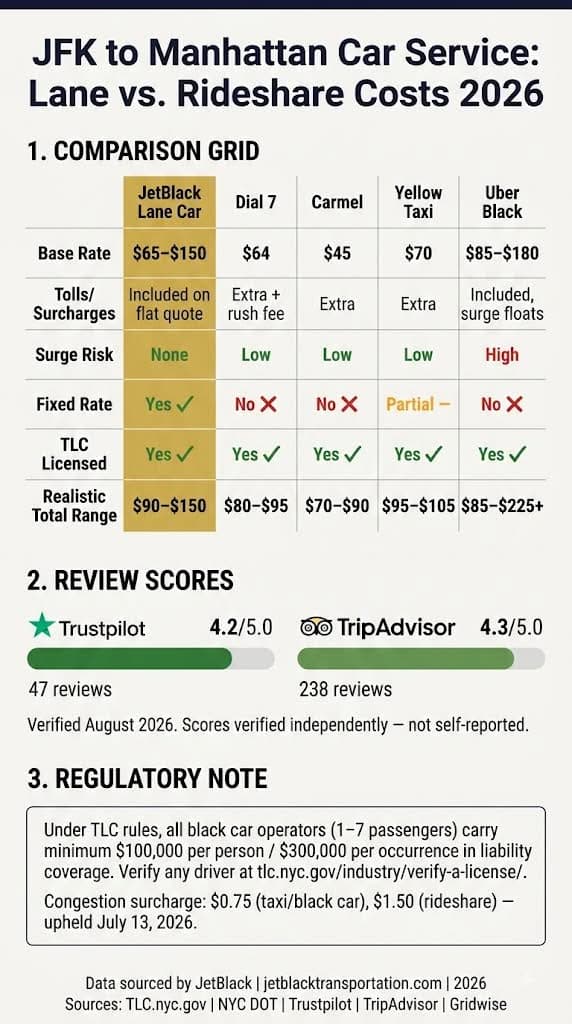
JetBlack publishes a JFK to Manhattan car service flat rate of $65 on its FAQ page, though its own route table lists $90–$150 for the same trip — a gap worth asking about directly when you book, since which figure applies depends on vehicle class and time of pickup. Dial 7 advertises a JFK base rate of $64, but that figure excludes tolls, the congestion surcharge, and a published rush-hour fee, pushing the realistic landed cost toward $80–$95. Carmel’s basic sedan starts near $45 before the same additions.
None of these numbers tell you much about lane cars specifically until you isolate what the flat rate is actually buying: a confirmed curb position versus a queue you join on arrival.
| Option | Base Rate | Tolls/Surcharges | Surge Risk | Fixed Rate? | TLC Licensed? | Realistic Range |
|---|---|---|---|---|---|---|
| Carmel | $45 | Extra | Low | No | Yes | $70–$90 |
| Dial 7 | $64 | Extra + rush fee | Low | No | Yes | $80–$95 |
| JetBlack (lane car) | $65–$150 | Included on flat quote | None | Yes | Yes | $90–$150 |
| Yellow Taxi | $70 | Extra | Low | Partial | Yes | $95–$105 |
| Uber Black | $85–$180 | Included, surge floats | High | No | Yes | $85–$225+ |
Uber Black has no fixed lane assignment — it dispatches to a general rideshare zone that can add a genuine wait even before the ride begins, and pricing floats with demand. A Gridwise analysis found roughly a third of Manhattan-bound JFK rides hit surge pricing, averaging 1.5 to 2.5 times the base fare. That is the trade lane cars are built to avoid: a fixed number confirmed before wheels-down, rather than one that changes while you’re standing at the curb.
Every for-hire trip below 60th Street in Manhattan now carries a $0.75 per-trip surcharge for taxis and black cars, and $1.50 for rideshare vehicles — a fee structure the Second Circuit upheld on July 13, 2026, after two suburban counties challenged it. Separately, a $9 Congestion Relief Zone toll applies to vehicles entering below 60th Street during peak hours; trips confined to Queens, including LGA-to-JFK transfers, are exempt entirely.
Ask any provider whether their quoted lane car rate already folds in both charges, because a “flat rate” that excludes them is not actually flat — and it’s the single most common way lane cars end up costing more than the number first quoted. The honest value read: lane cars earn their premium over Dial 7 or Carmel when your schedule can’t absorb a wait or a surge spike — a 6 a.m. departure, a same-day return, a client meeting with no buffer. For a leisure trip with flexible timing, a metered or budget operator can genuinely be the smarter spend.
Real Passengers, Real Trips: What Customers Actually Experienced
Case Study 1 — Trustpilot Reviewer, 5 Stars, June 2026
The Situation: A business traveler flying in for back-to-back morning meetings needed a pickup that would not slip if the flight landed early.
What Happened: The assigned driver was already waiting in the lane car zone on arrival, and the reviewer noted the same reliability on a prior early-morning run.
Why It Matters: A named driver already positioned at the curb is the entire value proposition lane cars offer over an app queue.
Case Study 2 — TripAdvisor Reviewer, 5 Stars, 2026
The Situation: A repeat corporate traveler, exactly the profile a business travel car service NYC operator depends on for steady revenue, had booked the same operator five separate times for New York arrivals.
What Happened: The reviewer described the service as consistently professional, organized, and fairly priced across all five trips, with no mention of surge pricing or last-minute cancellations.
Why It Matters: Repeat-use patterns from business travelers are a stronger signal than a single five-star review, since they reflect performance under real scheduling pressure.
Case Study 3 — Trustpilot Reviewer, 5 Stars, 2026
The Situation: A family arriving on a delayed flight needed patience and clear communication from dispatch.
What Happened: The reviewer highlighted attentive text and call responses from the driver, describing the pickup as smooth despite the delay, though noting communication occasionally felt like more contact than necessary.
Why It Matters: Over-communication is a minor complaint next to a missed pickup, but it’s a real trade-off worth knowing before you book.
Not every review is glowing. A pattern in lower-rated reviews across multiple NYC operators points to unadvertised fees — meet-and-greet charges billed without the service delivered, wait-time fees applied before the contracted grace period actually expires, and toll charges that don’t match the route the driver took. Worth asking about explicitly at booking, in writing.
How to Book Lane Cars Without Getting Burned — A Practical Checklist
Book your JFK pickup lane car at least 24 hours ahead for the best rate and driver availability, longer during major fall conference weeks when demand spikes citywide. Confirm the TLC base license number and ask whether the quoted price is genuinely all-in — tolls, congestion surcharge, and gratuity included, not added at drop-off.
Ask specifically when the grace period begins: from wheels-down or from your originally scheduled arrival time. A 90-minute international grace period that actually starts at scheduled time, rather than touchdown, gives you far less real buffer than it sounds. Most of the lane cars booked through corporate accounts run into trouble at exactly this step — a grace period assumption that doesn’t match what’s actually written in the terms. Get the cancellation window in writing before you pay, not after a delayed flight forces a rebooking.
Request that your driver’s name and vehicle details are sent at least 30 minutes before pickup, and confirm your flight number reached dispatch directly rather than through a booking form that may not sync with live tracking. Any legitimate TLC licensed car service will provide all of this without hesitation — hedging on these details is itself a warning sign. A pre-booked airport transfer at your JFK pickup lane is only as reliable as the confirmation paper trail behind it.

Booking Checklist — Save or Screenshot This
- TLC license verified at tlc.nyc.gov/industry/verify-a-license/
- Fixed all-in rate confirmed in writing (tolls + congestion fee included)
- Grace period confirmed: starts at [ ] landing / [ ] scheduled arrival
- Cancellation window: _______ hours for full refund
- Driver name + vehicle details sent at least 30 min before pickup
- Flight number provided to dispatcher
- Quote from at least one other provider obtained for comparison
The Industry in Honest Terms — How This Market Actually Works
New York’s for-hire vehicle market is large and fragmented: tens of thousands of active TLC-licensed vehicles compete across black car service NYC operators, yellow taxis, and app-based rideshare, each governed by a different regulatory tier. Black car and limousine bases like JetBlack operate under TLC base licensing with fixed insurance minimums, while high-volume rideshare platforms answer to a separate for-hire framework with its own driver-pay rules. Lane cars sit specifically within that first tier — TLC base licensing, not the app-dispatch model.
Dial 7 has run corporate car service NYC operations since 1977 and carries genuine scale — over 600 vehicles and same-day availability smaller operators can’t match — but its rotating driver pool and mixed fleet mean less trip-to-trip consistency than a dedicated chauffeur assignment. JetBlack’s smaller, more curated fleet trades some of that flexibility for tighter vehicle standards on its JFK to Manhattan car service routes, though its own reviewers have flagged pricing clarity as worth double-checking before booking. Carmel undercuts both on base fare but has drawn documented complaints about incomplete group bookings on multi-car airport runs, and neither budget option markets itself as a black car service NYC business travelers can default to without checking terms first.
The industry’s near-term trajectory points toward more hybrid and electric fleets, continued congestion pricing enforcement, and growing separation between dynamic-pricing apps and fixed-rate pre-booked airport transfer operators, as business travelers increasingly prioritize predictability over the lowest headline fare. Not every service delivers on that promise. Look for a published TLC base number, a written all-in rate, and a grace period defined in minutes, not vague reassurance.
Choosing a lane car over a taxi queue or a surge-priced app is ultimately a bet on certainty, and this fall’s travel volume makes that bet more worthwhile than it was in a quieter season. Not every trip justifies the premium lane cars carry over a metered ride, but for a schedule with zero room for error, that premium is the entire point.
The one action worth taking in the next ten minutes: request a written, all-in quote from two providers and ask both the same grace-period question. The answer tells you more about reliability than any star rating.
FAQ
What are lane cars at NYC airports?
Lane cars are pre-booked black cars staged in the dedicated commercial pickup lane at JFK, LaGuardia, or Newark, rather than dispatched into the general taxi or rideshare queue. The driver already has your flight number and terminal before you land, so the car is waiting in position rather than being summoned after you clear customs. This is the core difference from an app-based pickup, where you join a rotating queue and a driver is assigned only once you request one.
Is a black car service NYC option worth it over Uber for airport pickups?
Yes for peak-hour airport transfers, no for short off-peak crosstown trips. A Gridwise analysis found roughly a third of Manhattan-bound JFK rideshare trips hit surge pricing, averaging 1.5 to 2.5 times the base fare, while a fixed-rate black car locks the number in before you land. For a spontaneous short ride around Manhattan with no luggage and flexible timing, standard rideshare is usually cheaper and there is no real reliability trade-off to worry about.
Do lane cars cost more than a taxi from JFK?
A lane car typically runs $90 to $150 from JFK to Manhattan versus a yellow taxi’s $70 flat base fare, but the taxi fare does not include tolls, the congestion surcharge, or tip, which usually push the real taxi cost to $95 to $105. The remaining gap comes down to what you’re actually paying for: a confirmed driver and curb position versus a taxi line that can run 30 to 45 minutes during peak arrivals at busy terminals. For a solo traveler with no time pressure, the taxi is the better value; for a scheduled meeting, the lane car’s certainty is usually worth the premium.
Is tip included when you book a car service in advance?
Sometimes, and it depends entirely on the operator, so check your booking confirmation for the words u0022included gratuityu0022 or u0022service chargeu0022 before your ride. Some flat-rate operators fold an 18 to 20 percent gratuity into the quoted price, while others leave it as a separate cash or card add-on at drop-off. Tipping twice, once assumed and once added on top, is the most common and avoidable mistake travelers make with pre-booked car service, so confirm this one detail in writing rather than guessing curbside.
How do I verify a TLC licensed car service before I book?
Run the operator’s TLC base number and the assigned driver’s license number at tlc.nyc.gov/industry/verify-a-license/ before your trip, which takes under a minute and confirms both are currently active. A legitimate operator will provide both numbers without hesitation when asked, and hedging on this request is itself a warning sign. This step matters more than it sounds: an unlicensed vehicle soliciting near a terminal carries none of the TLC’s mandated insurance coverage if something goes wrong.
What happens if my flight is delayed and I already booked a car?
A legitimate pre-booked airport transfer tracks your flight automatically and adjusts your pickup time at no extra charge, so a delay on its own should not cost you anything. The detail that actually matters is when the complimentary wait-time clock starts — from the moment your flight lands, or from your originally scheduled arrival time. A 90-minute international grace period that only starts at the scheduled time, not touchdown, gives you meaningfully less real buffer than the same policy worded to start at wheels-down.
Are lane cars TLC licensed and insured?
Yes, legitimate lane car operators run under NYC TLC base licensing, which requires standard black car operators carrying 1 to 7 passengers to hold a minimum of $100,000 per person and $300,000 per occurrence in liability coverage. That figure is often misquoted online as $1.5 million, which is inaccurate for a standard sedan or SUV booking. Larger vehicles, including stretch limousines and vans, carry higher required minimums under the same TLC framework.
What’s the best way to get from JFK to Manhattan on a tight business schedule?
For a fixed arrival time you can’t afford to miss, a pre-booked lane car with real-time flight tracking is the most predictable option, since the price and the driver’s position are both locked in before you land. The AirTrain-to-subway combination is cheaper but takes roughly an hour with transfers and is a poor fit if you’re carrying luggage or arriving after a long flight. A metered yellow taxi sits in between: no advance booking needed, but a real chance of a 30-to-45-minute line at busy terminals during peak arrival windows.
Does JFK to Manhattan car service pricing change based on which terminal I land at?
The base fare itself generally does not change by terminal, but your realistic total can, since some terminals have longer walks to the pickup lane and busier curb congestion during peak international arrival banks. Terminal 4 and Terminal 1, which handle the bulk of international carriers, see the heaviest curb traffic and the longest taxi lines, which is where a pre-assigned lane car position has the most practical value. Always confirm your specific terminal and airline with your driver ahead of time so the pickup coordinates match your actual arrival gate.
Can I request a car seat for a family trip from the airport?
Yes, most established black car service NYC operators provide child seats free of charge when you specify the child’s age and the number of seats needed at the time of booking. New York State law requires booster seats up to age eight, and a reputable operator will confirm this is included rather than leaving it as an assumption. If a provider can’t confirm car seat availability in writing before your trip, treat that as a signal to ask more questions or book elsewhere.
How far in advance should I book a lane car for an airport pickup?
Book at least 24 hours ahead for standard availability and the best published rate, and further out during major fall conference weeks or holiday periods when citywide demand spikes across every operator. Same-day booking is often possible with higher-volume operators, but it narrows your choice of vehicle class and increases the odds of a rotating, unfamiliar driver rather than a dedicated assignment. For a fixed, unmovable meeting time, booking early is the single easiest way to protect the schedule.
What’s the difference between a lane car and a regular black car booking?
In practice, the terms describe the same underlying TLC-licensed vehicle category — the distinction is about pickup logistics, not vehicle type. A lane car specifically refers to that pre-booked vehicle being staged in the airport’s dedicated commercial pickup lane with your flight and terminal details already on file, rather than a black car requested on the fly through an app with no fixed staging position. Both operate under the same TLC base licensing and insurance requirements.
Is a corporate car service NYC account worth setting up for frequent travelers?
For travelers averaging several NYC trips a month, yes — a corporate account typically adds consolidated monthly billing, priority booking during high-demand periods, and a dedicated account contact for schedule changes. The main trade-off is less flexibility to shop rates trip-by-trip, since corporate rates are usually negotiated as a package rather than compared per ride. For occasional travelers, a one-off booking with a written all-in quote is simpler and rarely costs meaningfully more.
What should I do if a car service charges me fees I wasn’t told about?
Request an itemized breakdown in writing and compare it against your original confirmation, since the most common disputes involve meet-and-greet charges billed without the service being delivered, wait-time fees applied before the actual grace period expired, or tolls charged for a route the driver didn’t take. If the operator won’t produce documentation matching the charge, most major card networks allow a chargeback for services not rendered as agreed. This is also why getting the all-in rate, grace period, and cancellation terms in writing before the trip matters more than any single review score.
Sources
- NYC Taxi and Limousine Commission. “Vehicle Insurance Requirements.” TLC.nyc.gov. Accessed August 2026.
- Courthouse News Service. “Second Circuit rejects last-ditch bid to pause NYC congestion toll.” July 13, 2026.
- ABC News. “Manhattan’s congestion pricing can continue, judge rules.” March 3, 2026.
- JetBlack. Official site — services, pricing, FAQ. Accessed August 2026.
- Dial 7 Car Service. Official site — pricing and fleet. Accessed August 2026.
- Trustpilot. JetBlack Transportation reviews. Accessed August 2026.
- TripAdvisor. Jet Black Transportation reviews. Accessed August 2026.