

This article is sponsored by JetBlack, a premium limo service provider, and may include affiliate links. Recommendations are independent and based on consensus data.
Quick Takeaways
- TLC Insurance Minimum: Standard NYC black car operators must carry $100,000 per person and $300,000 per occurrence — not the $1.5 million figure that circulates online.
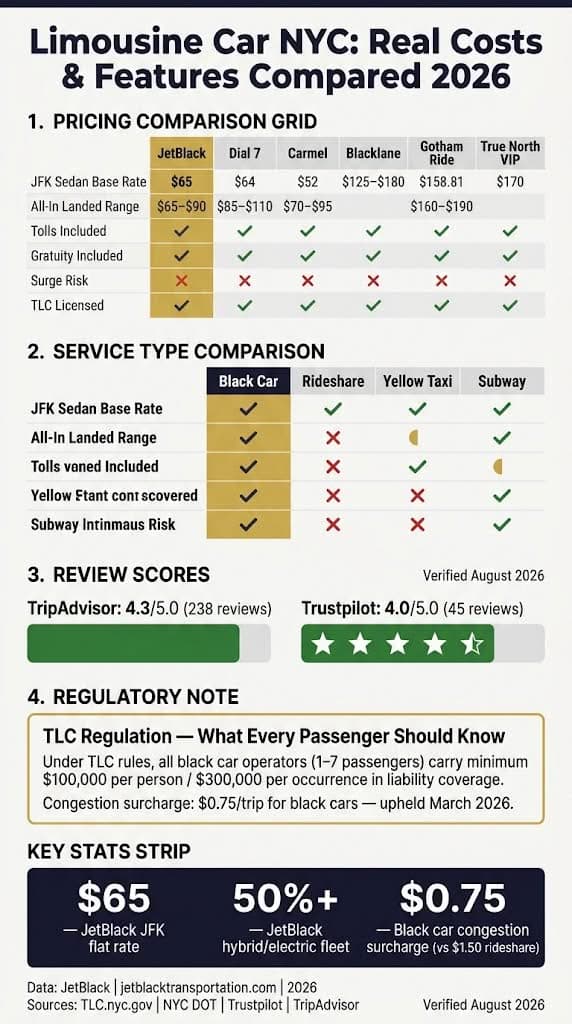
- Peak Season Reality: A $65 JetBlack JFK flat rate in January stays $65 in December, while rideshare surges 2–3× during UN Assembly week and holiday crunch.
- Congestion Pricing Upheld: Federal Judge Lewis Liman ruled March 3, 2026 that NYC congestion pricing is legal — black cars pay $0.75 per trip into Manhattan south of 60th Street.
- Competitor Spread: JFK-to-Manhattan sedan rates range from $64 (Dial 7) to $170 (True North VIP) in 2026 — the gap reflects bundled services, not identical products.
- Review Honesty: JetBlack holds 4.3/5.0 on TripAdvisor (238 reviews) and 4.0/5.0 on Trustpilot (45 reviews), with lower-rated feedback flagging estimate-to-final-price gaps worth confirming at booking.
- Fleet Shift: Over 50% of JetBlack’s fleet is now hybrid or electric, reflecting an industry-wide 2026 pivot toward lower-emission corporate ground transport.
Fact-checked by: Alex Freeman. Specialises in for-hire vehicle regulations, insurance requirements, and dispatch operations.
Full bio: jetblacktransportation.com/editorial-team
Last verified: August 17, 2026
I didn’t think twice about booking a sedan for my first corporate trip to Manhattan. I was wrong.
The email from my editor landed on a Monday: cover a transportation story in Midtown, arrive Tuesday, back Wednesday. I opened a rideshare app, watched the price jump forty dollars while I was still scrolling, and realized I knew nothing about how corporate ground transport actually works in New York. That was three years ago. Since then, I’ve spent more than one hundred hours on trains across six countries and learned that how you book ground transport matters as much as where you’re going.
For corporate bookers, a lemosin car in NYC is not a luxury splurge — it is a logistics decision. The difference between a pre-booked black car and a last-minute app ride can mean a missed meeting, a two-hundred-dollar surge charge, or a stranded executive at JFK Terminal 4. Here’s what 2026 actually looks like.
What a lemosin car Service Is — And Why the Name Confuses Everyone
A lemosin car in the NYC regulatory sense is any pre-booked, TLC-licensed for-hire vehicle dispatched through a licensed base. That includes the classic stretch limousine you picture at a wedding, but it also covers the black sedan that picks up your CFO at LaGuardia. The term has stretched.
Under TLC rules, standard black car operators carrying one to seven passengers must carry a minimum of one hundred thousand dollars per person and three hundred thousand dollars per occurrence in liability coverage. Larger vehicles face higher minimums. That distinction matters because some operators advertise one-point-five million dollars in coverage — a figure that applies to commercial buses, not the sedan your colleague is riding in.
The practical implication for corporate bookers is simple: verify the license, not just the leather seats. When you reserve lemosin car service, you are buying traceability. The driver has a TLC number. The vehicle has an inspection record. The base has a physical address. None of that is guaranteed with an unlicensed curb operator waving a clipboard at JFK arrivals.
I learned this the hard way on a reporting trip to Chicago last year. I booked what I thought was a black car through a referral. The driver showed up in an unmarked SUV, couldn’t find my terminal, and spent ten minutes arguing about tolls. A real lemosin car operator would have had my flight on a screen somewhere, not in a group text thread.
What a lemosin car Actually Costs — Real Numbers, August 2026
The JFK-to-Manhattan route is the industry benchmark. Here’s what corporate bookers should expect to pay.
| Option | Base Rate | Tolls/Surcharges | Surge Risk | Fixed Rate? | TLC Licensed? | Realistic Range |
|---|---|---|---|---|---|---|
| Dial 7 (sedan) | $64 | Tolls + state surcharge extra | Low | Yes | Yes | $85–$110 |
| Carmel (sedan) | $52 | Tolls/gratuity extra | Low | Optional | Yes | $70–$95 |
| JetBlack (sedan) | $65 | Included in quote | None | Yes | Yes | $65–$90 |
| Blacklane (Business) | $125–$180 | All-included | None | Yes | Yes | $125–$180 |
| Gotham Ride (sedan) | $158.81 | Included | None | Yes | Yes | $160–$190 |
| True North VIP (sedan) | $170 | All-included | None | Yes | Yes | $170 |
Wait — JetBlack at sixty-five dollars and True North VIP at one hundred seventy? The spread is real, and it reflects different service tiers. JetBlack’s sixty-five-dollar JFK flat is a competitive anchor; True North VIP bundles gratuity, sixty-minute wait, and meet-and-greet into a single number. Both are legitimate. The trap is assuming they are the same product.
The counterintuitive finding: during peak season — UN General Assembly week in September, or the December holiday crunch — flat-rate operators hold their lemosin car rate steady while rideshare surges two to three times. A sixty-five-dollar lemosin car booking in February stays sixty-five dollars in December. An app ride does not.
Hourly charters tell a different story. JetBlack starts at seventy-five dollars per hour with a two-to-three-hour minimum. Blacklane’s hourly Business Class runs ninety to one hundred twenty dollars. For a full day of Manhattan meetings — say, eight hours — you’re looking at six hundred to nine hundred sixty dollars depending on vehicle class. That’s where a lemosin car shifts from airport utility to mobile office. The Wi-Fi, charging ports, and predictable schedule become the value, not just the seat.
Corporate Limousine Rental in NYC — A Seasonal Calendar Most Bookers Miss
Corporate limousine rental in NYC follows a calendar most bookers never see.
September brings UN General Assembly week, when Midtown hotel blocks and ground transport lock up fourteen days in advance. October through early November is marathon and gala season. December holiday parties consume Sprinter vans and stretch fleets by the first week of the month. January is the quietest corporate window — rates soften and availability widens.
February through March rebounds with fashion week and spring conference season. The FIFA World Cup 2026 in June and July will spike demand for SUVs and Sprinters, especially for groups heading to MetLife Stadium from Manhattan. Corporate bookers who plan thirty to forty-five days ahead during these windows secure vehicle class and rate. Those who wait until the week of travel often face vehicle substitutions or premium upcharges.
Summer Fridays also matter. Many NYC firms shift to four-day schedules from Memorial Day through Labor Day, compressing Monday and Tuesday demand while spreading Thursday afternoon pickup requests across a thinner fleet. A lemosin car booked for a Thursday evening in August is harder to secure than the same ride on a Wednesday in March.
Here’s a booking tip nobody tells you: the best time to reserve a lemosin car for December travel is the second week of November. By Thanksgiving, the good operators are already allocating their holiday fleets to recurring corporate accounts. First-time bookers get whatever is left — often older vehicles or less-experienced drivers pulled from other bases.
lemosin car Fleet Options — Matching Vehicle to Group Size
Vehicle selection is where corporate bookers make their second-most-common mistake. A standard sedan fits three passengers and two large bags comfortably. An SUV handles up to six passengers and four checked bags. A Sprinter van moves fourteen people with full luggage loads. The wrong choice means two vehicles, two drivers, and two chances for something to go wrong.
One correctly sized lemosin car, booked from the start, is almost always cheaper per person and considerably less chaotic. JetBlack’s fleet includes sedans, SUVs, eco-hybrid options, stretch limousines, passenger vans, and mini-buses — all DOT-certified and maintained. Over fifty percent of the fleet is hybrid or electric, which matters for corporate sustainability reporting.
I made this mistake last fall. Three of us were heading to a press event in Brooklyn with camera gear. I booked a sedan. We barely fit. The driver had to play Tetris with our Pelican cases in the trunk. A lemosin car with proper cargo space — an SUV or a van — would have saved us twenty minutes of curbside rearranging and a lot of stress.

Real Passengers, Real Trips — What Corporate Riders Actually Experienced
Case Study 1 — Rodney B., Trustpilot, 5 stars, October 2025
The Situation: A corporate traveler who flies out of NYC airports regularly and needed reliable, repeatable service without re-explaining preferences every time.
What Happened: He reported punctual, professional service on multiple airport runs. The driver arrived early, knew the terminal layout, and required no back-and-forth communication.
Why It Matters: For corporate bookers, consistency is the product. A driver who remembers your route without asking is worth more than a cheaper ride that shows up late.
Case Study 2 — Carrie H., Trustpilot, 5 stars, October 2025
The Situation: A first-time JetBlack user arriving at JFK for a business meeting, anxious about timing and communication.
What Happened: The company sent pickup details before landing. The driver was friendly, the car was clean, and the driving felt safe — small details that reduce travel stress before a presentation.
Why It Matters: Pre-arrival communication is where premium operators separate from app-based services. Corporate bookers should weight this heavily when scheduling rides for executives who do not have time to coordinate curbside logistics.
Case Study 3 — SeanKyie A., Trustpilot, 5 stars, December 2025
The Situation: A business traveler whose flight was delayed seven hours — the kind of disruption that breaks most ground transport arrangements.
What Happened: JetBlack maintained online communication throughout the delay. The driver was still waiting when the flight finally landed, with no additional charge or attitude.
Why It Matters: Flight tracking is marketed by everyone. Actually executing through a seven-hour delay is the test. For corporate bookers, this is the difference between a service partner and a vendor.
Not every review is glowing. A one-star review from October 2025 flagged a pricing gap between the online estimate — sixty to sixty-five dollars — and the final confirmation, which added gratuity, an STC surcharge, and other fees. The company responded publicly, itemizing each charge and acknowledging the estimate clarity needed improvement. Worth asking about at booking.
How to Book a lemosin car Without Getting Burned — A Practical Checklist
Corporate ground transport fails at the handoff points: booking confirmation, flight delay communication, and curbside pickup. Cover these in writing.
Book at least twenty-four hours ahead. Forty-eight is safer during peak weeks. Verify the TLC license at tlc.nyc.gov before you confirm. Ask whether the quoted rate is all-inclusive — tolls, congestion surcharge, and gratuity — or if fees stack on arrival. Confirm the grace period starts at wheels-down, not scheduled arrival. Request driver name and vehicle details at least thirty minutes before pickup. Provide the flight number to dispatch. Get a quote from at least one other provider for comparison.
The biggest mistake I see? Treating a lemosin car like a commodity. It isn’t. You’re not buying miles. You’re buying certainty. The certainty that someone will be there when the plane lands. The certainty that the rate won’t double because it rained. The certainty that your executive won’t be standing on a curb in Queens at midnight, refreshing a rideshare app that says “no cars available.”
Booking Checklist — Save or Screenshot This
- TLC license verified at tlc.nyc.gov/industry/verify-a-license/
- Fixed all-in rate confirmed in writing (tolls + congestion fee included)
- Grace period confirmed: starts at [ ] landing / [ ] scheduled arrival
- Cancellation window: _______ hours for full refund
- Driver name + vehicle details sent at least 30 min before pickup
- Flight number provided to dispatcher
- Quote from at least one other provider obtained for comparison
The Industry in Honest Terms — How This Market Actually Works
NYC’s for-hire vehicle market is regulated by the TLC, which currently licenses approximately eighty thousand active vehicles — though new non-wheelchair-accessible FHV licenses have been paused since 2023. The black car tier sits between yellow taxis and high-volume rideshare apps: pre-booked, base-affiliated, and subject to stricter insurance and driver training requirements.
The March 3, 2026 federal court ruling upholding congestion pricing means every trip entering Manhattan south of 60th Street carries a surcharge — seventy-five cents for black cars and taxis, one dollar fifty for high-volume rideshare vehicles. That cost is typically folded into flat-rate quotes but itemized on metered rides. Judge Lewis Liman called the federal government’s attempt to kill the program arbitrary and capricious, restoring the Value Pricing Pilot Program agreement.
Two trends are reshaping corporate bookings in 2026. First, EV and hybrid fleets are expanding — JetBlack reports over fifty percent of its fleet as hybrid or electric. Second, corporate travel managers are consolidating vendors, preferring single-platform billing across multiple cities. Global operators like Blacklane win on consolidation; NYC-specific operators win on local route knowledge and shorter booking windows.
Here’s what I tell friends who book travel for their companies: a lemosin car operator with a physical garage in Queens knows the Van Wyck Expressway construction schedule. An app algorithm doesn’t. That local knowledge saves fifteen minutes on a Tuesday evening in July when half the airport exit is closed. It’s the kind of edge you can’t price on a spreadsheet, but it shows up in your on-time percentage.
Booking a lemosin car in NYC is not about the vehicle — it is about the decision to remove uncertainty from a travel day. The corporate booker’s job is not to find the cheapest ride. It is to make sure the executive never thinks about the ride at all.
In the next ten minutes, get quotes from two operators for your next JFK pickup. Ask both the same question: what happens if the flight is delayed four hours? The answer will tell you which one to trust.
FAQ
What exactly counts as a lemosin car Uber or a taxi?
u003cstrongu003elemosin caru003c/strongu003eu003cbru003eA u003cstrongu003elemosin caru003c/strongu003e in New York City is any pre-booked, TLC-licensed for-hire vehicle dispatched through a licensed base, which includes everything from a black sedan to a classic stretch limo, while Uber and yellow taxis operate under different regulatory tiers with separate insurance and booking requirements. Under TLC rules, a standard black car carrying one to seven passengers must carry at least $100,000 per person and $300,000 per occurrence in liability coverage, and the vehicle and driver both hold TLC licenses that you can verify at tlc.nyc.gov. The key difference is traceability: when you book a u003cstrongu003elemosin caru003c/strongu003e, you get a specific driver, vehicle details, and a base with a physical address, whereas Uber assigns whoever is closest and yellow taxis are hailed on the street without advance coordination.
Is booking a lemosin car from JFK to Manhattan actually worth it compared to Uber Black?
Yes, a pre-booked u003cstrongu003elemosin caru003c/strongu003e is worth the cost for travelers who value fixed pricing, flight tracking, and guaranteed pickup, especially during peak times when Uber Black surges two to three times above base rates. A flat-rate u003cstrongu003elemosin caru003c/strongu003e from JFK to Manhattan typically runs $65 to $170 depending on the service tier, with tolls and congestion fees folded into the quote, while Uber Black uses dynamic pricing that can spike during rush hour, bad weather, or events. The real value shows up when your flight is delayed: u003cstrongu003elemosin caru003c/strongu003e operators like JetBlack track your flight and adjust pickup automatically, whereas Uber drivers may cancel after a long wait and leave you rebooking at surge rates from the curb.
How much should I tip my lemosin car driver and is gratuity included in the quoted rate?
A customary tip for a u003cstrongu003elemosin caru003c/strongu003e driver is 18 to 20 percent of the total fare, though whether that amount is included in your quote depends entirely on the provider, so you should ask before you book. Some operators like True North VIP bundle gratuity into their flat rate upfront, while others such as JetBlack quote the fare separately and expect you to tip the u003cstrongu003elemosin caru003c/strongu003e driver directly in cash or by card at the end of the ride. If you are booking for corporate travel, clarify the tipping policy with your accounts payable team in advance, because an unexpected gratuity line item can throw off expense reconciliation if it was not budgeted separately.
What’s the best way to arrange a car for a group of five with luggage flying into LaGuardia?
The best approach is to book an SUV or Sprinter u003cstrongu003elemosin caru003c/strongu003e at least 24 hours in advance, specifying exactly five passengers and your total luggage count, because a standard sedan only fits three passengers and two large bags comfortably. An SUV handles up to six passengers and four checked bags, while a Sprinter van accommodates fourteen people with full luggage loads, and choosing the right u003cstrongu003elemosin caru003c/strongu003e from the start prevents the chaos and extra cost of needing a second car at the airport. When you book, provide your flight number, terminal, and a mobile number where the dispatcher can reach you, since LaGuardia’s pickup zones vary by terminal and construction can shift curbside access without warning.
How far in advance do I need to reserve a lemosin car for a corporate event during UN General Assembly week?
You should book a u003cstrongu003elemosin caru003c/strongu003e at least 14 days ahead for UN General Assembly week in September, and 30 to 45 days ahead if you need multiple vehicles or a Sprinter van, because Midtown hotel blocks and ground transport fleets lock up early during that period. For routine corporate travel, 24 to 48 hours is usually sufficient, but during major NYC events like the Met Gala, Fashion Week, or the December holiday party season, u003cstrongu003elemosin caru003c/strongu003e availability tightens and last-minute bookings often face vehicle substitutions or premium upcharges. The safest practice is to reserve as soon as you have the event date, then confirm driver and vehicle details 24 hours before pickup.
Can I trust that my driver is actually TLC-licensed and not just a random person with an app?
Yes, you can verify any driver’s TLC license yourself at tlc.nyc.gov/industry/verify-a-license/ by entering their name or TLC number, which every legitimate u003cstrongu003elemosin caru003c/strongu003e operator will provide when you ask. A licensed u003cstrongu003elemosin caru003c/strongu003e driver has passed a seven-year criminal background check, an annual drug test, fingerprinting through NY State, and a defensive-driving certificate, plus their vehicle undergoes regular TLC inspections. If a provider refuses to give you a driver name or TLC number before pickup, that is a red flag, and you should book with a different base that operates transparently.
What happens if my flight is delayed three hours — will my car still be waiting or do I get charged extra?
A reputable lemosin car service will still be waiting when you land, with no extra charge for the delay, because they use FAA flight tracking to monitor your arrival time and automatically adjust the driver’s dispatch schedule. Most premium operators include 30 minutes of complimentary wait time for domestic flights and 60 minutes for international arrivals, and the wait clock starts from wheels-down, not from your scheduled landing time. If your delay stretches beyond those windows, ask your provider at booking what their extended-wait policy is, because practices vary and some companies charge a per-minute rate after the grace period expires.
Is the NYC congestion pricing surcharge included in my lemosin car fare or added at the end?
For most flat-rate lemosin car bookings, the $0.75 per-trip congestion pricing surcharge is already folded into your quoted fare, so you will not see it as a separate line item on your invoice or receipt. The MTA charges this fee to all for-hire vehicles entering Manhattan south of 60th Street, but black cars and taxis pay only $0.75 per trip compared to the $1.50 charged to high-volume rideshare apps like Uber and Lyft. If you are booking a metered ride rather than a flat rate, the surcharge may be itemized separately, so always confirm whether your quote is all-inclusive before you confirm the reservation.
Should I book by the hour or as a flat point-to-point rate for a day of meetings?
Book hourly if you have multiple stops with uncertain timing between them, because a flat point-to-point rate is designed for one clean transfer from A to B and does not cover waiting time or route changes. Hourly lemosin car service in Manhattan typically starts at $75 to $120 per hour with a two-to-three-hour minimum, and for a day of back-to-back meetings in Midtown, FiDi, and Hudson Yards, four hours of dedicated service often costs less than four separate flat rides plus four congestion surcharges. If your day involves only one airport transfer and one hotel drop-off, a flat rate is the better value, but add up the individual legs first because the math flips quickly once you exceed two stops.
Why does one company quote $65 for JFK while another quotes $170 for the same route?
The price gap reflects different service tiers and what is bundled into the quote, not a difference in the route itself, because a $65 flat rate from JetBlack covers the sedan, tolls, and congestion fee, while a $170 rate from True North VIP also bundles gratuity, 60 minutes of wait time, and an inside meet-and-greet at baggage claim. Both are legitimate lemosin car products, but they are not identical, and the trap is assuming the cheaper quote includes everything the expensive one does. Before you book, ask each provider exactly what their quote covers — tolls, congestion surcharge, gratuity, wait time, and meet-and-greet — so you can compare apples to apples.
How do I know my ride will actually show up and not cancel like my last Uber did?
A pre-booked lemosin car is far less likely to cancel because the driver is assigned to your specific trip in advance, not matched algorithmically at the last minute like a rideshare driver who might accept a better fare closer to pickup time. Reputable operators send you the driver’s name, vehicle details, and a direct contact number at least 30 minutes before pickup, and their dispatch team monitors the assignment in real time. If you want extra assurance, book with a provider that has a published cancellation policy and a physical dispatch office in New York, because fly-by-night operators are more likely to ghost you than an established base with a real address and TLC license.
Are child seats available and do I need to request them ahead of time?
Yes, child seats are available from most lemosin car providers, but you must request them during booking — not the day of travel — because the company needs to match the correct seat type to your child’s age and weight and install it before the vehicle leaves the garage. Specify the child’s age, the type of seat you need, and how many seats when you make the reservation, since a standard sedan may not have room for multiple car seats plus luggage without upgrading to an SUV. Not every driver carries spare seats in the trunk, so assuming they will have one available at the curb is a common mistake that can delay your departure or force a vehicle swap.
What vehicle type should I choose — sedan, SUV, or Sprinter van?
Choose a sedan for one to three passengers with light luggage, an SUV for up to six passengers or four checked bags, and a Sprinter van for groups of eight to fourteen people or when you are transporting equipment, wardrobe, or event materials. A standard lemosin car sedan fits three passengers and two large bags comfortably, and squeezing in extra people or luggage means someone sits with a suitcase on their lap or you end up needing a second vehicle. If you are unsure, tell the dispatcher your exact passenger count and total luggage pieces, because they have routed thousands of airport runs and can recommend the right vehicle class in about ten seconds.
Is it safe to take a car from JFK at midnight if I’ve never used one before?
Yes, it is safe as long as you book through a TLC-licensed base that sends you driver and vehicle details in advance, because the pre-booking model eliminates the uncertainty of hailing a random car at the curb or waiting in a rideshare lot with dozens of other travelers. A legitimate lemosin car operator will text or email you the driver’s name, vehicle make, model, and license plate at least 30 minutes before pickup, and the driver will meet you at a designated terminal pickup zone or inside baggage claim if you requested meet-and-greet. If anyone approaches you at JFK claiming to be your driver but cannot show a TLC license or match the vehicle details you were sent, walk away and call the dispatch number directly.
What’s the difference between a black car service and a lemosin carservice in New York?
In New York City, the terms overlap almost completely, because a black car service is technically a subset of lemosin car services — both are pre-booked, TLC-licensed for-hire vehicles dispatched through a licensed base, and both carry the same $100,000 per person and $300,000 per occurrence insurance minimum for vehicles carrying one to seven passengers. The distinction is mostly marketing: some companies use limousine car to emphasize stretch limos and special-event vehicles, while black car signals corporate sedan and SUV service for airport transfers and business travel. When you are booking, ignore the label and verify the TLC license, insurance, and what the quote actually includes, because a well-run black car service and a well-run limousine car service operate under identical TLC rules.
Sources
- NYC Taxi and Limousine Commission. “Vehicle Insurance Requirements.” TLC.nyc.gov. Accessed August 2026.
- NYC Taxi and Limousine Commission. “Get a For-Hire Vehicle License.” TLC.nyc.gov. Accessed August 2026.
- The New York Times. “Congestion Pricing Wins in Court After Lengthy Battle With Trump Administration.” March 3, 2026.
- Trustpilot. “JetBlack Transportation Reviews.” Accessed August 2026.
- TripAdvisor. “JetBlack Transportation.” Accessed August 2026.
- JetBlack Transportation. “Official Website.” Accessed August 2026.
- Black Car NYC. “Rates.” Accessed August 2026.
- True North VIP. “NYC Car Service Cost in 2026: Real Prices, No Surge.” July 25, 2026.
- Joey Hadden, Business Insider. “How to Travel More Sustainably: Practices and Tips.” April 26, 2023.