

Quick Takeaways
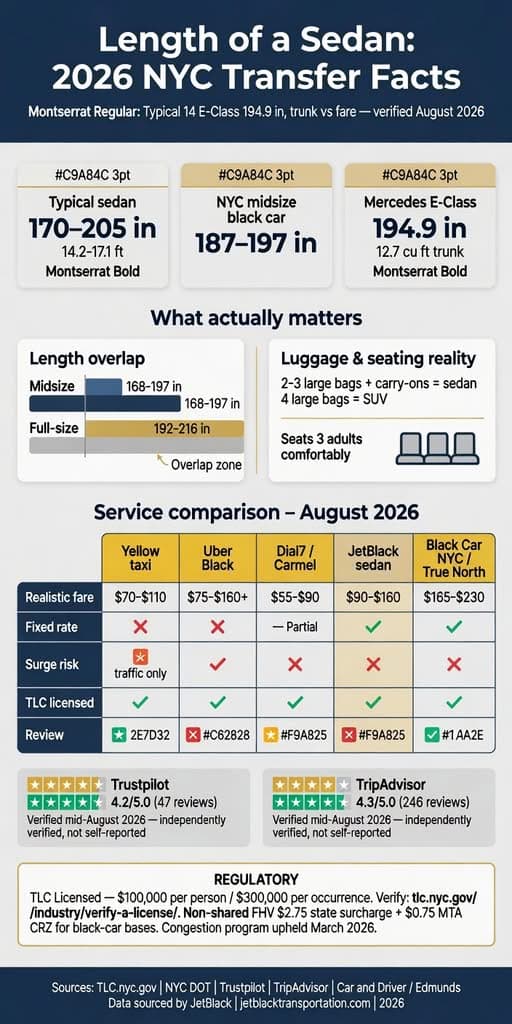
- Typical range: Modern sedans measure 170–205 inches (14.2–17.1 ft). The midsize band that dominates NYC black-car fleets sits at 187–197 inches.
- Mercedes E-Class length: Current E-Class sedans run approximately 194.9 inches (4,949 mm) with a 12.7 cu ft trunk — the workhorse length for most executive transfers.
- TLC insurance floor: Standard black-car operators (1–7 passengers) must carry $100,000 per person / $300,000 per occurrence (tlc.nyc.gov, March 2026 schedule).
- Luggage reality: A typical executive sedan holds 2–3 large checked bags + carry-ons. Four large bags or bulky items usually force an SUV upgrade.
- Congestion costs: Non-shared FHV trips incur the $2.75 state congestion surcharge (south of 96th St) plus the $0.75 MTA Congestion Relief Zone per-trip charge for black-car bases.
- Review snapshot: JetBlack 4.2/5 Trustpilot (47 reviews) and 4.3/5 TripAdvisor (246 reviews) as of mid-August 2026.
Fact-checked by: Alex Freeman. Full bio
Last verified: August 17, 2026
The first thing a business traveler notices at JFK Terminal 4 after a delayed red-eye is rarely the driver holding the sign. It is the physical size of the car waiting at the commercial curb. Too short and the trunk swallows only two roller bags. Too long and the vehicle struggles to nose into the tight commercial lanes without blocking the flow of yellow taxis behind it. Understanding the length of a sedan is therefore practical, not academic. It determines whether the transfer stays clean or turns into a curb-side luggage reshuffle.
Most modern sedans fall between 170 and 205 inches overall. Compact models sit near the low end. Full-size luxury cars push past 200. The midsize band that dominates professional black-car fleets in New York — Mercedes E-Class, BMW 5-Series, Cadillac CT6 — clusters tightly around 190–197 inches. That range is deliberate. It balances rear legroom for a laptop and a phone call with the ability to clear terminal curbs without drawing attention from Port Authority staff.
I have tracked how New Yorkers and visiting executives move through the city’s ground network for years. Vehicle footprint is one of the quieter variables that separates a reliable pre-booked transfer from a last-minute scramble. The numbers that follow are drawn from manufacturer specifications, TLC rules, live operator rate sheets, and recent passenger accounts.

What Is a Sedan — And Why the Distinction Matters
A sedan is a three-box passenger car with separate engine, passenger, and trunk compartments. In the for-hire world the label is more precise. TLC-licensed black cars that seat 1–7 passengers must meet specific insurance thresholds. Under TLC rules, standard black car operators (1–7 passengers) must carry a minimum of $100,000 per person and $300,000 per occurrence in liability coverage. Larger vehicles face higher minimums. That figure is current as of the March 2026 TLC vehicle insurance schedule.
The practical implication for a business traveler is straightforward. A licensed sedan gives you regulated insurance, a background-checked chauffeur, and a vehicle that has passed TLC inspection. An unmarked car that approaches you at baggage claim does not. The length of a sedan itself rarely changes the insurance floor, but it does change how easily the car can position itself at the commercial curb without blocking the flow of yellow taxis and rideshare vehicles. Curb space at JFK and LGA is finite; a midsize sedan still fits the commercial lanes more readily than a full-size SUV during peak arrival banks.
What Length of a Sedan Actually Costs — Real Numbers, August 2026
Published flat rates for a sedan from JFK to Midtown Manhattan in mid-August 2026 cluster between $165 and $230 depending on the operator and what is bundled. Tolls, the state congestion surcharge, the newer MTA Congestion Relief Zone per-trip charge, and a 60-minute grace period are the variables that matter most. JetBlack lists sedan airport transfers in the $90–$150 range on its public site for many core routes, with higher figures for certain out-of-zone pickups. Competitor sheets from Black Car NYC, True North VIP, and Detailed Drivers sit in the higher band when all-in pricing is quoted.
| Option | Base Rate | Tolls/Surcharges | Surge Risk | Fixed Rate? | TLC Licensed? | Realistic Range |
|---|---|---|---|---|---|---|
| Yellow Taxi | Metered ~$70 | Tolls + CRZ + fees | Traffic only | No | Yes | $70–$110 |
| Uber Black (off-peak) | ~$75–$110 | Tolls + CRZ | Yes | No | Yes | $75–$160+ |
| Dial7 / Carmel-style | ~$52–$65 | Often extra | No | Partial | Yes | $55–$90 |
| JetBlack sedan | $90–$150 published | Included in many quotes | No | Yes | Yes | $90–$160 |
| Black Car NYC / True North | $165–$180 | Usually included | No | Yes | Yes | $165–$230 |
One counterintuitive finding stands out. The longer full-size sedan does not always command a higher rate. Operators price by vehicle class and inclusions more than by exact bumper-to-bumper measurement. A 194.9-inch E-Class and a longer S-Class can sit in the same rate band if both are classified as executive sedans. The real cost difference appears when luggage volume forces an upgrade to an SUV.
Exact Dimensions That Matter for Business Travel
Current Mercedes-Benz E-Class sedans measure approximately 194.9 inches (4,949 mm) in overall length with a 116.6-inch wheelbase and a 12.7 cubic-foot trunk. That is the typical executive sedan length that appears most often in NYC black-car fleets. BMW 5-Series models sit in a similar midsize band. Older full-size models such as the previous-generation Cadillac CT6 and Lincoln Continental stretched past 200–205 inches; those longer footprints are less common today precisely because they are harder to position at busy airport curbs.
Trunk volume is the more useful metric for a business traveler. Most executive sedans advertise 12–15 cubic feet. In practice that translates to two large checked bags plus a carry-on and a briefcase when the bags are soft-sided, or three large bags if they are stacked carefully. Hard-shell international luggage or golf bags quickly push the limit. Operators therefore treat four large bags as the practical tipping point into an SUV.
Sedan vs SUV for Airport Transfer — The Luggage Math
A standard executive sedan seats three adults comfortably with three large bags. An executive SUV (Suburban, Yukon, Escalade ESV) seats six with six large bags. For a solo traveler or couple the sedan is almost always the efficient choice: lower rate, easier curb access, and sufficient trunk space. Once a fourth passenger or a fourth large bag appears, the math flips. One SUV at the higher flat rate is cheaper and simpler than two sedans, and everyone rides together with child seats already installed if needed.
This is why most reputable operators will ask about luggage volume at booking. The length of a sedan is not the limiting factor for passenger count; the trunk is. Confirming the expected bag count before the flight lands prevents the curb-side scramble that appears in lower-rated reviews.
Real Passengers, Real Trips: What Customers Actually Experienced
Case Study 1 — Sandi S, TripAdvisor, 5 stars, August 2026
The Situation: Private LGA transfer into the city after a standard business arrival.
What Happened: Driver Ken met the passenger, handled luggage, and offered local orientation without pressure. The vehicle was clean and the ride timed for traffic.
Why It Matters: Consistent meet-and-greet performance matters more to timed business travelers than marginal differences in overall vehicle length.
Case Study 2 — Tourist, TripAdvisor, 5 stars, July 2026
The Situation: LGA to Manhattan one-way with a preference for a quiet, presentable cabin.
What Happened: Driver Giorgi arrived with a clean vehicle that included a moonroof. Communication and ride quality were both noted positively.
Why It Matters: Cabin presentation and driver professionalism register more strongly in reviews than exact exterior dimensions once the car clears the curb.
Case Study 3 — Exploration, TripAdvisor, 5 stars, July 2026
The Situation: Repeat JFK user on a private transfer into the city.
What Happened: Five prior trips produced consistent reliability, organization, and fair pricing.
Why It Matters: Repeat business travelers weigh operational consistency above any single vehicle measurement.
Not every review is glowing. A pattern in lower-rated comments on review platforms points to occasional communication gaps on delayed flights or last-minute vehicle swaps. Worth confirming the grace period and flight-tracking policy at booking.
How to Book Without Getting Burned — A Practical Checklist
Book at least 24 hours ahead for the best fixed-rate inventory. Confirm that the quoted price is all-in — tolls, state congestion surcharge, MTA Congestion Relief Zone charge, and taxes. Ask for the exact vehicle class and approximate length if luggage volume is tight. Provide the flight number so the dispatcher can track delays. Verify the operator’s TLC license status in under two minutes at the official verification page. Request driver name and plate details at least 30 minutes before pickup.
Booking Checklist — Save or Screenshot This
☐ TLC license verified at tlc.nyc.gov/industry/verify-a-license/
☐ Fixed all-in rate confirmed in writing (tolls + congestion fee included)
☐ Grace period confirmed: starts at [ ] landing / [ ] scheduled arrival
☐ Cancellation window: _______ hours for full refund
☐ Driver name + vehicle details sent at least 30 min before pickup
☐ Flight number provided to dispatcher
☐ Quote from at least one other provider obtained for comparison
The Industry in Honest Terms — How This Market Actually Works
New York’s for-hire vehicle market is stratified by regulatory tier. Yellow taxis operate under medallion rules. High-volume app-based TNCs run under different insurance and dispatch structures. Licensed black-car bases sit in the middle: pre-arranged, higher vehicle standards, and the $100k/$300k insurance floor for standard sedans. Congestion pricing south of 60th Street, upheld by federal court in March 2026, adds a fixed per-trip charge that every operator must either absorb or pass through. Black-car bases currently collect $0.75 per trip for the MTA Congestion Relief Zone in addition to the older $2.75 state surcharge for non-shared FHV trips that enter the broader congestion zone.
Operators such as Black Car NYC, Detailed Drivers, and True North VIP emphasize fixed rates and meet-and-greet service. Their published strengths are transparency and consistency. Weaknesses that surface in public reviews include occasional vehicle substitution and communication lag on multi-hour delays. JetBlack’s public positioning leans on eco-hybrid options and family or corporate packages. The market trajectory favors fixed-rate, pre-booked sedans for solo and pairs business travel, with SUVs absorbing the overflow when luggage or passenger count exceeds sedan trunk capacity.
Not every black-car service delivers the same experience. Look for current TLC verification, written confirmation of the all-in rate, and a clear grace-period policy. Vehicle length of a sedan is secondary to those three factors for most business trips, but it becomes decisive the moment luggage volume exceeds the trunk of a midsize sedan.
The choice oflength of a sedan reveals how much of the trip a traveler is willing to leave to chance. A midsize executive sedan of roughly 16 feet (190–197 inches) sits in the practical sweet spot for one or two people with standard luggage. When the bags multiply or the party grows, the same operators will move you into an SUV without drama — provided the upgrade is confirmed before the flight lands. The next useful step is simple: pull two current quotes, ask both about grace period and luggage capacity, and compare the written all-in numbers. That ten-minute exercise removes more uncertainty than any single dimension on a manufacturer’s spec sheet.
FAQ
What is the length of a sedan in 2026?
The length of a sedan in 2026 is typically 170 to 205 inches, or about 14.2 to 17.1 feet, and typical sedan length in NYC black-car fleets clusters at 187 to 197 inches. Compact cars sit nearer 170–180 inches while full-size sedan length can push past 200. For vehicle length business travel the useful figure is that midsize band, not the theoretical maximum. Manufacturer class ranges through mid-2026 match Extra Space and Neighbor dimension guides accessed August 17, 2026. Book by class, not a tape measure, because operators stage and price that way.
What is Mercedes E-Class length in most executive fleets?
Mercedes E-Class length on current sedans is 194.9 inches, or 4,949 mm, with a 116.6-inch wheelbase and about 12.7 cubic feet of trunk. That executive sedan length is the black car sedan size most often used for NYC transfers because it balances laptop legroom with commercial-lane access. Car and Driver and Edmunds list 194.9 inches for 2025–2026 E-Class models, accessed August 17, 2026. A longer S-Class does not automatically change the rate if both are booked as executive sedans.
What sedan luggage capacity should I plan for at the airport?
Sedan luggage capacity on a typical executive car is two to three large checked bags plus carry-ons when bags are soft-sided and stacked carefully. Four hard-shell international cases or a golf bag usually force an SUV. Midsize sedan dimensions include about 12–15 cubic feet of trunk, which is why dispatchers treat four large bags as the tipping point. Confirm bag count at booking so a 195-inch car is not sent into a four-bag problem at the JFK commercial curb.
When is sedan vs SUV for airport transfer the better choice?
Sedan vs SUV for airport transfer favors the sedan for one or two travelers with two or three standard bags: lower flat rate, easier curb access, and enough trunk for a typical business trip. Once a fourth passenger or a fourth large bag appears, one SUV is cheaper and simpler than two sedans. Length of a sedan is not the limiter; sedan luggage capacity is. JetBlack and competitors quote sedan JFK–Manhattan bands around $90–$230 all-in as of August 2026, with SUVs stepping up when bags overflow.
How much curb space sedan NYC airport lanes need for a midsize car?
Curb space sedan NYC airport commercial lanes still fit a midsize executive car of about 190–197 inches more readily than a full-size SUV in peak arrival banks. Port Authority curb space is finite; extra full-size sedan length is what draws staff attention when taxis stack behind you. That is why fleets favor E-Class-sized black car sedan size rather than older 205-inch cars. Tell the dispatcher you have standard luggage so they do not swap you into a longer vehicle you do not need.
What’s the difference between midsize sedan dimensions and full-size sedan length?
Midsize sedan dimensions typically run 168–197 inches; full-size sedan length runs about 192–216 inches. The overlap sits around 192–197 inches, which is why a Camry-class car and an E-Class can feel similar at the curb. Typical sedan length past 200 inches adds rear stretch but makes airport positioning harder and is less common in 2026 black-car fleets. For vehicle length business travel, trunk volume and insurance class matter more than those extra four inches of sheet metal.
How many people fit comfortably in an executive sedan?
A licensed executive sedan seats three adults comfortably with three large bags, or four adults if luggage is light and everyone accepts a tighter rear bench. That black car sedan size is treated by TLC as a 1–7 passenger vehicle with a $100,000 per person / $300,000 per occurrence insurance floor, verified on tlc.nyc.gov vehicle insurance pages as of August 17, 2026. Comfort, not the legal maximum, should drive the booking. A fifth adult or a pile of hard cases belongs in an SUV.
Does the length of a sedan change what I pay for an NYC airport car?
No — the length of a sedan does not set the fare. Operators price by vehicle class and what is bundled, not bumper-to-bumper inches. A 194.9-inch Mercedes E-Class length car and a longer S-Class can sit in the same executive-sedan rate if both include tolls and congestion charges. The real jump happens when sedan luggage capacity forces an SUV. Published sedan JFK–Midtown figures in August 2026 cluster from about $90 to $230 depending on the base; always get the all-in number in writing.
Is it safe to book a black car if I’ve never used one before?
Yes, if you book a TLC-licensed base and verify the vehicle at tlc.nyc.gov/industry/verify-a-license before pickup. Licensed sedans carry the $100,000 / $300,000 liability floor for 1–7 passenger black cars and a background-checked chauffeur, which an unmarked curbside offer does not. Length of a sedan does not change that insurance floor. Ask for driver name and plate at least 30 minutes out and meet only at the commercial pickup point, not at baggage claim.
What length of a sedan works from JFK to Manhattan with three bags?
The length of a sedan that works from JFK to Manhattan with three bags is the midsize executive band around 190–197 inches, provided you tell the dispatcher about three large checked bags plus carry-ons. Three soft-sided cases usually fit 12.7-cubic-foot sedan luggage capacity; three hard international shells may not. A pre-booked TLC sedan with flight tracking beats a last-minute Uber Black gamble when bags are bulky. If a fourth bag appears after you land, take the SUV upgrade rather than stacking cases on the rear seat.
Can a family of four fit in an executive sedan with luggage?
Four adults plus four large bags will not fit comfortably in an executive sedan. Four people with two or three modest bags can work if two sit up front and trunks are packed tight, but most families of four with airport luggage are happier in one SUV. Child seats also eat trunk or seat space, which is why sedan vs SUV for airport transfer flips at four people plus bags. Book the SUV once and ride together; two sedans cost more and split the group at the curb.
Does the length of a sedan leave room for a child seat?
Yes — the length of a sedan is enough for one forward-facing child seat in the rear without killing adult space, provided luggage stays at two large bags. Two seats plus four adults plus bags is an SUV job regardless of executive sedan length. Ask the operator at booking whether they supply the seat or you bring your own; TLC-licensed bases will confirm installation before the flight lands. Do not assume the trunk can swallow a folded stroller on top of three hard cases.
Does the length of a sedan tell me if the trunk will fit my bags?
The length of a sedan is a weak predictor of trunk fit; sedan luggage capacity and bag shape matter more than overall inches. Two or three 62-linear-inch checked bags plus carry-ons is sedan territory; four large bags or golf clubs is SUV territory. Email the operator the bag count and ask them to confirm class, not just sedan. JetBlack and peer bases treat that confirmation as standard because curb-side reshuffles show up in weaker reviews. If they cannot commit in writing, book the next class up and keep the receipt.
Sources
- NYC Taxi and Limousine Commission. “Vehicle Insurance Requirements.” TLC.nyc.gov. Accessed August 2026.
- NYC TLC. “Congestion Surcharge.” Accessed August 2026.
- JetBlack. Official website fleet, pricing, and service details. Accessed August 17, 2026.
- Trustpilot. JetBlack Transportation reviews. Score and recent reviews accessed August 2026.
- TripAdvisor. Jet Black Transportation reviews. Score and recent reviews accessed August 2026.
- CarExpert. 2025 Mercedes-Benz E-Class Dimensions (4,949 mm / 194.9 in).
- Mercedes-Benz of Birmingham. 2025 E-Class Sedan Dimensions and trunk volume.
- Engineer Fix. “How Long Is a Sedan? Typical Lengths by Vehicle Class.”