
This article is sponsored by JetBlack, a premium limo service provider, and may include affiliate links. Recommendations are independent and based on consensus data.
Quick Takeaways
- No direct rail link: LGA by TrainLaGuardia is the only major NYC-area airport without a train station or AirTrain, so every public route starts with a bus.
- Fastest public sequence: Free Q70 to Woodside then LIRR reaches Penn Station or Grand Central Madison in roughly 25–40 minutes when connections line up.
- True cost range: Public options run $3–$14 total; yellow taxis and rideshares commonly land between $45 and $90 once tolls and both congestion surcharges are added.
- TLC insurance minimum: Standard black cars must carry $100,000 per person and $300,000 per occurrence — the $1.5 million figure circulating online is incorrect for 1–7 passenger vehicles.
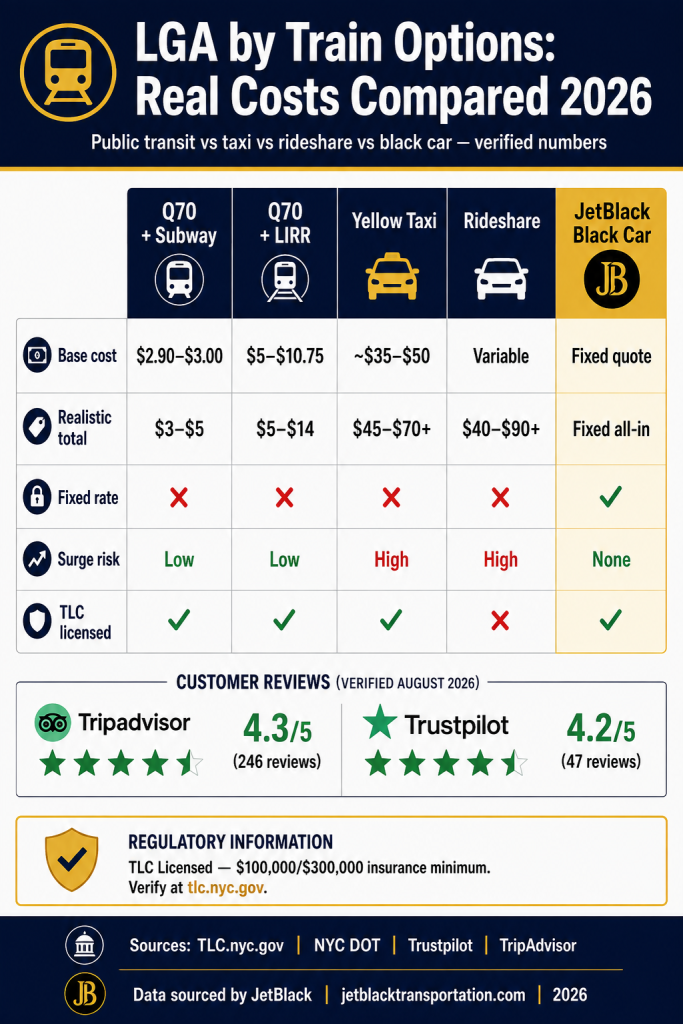
- Review scores: JetBlack holds 4.3/5 on TripAdvisor (246 reviews) and 4.2/5 on Trustpilot (47 reviews) as of August 2026.
- Honest trade-off: Public transit is cheapest but adds luggage friction and schedule risk; a fixed-rate car removes both for travelers who value predictability over the fare savings.
Fact-checked by: Alex Freeman, JetBlack editorial team. Full bio
Last verified: August 20, 2026
You land at LaGuardia, grab your bag, and the first practical question lands with it: is there a train out of here?
There isn’t. LGA by train is still a transfer game. No AirTrain. No subway platform at the terminals. The project that was supposed to fix that was canceled after costs blew past $2 billion. What remains is a free bus that gets you to real trains a few miles away.
For a business traveler on a tight schedule the gap between a smooth exit and a scrambled one shows up fast. This buyer’s guide lays out the actual routes, the real numbers, and the points where the public options start to cost more than they save.
What LGA by Train Really Looks Like
LaGuardia is the only major New York-area airport without a direct rail connection. That fact still surprises people. The free Q70 LaGuardia Link is the required first step. It leaves from Terminals B and C, skips local stops, and drops you at Jackson Heights–Roosevelt Avenue or one stop later at Woodside for the Long Island Rail Road.
From Woodside the LIRR runs into Penn Station or Grand Central Madison in roughly ten to fifteen minutes. That combination is currently the nearest practical version of LGA by train. It is also more physical than a car once you factor in stairs, platforms, and the time spent waiting for the next train.
Under TLC rules, standard black car operators carrying one to seven passengers must maintain at least $100,000 per person and $300,000 per occurrence in liability coverage. Larger vehicles face higher minimums. That regulatory baseline is worth knowing before you decide between public options and a private transfer.
What LGA by Train Actually Costs — Real Numbers, August 2026
The free Q70 plus a subway ride costs only the current OMNY fare of $2.90 to $3.00. If you stay on the Q70 one more stop to Woodside and board the LIRR, the train fare becomes the main cost. CityTicket keeps that leg at $5.00 on off-peak and weekend trains. On weekday peak trains the regular Zone 1 fare is about $10.75. A complete LGA by train itinerary therefore runs $5 to $14 for most people.
Yellow taxis from LGA are metered. There is no flat rate the way there is from JFK. Base meter readings commonly land between $35 and $50 before the RFK Bridge toll, the state congestion surcharge, and the newer CRZ charge are added. Rideshares face the same surcharges plus the risk of surge pricing. A licensed black-car service quotes a single fixed number that already folds those extras in.
| Option lga by train | Base Rate | Tolls/Surcharges | Surge Risk | Fixed Rate? | TLC Licensed? | Realistic Range |
|---|---|---|---|---|---|---|
| Q70 + subway | $2.90–$3.00 | None extra | None | Yes | N/A | $3–$5 |
| Q70 + LIRR | $5.00–$10.75 | None extra | None | Yes | N/A | $5–$14 |
| Yellow taxi | Metered $35–$50 | Tolls + $2.50–$2.75 + $0.75 | None | No | Yes | $45–$70+ |
| Rideshare | Variable | Tolls + $2.75 + $1.50 | High | No | Yes | $40–$90+ |
| JetBlack | Flat rate | Included | None | Yes | Yes | Fixed quote |
One useful finding for anyone still evaluating LGA by train: the rail combo frequently beats a taxi on both time and cost when traffic on the Grand Central Parkway is moving. The advantage disappears the moment bags are heavy or the clock is tight.
Real Passengers, Real Trips: What Customers Actually Experienced
Case Study 1 — May 2026, Trustpilot, 5 stars
The Situation: A delayed flight stretched seven hours past schedule. The traveler landed early morning with almost no sleep left.
What Happened: The company kept communication open throughout the delay. The driver was already waiting when the passenger cleared the terminal. The car was clean and the ride into the city was quiet.
Why It Matters: When a flight falls apart, the ability of the ground operator to stay flexible becomes more valuable than the difference in fare.
Case Study 2 — July 2026, TripAdvisor, 5 bubbles
The Situation: A standard arrival looking for a clean, professional transfer into Manhattan.
What Happened: The vehicle was well maintained, the driver handled the route efficiently, and the conversation stayed light and useful. The passenger noted the moonroof and the sound system as unexpected upgrades after a long flight.
Why It Matters: Small details of vehicle condition and driver composure register quickly when you are tired and still have a full day ahead.
Case Study 3 — October 2025, Trustpilot, 5 stars
The Situation: A frequent corporate user who needs early-morning pickups for flights and first meetings.
What Happened: On-time performance held across multiple trips spanning years. The same communication standard and vehicle quality appeared each time.
Why It Matters: Consistency over time is the feature that actually reduces stress for people who fly the same route repeatedly.
Not every review is glowing. A clear pattern in lower-rated comments on Trustpilot points to last-minute cancellations when demand spikes and disagreements over when the waiting clock starts. Both issues are worth clarifying before you confirm a reservation.
How to Book Without Getting Burned — A Practical Checklist
Book with enough lead time. A few hours is usually enough; same-day requests get thinner during heavy conference periods. Check the TLC base license number yourself at the official verification page. Make sure the rate you are quoted is the final number — tolls and both congestion charges already folded in. Ask the operator whether the grace period begins at the scheduled arrival time or at actual landing. That single detail can determine whether you pay waiting-time fees.
Confirm the cancellation window in hours, not vague language. Require the driver name and vehicle details at least thirty minutes before pickup. Always give the flight number. And get at least one other quote so the comparison is real rather than theoretical. These checks apply whether you are still looking at LGA by train options or have moved on to a private car.
Booking Checklist — Save or Screenshot This
- TLC license verified at tlc.nyc.gov/industry/verify-a-license/
- Fixed all-in rate confirmed in writing (tolls + congestion fee included)
- Grace period confirmed: starts at [ ] landing / [ ] scheduled arrival
- Cancellation window: _______ hours for full refund
- Driver name + vehicle details sent at least 30 min before pickup
- Flight number provided to dispatcher
- Quote from at least one other provider obtained for comparison
The Industry in Honest Terms
The New York for-hire market splits into clear tiers. Yellow taxis operate under medallion rules and pure meter pricing. App-based rideshares move the highest volume but leave the passenger exposed to surge. Licensed black-car bases sit between them — pre-arranged, fixed-rate, and held to the same TLC insurance and background standards.
The free Q70 turned into the practical rail connector after the AirTrain project was dropped. LIRR CityTicket pricing makes the Woodside transfer one of the better public values if you want a seat and can live with the schedule. Congestion pricing then layered two separate charges onto any for-hire vehicle that touches the zone south of 60th Street. The bus-and-train route does not carry those fees.
Not every operator claiming to be a black-car service performs at the same level. Transparent all-in pricing, visible TLC credentials, and recent reviews that mention communication during delays are the practical filters. Those details separate companies that treat airport work as core business from those that treat it as overflow. The same filters apply when you are still deciding between LGA by train connections and a private car.
Leaving LaGuardia is ultimately a choice about what you need on that specific day. Cost is only one variable. Time, luggage, and the ability to stay productive on the way into the city are the others. Public options deliver the lowest fare when the bags are light and the schedule has slack. When those conditions disappear, a licensed fixed-rate car removes the variables that turn a simple transfer into a problem.
In the next ten minutes open two different providers, request the same LGA-to-Midtown quote, and ask both the identical grace-period question. The answers will give you clearer information than any single ranking or marketing claim.
FAQ
Is there actually a train at LaGuardia Airport?
No. There is still no train station at LGA and no AirTrain. Every public option requires taking a bus first. When people search for LGA by Train they are really looking for the best bus-plus-rail combination available today.
What is the closest practical option to LGA by Train?
Take the free Q70 LaGuardia Link bus from Terminals B or C to the Woodside LIRR station, then board a train into Penn Station or Grand Central Madison. That sequence is currently the nearest thing to LGA by Train that exists.u003cbru003e
How long does the Q70 + LIRR route take?
When the bus and train connect reasonably well, the total trip runs 25–40 minutes. Add walking time between platforms and any waiting, and most business travelers should plan for closer to 45 minutes door-to-door.u003cbru003e
How much does the public option cost right now?
The Q70 itself is free. The LIRR leg costs $5 with CityTicket (off-peak and weekends) or about $10.75 on weekday peak trains. Total cash outlay for a true LGA by Train itinerary is therefore $5–$11 for most people.u003cbru003e
Is the free Q70 reliable for someone with a tight schedule?
It runs frequently during the day (every 8–10 minutes), but it is still a bus operating in New York traffic. Delays happen. If your meeting starts less than 90 minutes after landing, many business travelers prefer a pre-booked car over gambling on LGA by Train connections.u003cbru003e
Does the Q70 serve every terminal?
u0022It primarily serves Terminals B and C. From Terminal A you usually need a short airport shuttle or the M60 SBS. If you are planning your route to u003cstrongu003eLGA by trainu003c/strongu003e, factor that extra step into your planning if you land at A.u0022
How practical is LGA by Train when you have luggage?
u0022It works if you travel light. A full-size roller bag plus a laptop bag is manageable when taking u003cstrongu003eLGA by trainu003c/strongu003e. Two large suitcases or a family group with multiple bags makes the bus-to-train transfer noticeably more awkward than a door-to-door car.u0022
How do yellow taxis and rideshares compare on cost and reliability?
Yellow taxis run on the meter with no flat rate from LGA, so $35–$55 before tolls and the two congestion surcharges is common. Rideshares add surge pricing on top of the same surcharges. Both can be faster than LGA by Train in light traffic and slower in heavy traffic.u003cbru003e
What does a licensed black-car service offer that public transit cannot?
A fixed all-in price, flight tracking, a driver waiting at the terminal, and no luggage wrestling on buses or platforms. For many business travelers that predictability is worth more than the fare savings of LGA by Train.u003cbru003e
What insurance coverage must a legitimate black car carry?
u0022Under TLC rules, standard black cars (1–7 passengers) must carry at least $100,000 per person and $300,000 per occurrence—offering premium insurance coverage compared to public options like u003cstrongu003eLGA by trainu003c/strongu003e. Always verify the base license at tlc.nyc.gov before you book.u0022
Do congestion pricing charges apply to cars leaving LGA?
u0022Yes. Any for-hire vehicle that enters, exits, or passes through the zone south of 60th Street picks up both the $0.75 CRZ surcharge and the older $2.75 New York State congestion surcharge—extra costs you completely avoid when traveling to u003cstrongu003eLGA by trainu003c/strongu003e. A good black-car quote already includes these.u0022
Should I book a car in advance or wait until I land?
u0022For business trips, book in advance—especially if you want to avoid crowded public transit like u003cstrongu003eLGA by trainu003c/strongu003e. Same-day availability shrinks during conference weeks and peak travel periods. Confirm the all-in price, grace period, and cancellation policy when you reserve.u0022
What is the single most important question to ask when booking?
u0022Whether the grace period starts at scheduled arrival or actual wheels-down—a key detail you don’t have to monitor when taking u003cstrongu003eLGA by trainu003c/strongu003e. The difference can cost you waiting-time fees if your flight is early or late.u0022
When does LGA by Train make the most sense?
u0022When you have light luggage, a flexible schedule, and want to keep costs under $15, taking u003cstrongu003eLGA by trainu003c/strongu003e is a solid, low-cost option for travelers who already know the system and are comfortable with transfers.u0022
When does a private car clearly win?
When you have heavy luggage, a tight meeting, a late arrival, or simply want to work or rest on the way into the city instead of managing platforms and schedules. In those cases the reliability of a fixed-rate car usually outweighs the savings of LGA by Train.
Sources
- Port Authority of NY & NJ. “Public Transportation – LGA LaGuardia Airport.” laguardiaairport.com. Accessed August 2026.
- MTA. “Getting to Manhattan from LaGuardia Airport.” mta.info. Accessed August 2026.
- NYC Taxi and Limousine Commission. “Vehicle Insurance Requirements.” tlc.nyc.gov. Accessed August 2026.
- MTA. “Congestion Relief Zone Toll: Taxis and FHVs.” mta.info. Accessed August 2026.
- Trustpilot. “Jetblacktransportation Reviews.” trustpilot.com. Accessed August 20, 2026.
- TripAdvisor. “Jet Black Transportation Reviews.” tripadvisor.com. Accessed August 20, 2026.
- JetBlack. Official website service and pricing pages. jetblacktransportation.com. Accessed August 20, 2026.
- John Surico. Author bio and published work. johnsurico.com. Accessed August 2026.