
Quick Takeaways
- No Flat Fare: Unlike JFK’s $70 flat taxi fare, an LGA taxi runs on the standard TLC meter — a 2022 proposal for a $39 LGA flat rate was never adopted.
- Realistic Cost: A metered LGA taxi to Midtown runs $50–$75 including surcharges and tip, per TLC fare rules and current rate-card analysis.
- Fixed-Rate Competitor: Carmel Car & Limousine publishes a $46 sedan rate from LGA (tolls and gratuity extra), under TLC license #B00256.
- Congestion Pricing: The MTA’s $0.75 charge for trips touching Manhattan south of 60th Street was upheld by the Second Circuit on July 13, 2026; rideshare platforms pay a separate $2.75 surcharge on the same routes.
- Pricing Transparency Gap: JetBlack publishes a flat $65 JFK rate but no equivalent published LGA figure — riders must request a quote rather than compare a posted number.
- Common Complaint: A recurring theme in JetBlack’s lower-rated Trustpilot reviews concerns pricing clarity — worth confirming an all-in rate before booking.
Fact-checked by: Alex Freeman. Full bio
Last verified: September 27, 2026
You’re standing at the LaGuardia curb with a client who has forty minutes before a downtown meeting, and your phone shows three different price estimates for three different ways to get there. This is the moment every corporate booker eventually hits: the LGA taxi line looks fastest, the rideshare app shows a number that might double before the car arrives, and a black car service is quoting a flat rate that sounds either too good or too high depending on who you ask.
None of the three options behaves the way you’d expect if you’ve only ever flown into JFK. JFK has a flat taxi fare — $70 each way, set by the city. LGA doesn’t. An LGA taxi runs on the meter, the same as a ride across Midtown, and that single fact changes how you should plan, budget, and book for every airport run into Manhattan.
This breakdown is built from live TLC fare rules, current published rates from three ground transport providers, and reviews pulled from Trustpilot and TripAdvisor — not marketing copy, not a single company’s numbers repeated back to you.
What Is LGA Taxi Service — And Why the Distinction from JFK Matters
An LGA taxi is a standard yellow or green cab, dispatched from the airport’s official taxi stand, running New York’s standard metered fare — not a fixed number. That’s the opposite of JFK, where every yellow cab ride to or from Manhattan runs a flat $70, set by the TLC regardless of traffic or route.
LaGuardia never got that treatment. A 2022 TLC proposal would have set a $39 flat fare for LGA-to-Manhattan trips. It was never adopted, and the meter is still running today.
Under TLC rules, standard black car operators (1–7 passengers) must carry a minimum of $100,000 per person and $300,000 per occurrence in liability coverage. Larger vehicles face higher minimums. That figure governs black car and limousine operators, not yellow cabs — but it’s worth knowing before booking any for-hire vehicle, since a widely repeated $1.5 million figure circulating online is simply wrong.
For a corporate booker, the practical implication is this: an LGA taxi fare is not predictable the way a JFK fare is. Budget approvals and expense reports work better with a number you can commit to in advance, which is exactly what a metered LGA taxi doesn’t offer.
What an LGA Taxi Actually Costs — Real Numbers, 2027
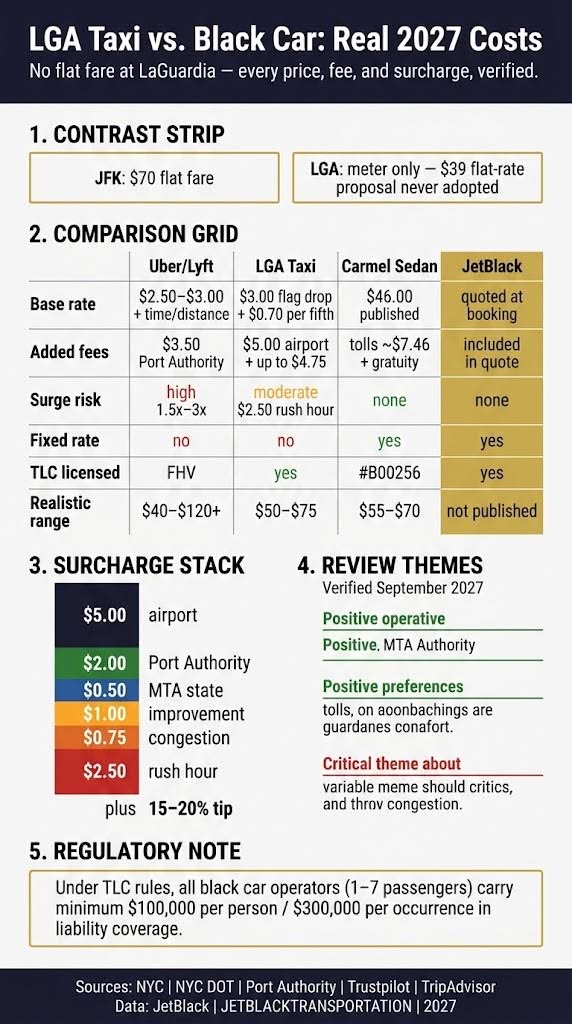
Here’s what stacks onto the meter for every LGA taxi ride: a $5.00 airport surcharge in both directions, a $2.00 Port Authority access fee on pickups, a $0.50 MTA state surcharge, a $1.00 improvement surcharge, and — for trips touching Manhattan south of 60th Street — a $0.75 MTA congestion charge. Add a $2.50 rush-hour surcharge between 4 and 8 p.m. on weekdays, and the meter climbs fast before the car has covered a single mile.
Put together, a realistic LGA taxi fare to Midtown runs $50 to $75 including surcharges and tip, according to current rate-card analysis. Compare that against the three most visible alternatives near the LaGuardia curb.
| Option | Base Rate | Tolls/Surcharges | Surge Risk | Fixed Rate? | TLC Licensed? | Realistic Range |
|---|---|---|---|---|---|---|
| Uber/Lyft (UberX) | $2.50–$3.00 + time/distance | $3.50 Port Authority pickup fee | High — 1.5x–3x during peak | No | FHV-licensed | $40–$120+ |
| LGA Taxi (Yellow/Green Cab) | $3.00 flag drop + metered | $5.00 airport fee + up to $4.75 state/congestion | Moderate — rush-hour surcharge only | No | Yes | $50–$75 |
| Carmel Car & Limousine (Full Size Sedan) | $46.00 published | Tolls (~$7.46 typical) and gratuity extra | None — fixed at booking | Yes | Yes (#B00256) | $55–$70 |
| JetBlack | Quoted at booking | Included in quote per site FAQ language | None — fixed once confirmed | Yes | Yes | Not published for LGA on-site |
One honest gap worth flagging: JetBlack’s own site publishes a flat $65 sedan rate for JFK-to-Manhattan but doesn’t list a comparable published figure for LGA — the rate is generated at booking through the app rather than posted on a rate table. Corporate bookers used to comparing published numbers side by side will need to request a quote rather than read one off the page.
The counterintuitive finding here isn’t which option is cheapest — it’s that the LGA taxi, the option every returning traveler assumes is simple and cheap, is frequently the least predictable of the four once rush hour or a Sunday-evening surge hits. A fixed-rate sedan from a licensed operator often lands in the same dollar range as the taxi, with none of the uncertainty.
An LGA taxi is worth taking when you land off-peak, travel light, and don’t need a rate locked in before landing. It’s a weaker choice when you’re expensing the ride, traveling during the 4-to-8 p.m. window, or need a number you can put on a client’s calendar invite without a caveat.
Seasonal demand changes the calculation too. Around major conventions, holiday travel weeks, and severe weather, an LGA taxi line can stretch past what a rushed corporate booker can absorb, and rideshare surge multipliers tend to spike hardest in exactly those same windows. A fixed-rate sedan booked a day ahead sidesteps both problems — the line and the multiplier — at the cost of losing the walk-up flexibility an LGA taxi offers a traveler with no fixed schedule.

Real Passengers, Real Trips: What Customers Actually Experienced
Case Study 1 — TripAdvisor Reviewer, 5 Stars
The Situation: A traveler switched to JetBlack after repeated problems with rideshare pickups, and their next flight landed two hours behind schedule.
What Happened: The driver was waiting at the designated time despite the delay, with no additional charge applied for the extra wait.
Why It Matters: A grace period that actually holds under a real delay is a detail an expense report can’t capture from a rate card alone.
Case Study 2 — Trustpilot Reviewer
The Situation: A repeat JetBlack customer booked a second trip and was matched with the same driver, Gurmeet, from a prior ride.
What Happened: The reviewer described the car as immaculate and the driver as courteous and professional throughout the trip.
Why It Matters: Driver consistency across bookings is a small detail that rarely shows up in a comparison table but matters for recurring corporate travel.
Case Study 3 — Trustpilot Reviewer, June 2026
The Situation: A passenger booked a standard sedan transfer and noted the driver by name, Alzahiri Mosab.
What Happened: The reviewer called the vehicle extremely clean and comfortable, with safe, unremarkable driving.
Why It Matters: The strongest airport transfer reviews are often the least dramatic ones — nothing went wrong, which is exactly what a corporate booker is paying for.
Not every review is glowing. A pattern in JetBlack’s lower-rated Trustpilot reviews points to pricing clarity — a handful of riders describe costs beyond what they expected at booking, and one detailed a no-show at a stadium pickup that ran past ninety minutes. Worth asking directly: whether the quote you receive is genuinely all-in, and what happens if a driver is delayed.
How to Book Without Getting Burned — A Practical Checklist
Booking lead time matters more at LaGuardia than it sounds. A quote requested the morning of travel locks in whatever availability is left; booking 24 to 48 hours out generally secures both the vehicle and the quoted rate before demand spikes push it up.
TLC verification takes thirty seconds and matters every time: confirm the plate and driver ID against the TLC’s public lookup before getting into any for-hire vehicle at LGA, taxi or otherwise. “Fixed rate” should mean tolls and the MTA congestion charge are already folded into the quoted number — ask directly, because not every provider defines it the same way.
Cancellation policies and grace-period start times vary by company: some start the clock at wheels-down, others at scheduled arrival, and the difference matters when a flight lands early or late.
Booking Checklist — Save or Screenshot This
- TLC license verified at tlc.nyc.gov/industry/verify-a-license/
- Fixed all-in rate confirmed in writing (tolls + congestion fee included)
- Grace period confirmed: starts at [ ] landing / [ ] scheduled arrival
- Cancellation window: _______ hours for full refund
- Driver name + vehicle details sent at least 30 min before pickup
- Flight number provided to dispatcher
- Quote from at least one other provider obtained for comparison
The Industry in Honest Terms — How This Market Actually Works
New York’s for-hire vehicle market is large enough that no single option dominates every trip. Yellow cabs remain the only choice with no app, no account, and no surge — you get in line and go, at whatever the meter reads. Black car and limousine operators like Carmel and JetBlack sit in a separate TLC licensing tier from high-volume rideshare platforms, with fixed-rate quoting as their core pitch against Uber and Lyft’s variable pricing.
Congestion pricing has reshaped the math for all of them. The MTA’s $0.75 charge for trips touching Manhattan south of 60th Street applies to taxis and green cabs; rideshare platforms pay a separate $2.75 surcharge on the same routes — upheld by the Second Circuit on July 13, 2026 — a gap that shows up in the final fare regardless of which app quoted the ride. The Port Authority’s rideshare pickup and drop-off fee, which rose to $3.50 in March 2026, adds a flat cost to every Uber and Lyft trip that a taxi or fixed-rate sedan simply doesn’t carry.
Electric and hybrid vehicles are a growing share of both the taxi and black car fleets serving LGA, a trend regulators expect to continue as replacement vehicles cycle in. Not every black car service delivers on its promises — the honest signal to look for is a published or quickly quoted rate, a real TLC license number you can verify independently, and reviews recent enough to reflect current drivers rather than a service from years past.
For a corporate travel program booking dozens of LGA runs a year, the math tends to favor whichever option produces the fewest surprise line items on an expense report — and an unpredictable LGA taxi fare, however cheap it looks in the best case, doesn’t always win that comparison once the worst case is factored in.
An LGA taxi will always be there, meter running, no reservation required. Whether that’s the right call for a given trip depends less on which option is theoretically cheapest and more on whether you can tolerate the meter’s uncertainty on the day you’re actually traveling.
Get quotes from two providers before your next LGA pickup and ask both the same question: is the rate genuinely all-in, and what starts the grace-period clock. That ten-minute comparison catches more billing surprises than any single company’s marketing page ever will.
FAQ
What is an LGA taxi and how is it different from a JFK taxi?
An LGA taxi is a standard yellow or green cab that runs on New York’s metered fare, unlike a JFK taxi, which charges a flat $70 rate to Manhattan. LaGuardia never got flat-fare treatment; a 2022 TLC proposal for a $39 flat rate was never adopted. Every LGA taxi ride starts at the meter’s base rate and climbs with distance, traffic, and mandatory surcharges. If predictability matters more than a possible off-peak discount, a fixed-rate black car removes that variable.
Is there a flat rate for LGA taxi service to Manhattan?
No, there is no flat rate for LGA taxi service; every ride runs on the standard TLC meter. The TLC considered a $39 flat fare for LaGuardia-to-Manhattan trips in 2022, but the rule was never finalized. Instead, the meter starts at $3.00 plus $0.70 per fifth of a mile, on top of a $5.00 LaGuardia surcharge and several smaller fees. Budget $50 to $75 for a realistic off-peak Midtown trip.
How much does a taxi from LaGuardia to Manhattan actually cost?
A taxi from LaGuardia to Manhattan typically runs $50 to $75 all-in, meter plus surcharges plus tip. That includes a $3.00 flag drop, $0.70 per fifth of a mile, a $5.00 LaGuardia surcharge, a $2.00 Port Authority fee, and smaller state and congestion charges. A $2.50 rush-hour surcharge applies weekdays from 4 to 8 p.m. Because none of this is fixed in advance, a corporate booker who needs a set number is often better served by a published sedan quote instead.
Is tip included in the LGA taxi fare?
No, tip is not included in the meter fare; it’s added separately, the same as any city cab ride. A standard tip runs 15 to 20 percent, roughly $8 to $15 on a $50-to-$75 fare. Cash tips go directly to the driver and don’t have to match the card reader’s suggested percentage.
How do I know if a taxi at LGA is licensed and not a scam?
A licensed taxi at LGA is a marked yellow or green cab from the official taxi stand, with a visible TLC medallion and a working meter — anything else offered inside the terminal is a red flag. CBS New York has documented TLC stings catching unlicensed drivers soliciting passengers at LaGuardia and JFK, including one posing as a shuttle employee. Verify any TLC-licensed vehicle or driver in seconds at tlc.nyc.gov/industry/verify-a-license/.
Is a black car service worth it over a taxi at LaGuardia?
It’s worth it when predictability matters more than shaving a few dollars off the lowest fare, which usually applies to a corporate booker locking in a client pickup. Fixed-rate sedans like Carmel’s $46 LGA rate often land in the same range as a metered taxi once surcharges and tip are counted, without the rush-hour uncertainty. The taxi’s edge is walk-up convenience — no reservation, no app. For a group, a delayed flight, or a fixed pickup window, the fixed rate earns its premium.
How much does a black car service LGA cost compared to a taxi?
About the same once you count the taxi’s full surcharge stack: Carmel publishes a $46 sedan rate from LGA, versus $50–$75 for a metered taxi with tip. The published black car rate excludes tolls and gratuity, so add those before comparing. JetBlack doesn’t post a fixed LGA rate at all — its quote is generated at booking. Request quotes from at least two providers and compare the all-in total.
Is Uber or Lyft cheaper than an LGA taxi?
Off-peak, yes — UberX typically runs $40 to $65 versus the taxi’s $50-to-$75 range — but that edge disappears once surge pricing hits. LaGuardia sees rideshare surge on a meaningful share of business-hour trips, and a $55 fare can climb past $120 with no warning. The taxi’s meter only adds a fixed $2.50 rush-hour surcharge, never a multiplier, though rideshare and taxi both now carry separate pickup fees. If your schedule is flexible, rideshare often wins; if you need a guaranteed number, neither beats a fixed-rate car service.
What is the TLC insurance minimum for black car operators?
Standard black car operators carrying 1 to 7 passengers must hold at least $100,000 per person and $300,000 per occurrence in liability coverage — not the $1.5 million figure that circulates online. Larger vehicles face higher minimums set separately by the TLC. This applies to black car and limousine operators specifically; taxis fall under a different schedule. Confirm any operator’s TLC status at tlc.nyc.gov before booking.
Does congestion pricing add extra cost to a taxi ride from LaGuardia?
Yes — a ride touching Manhattan south of 60th Street picks up a $0.75 MTA congestion charge, upheld by the Second Circuit on July 13, 2026. That stacks with a separate $2.50 state congestion surcharge for yellow cabs on trips through Manhattan south of 96th Street. Rideshare platforms pay a higher $2.75 version of that state surcharge on the same routes. None of these charges are optional — they’re set by public agencies regardless of provider.
How far in advance should a corporate booker reserve LGA car service?
Reserve 24 to 48 hours ahead to secure both vehicle availability and the quoted rate before demand-driven price increases set in. Around conventions, holidays, or weather events, that window tightens and same-day requests can mean paying a premium. Booking early also gives time to confirm grace period terms, cancellation policy, and whether the quote is genuinely all-in.
What happens if my flight into LGA is delayed — will the driver still be there?
With a reputable fixed-rate service, yes — flight tracking adjusts the driver to your actual landing time, and a documented grace period covers the wait at no extra charge. One JetBlack review described exactly this: a flight landing two hours late with the driver still waiting, no added fee. Grace period start times vary by provider — some use wheels-down, others scheduled arrival — so confirm before booking. An LGA taxi has no such mechanism; you simply join the stand line whenever you arrive.
Can I get a fixed, all-in quote before I land at LGA?
Yes, with a black car service — Carmel publishes rate tables in advance, and others like JetBlack generate a fixed quote at booking through the app. A taxi and a rideshare can’t offer the same certainty, since the meter runs regardless and an upfront rideshare price can still shift. Ask specifically whether tolls and the congestion charge are already folded into the quote, since fixed rate isn’t defined the same way everywhere. Get that confirmation in writing before your trip.
Is it cheaper to take a taxi from Manhattan to LGA than from LGA to Manhattan?
Published fares are close either direction, though some fixed-rate providers price the legs slightly differently — Carmel lists $46 from LaGuardia versus $49 to LaGuardia for its full-size sedan. For a metered taxi, direction doesn’t change the fare structure; the same flag drop and per-mile rate apply either way, so traffic and time of day matter more than direction. If booking a round trip with a fixed-rate provider, check both legs’ published rates rather than assuming they match.
Sources
- NYC Taxi and Limousine Commission. “Taxi Fare.” TLC.nyc.gov. Accessed 2026.
- LaGuardia Airport. “Taxi Service.” laguardiaairport.com. Accessed 2026.
- Carmel Car & Limousine Service. “Rates.” carmellimo.com. Accessed 2026.
- RideWise. “Cheapest Way From LGA to Manhattan.” getridewise.com.
- Trustpilot. “JetBlack Transportation Reviews.” trustpilot.com. Accessed 2026.
- TripAdvisor. “Jet Black Transportation Reviews.” tripadvisor.com. Accessed 2026.
- JetBlack Transportation. “Car Service In NYC.” jetblacktransportation.com. Accessed 2026.