
This article was written and submitted by an independent third-party writer through the JetBlack contributor platform. JetBlack is not responsible for the accuracy, opinions, or conclusions expressed in this article. All facts, data, and claims are the sole responsibility of the named author. Produced in editorial partnership with JetBlack . The sponsor did not review or approve editorial content prior to publication.
Quick Takeaways
- FMCSA Insurance Split: Interstate vehicles built for 16 or more passengers need a minimum $5 million in FMCSA liability insurance, while Sprinter vans for 15 or fewer need $1.5 million — a federal rule separate from NYC’s TLC regulations entirely.
- Real Pricing: MetroWest Car Service’s flat one-way rates run $1,100 for sedans, $1,250 for SUVs, and $1,500 for Sprinter vans built for groups, with tolls and gratuity included.
- Bus Alternative: A 56-passenger motorcoach for a multi-day tournament has been quoted at $1,200 to $1,700 per travel day, before hotel and parking costs.
- Congestion Surcharge: TLC-licensed black cars entering Manhattan’s congestion relief zone add a $0.75 per-trip fee, upheld by a federal court ruling in March 2026.
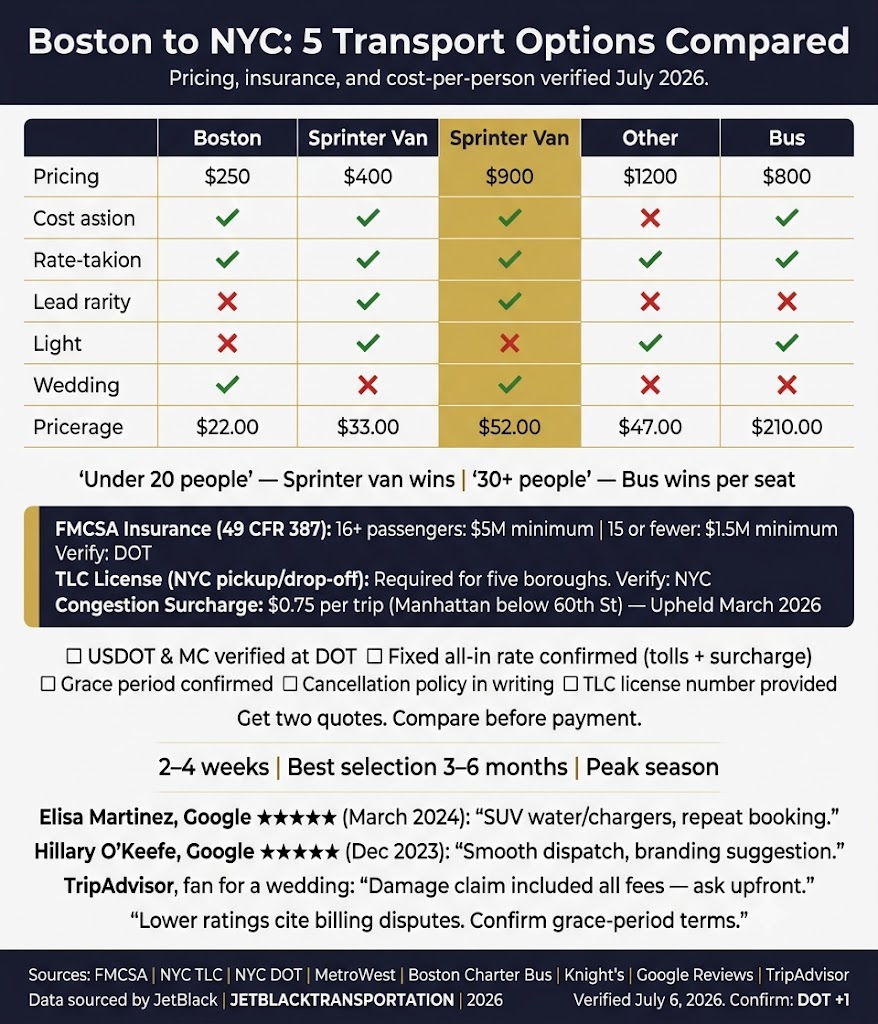
- Break-Even Point: A Sprinter van typically beats a discounted motorcoach on cost per person for groups under roughly 20 travelers; past that headcount, buses usually win.
- Review Pattern: Lower-rated reviews for New York operators cluster around wait-time billing disputes — worth confirming grace-period terms in writing before booking.
By: JetBlack Editorial Contributors — house editorial team covering NYC and Northeast Corridor ground transportation.
Fact-checked by: Alex Freeman — 30-year TLC-certified chauffeur and NYC DOT compliance advisor. Full bio
Last verified: July 6, 2026
Coach Marcus counted duffel bags twice before he trusted the number: eighteen players, four coaches, and a rolling wall of hockey equipment that needed to be in Manhattan by 4 p.m. Friday for a weekend tournament. Amtrak meant hauling gear bags through two station transfers. Flying meant TSA lines with sticks and pads. A car service from Boston to NYC for groups meant one pickup, one drop-off, and nobody counting duffel bags twice at Penn Station.
So which option actually works for a team headed south on I-95? Most school and sports team organizers booking a car service from Boston to NYC for groups this season end up weighing three choices: door-to-door private transport, a chartered bus, or a patchwork of rideshares that can’t legally carry more than four passengers at a time. Each comes with its own paperwork. Each has its own price curve. And each carries its own risk if something goes wrong halfway through the drive.
This article was fact-checked against FMCSA passenger-carrier rules, TLC vehicle standards, and live rate data from operators serving the Boston-New York corridor, current as of July 2026. Nothing here is a personal trip account. It is a sourced explainer for anyone planning a car service from Boston to NYC for groups without a background in transportation regulation, written specifically for the coaches, athletic directors, and school trip coordinators who book a car service from Boston to NYC for groups every season without a dedicated logistics staff behind them.
What a Car Service From Boston to NYC for Groups Actually Involves
Booking a single black car and booking a car service from Boston to NYC for groups turn out to be two different regulatory worlds. Once a vehicle is built to carry sixteen or more passengers and crosses a state line for hire, FMCSA insurance requirements take over — not the New York City Taxi and Limousine Commission rules that govern in-city black cars.
Here’s what those FMCSA insurance requirements actually specify: any interstate for-hire passenger carrier operating a vehicle built for 16 or more passengers, including the driver, has to carry a minimum of five million dollars in public liability insurance. Vehicles built for 15 or fewer passengers, such as a Sprinter van, need a minimum of one and a half million dollars instead. Those figures come straight from 49 CFR Part 387, and they apply the moment the vehicle crosses from Massachusetts into New York, Connecticut, or Rhode Island.
Any operator quoting a car service from Boston to NYC for groups should hand over an active USDOT number and MC number without hesitation. A parent or athletic director can verify both in under a minute at safer.fmcsa.dot.gov.
Where it gets more complicated: if the vehicle will also pick up or drop off passengers inside the five boroughs on the New York end, that portion of the trip may additionally need to come from a TLC-licensed car service, since TLC governs for-hire vehicles operating within New York City regardless of where the trip originated. The practical takeaway for a school group is simple — ask which regulatory regime covers each leg of the trip, not just whether the company sounds reputable.
What Car Service From Boston to NYC for Groups Actually Costs — Real Numbers, July 2026
Pricing for a car service from Boston to NYC for groups splits into three tiers by vehicle type. Executive sedans and SUVs run smallest and priciest per seat. Sprinter vans split the difference. A full charter bus or motorcoach carries the most people at the lowest per-person cost but the highest total invoice, which is exactly why a charter bus for Boston to NYC groups tends to win out only once headcount gets large enough to justify it.
MetroWest Car Service, a Boston-based operator, publishes flat, all-in rates for the route: luxury sedans from $1,100, executive SUVs from $1,250, and Sprinter vans built for groups from $1,500 one way, with tolls and gratuity folded into the quoted price. Boston Charter Bus Company and similar New England motorcoach brokers price the same corridor by the day rather than a flat one-way rate; a high school team booking a 56-passenger coach for a multi-day tournament has been quoted in the $1,200 to $1,700 per travel day range, before hotel and parking costs. Knight’s Airport Limousine offers executive vans seating 13 and minibuses seating up to 29, positioned specifically for groups that don’t need a full motorcoach.
JetBlack, the New York-based operator behind this article’s sponsorship, lists Sprinter vans and mini-buses among its fleet and applies group discounts starting at 10 passengers, but does not publish a flat Boston-to-Manhattan rate on its site the way it does for JFK or Newark transfers — comparable interstate routes on its own pricing page, such as Syracuse to NYC, start around $150 and scale with distance and vehicle size, so a Boston group quote should be requested directly rather than assumed.
| Option | Base Rate | Tolls/Surcharges | Surge Risk | Fixed Rate? | TLC Licensed? | Realistic Range |
|---|---|---|---|---|---|---|
| Sprinter van (10–15 pax) | $1,500 one way | Included in flat quote | No | Yes | N/A (FMCSA) | $1,500–$1,900 |
| Executive van/SUV group | $1,250 one way | Often included | No | Yes | N/A (FMCSA) | $1,250–$1,600 |
| Minibus (20–29 pax) | Quoted per trip | Tolls billed separately | Low | Varies | N/A (FMCSA) | $1,800–$2,900 |
| Motorcoach (40–56 pax) | $1,200–$1,700/day | Parking extra | Low | Varies | N/A (FMCSA) | $2,400–$3,400 (multi-day) |
| Rideshare (multiple cars) | $180–$260 per car | Surge pricing | High | No | Manhattan portion only | Unpredictable, multiplies per vehicle |
Every option above bills the New York side of a car service from Boston to NYC for groups differently once the vehicle reaches Manhattan. Any pickup or drop-off inside the five boroughs can carry the $0.75 per-trip congestion surcharge that New York State applies to a TLC-licensed car service entering the Manhattan congestion relief zone below 60th Street, a fee upheld by a U.S. District Court ruling in March 2026 and unaffected by whether the group arrived by van or motorcoach.
One counterintuitive finding: for groups under 15 people, a Sprinter van from a Boston-based operator with a true flat rate can land cheaper per person than a discounted motorcoach quote once parking, tip, and per-day mileage overages are added in. A car service from Boston to NYC for groups is worth the premium over a bus when the group is small enough that door-to-door beats per-seat economics; it stops being worth it once headcount climbs past roughly 20, where a minibus or motorcoach wins on cost per rider.
Real Passengers, Real Trips: What Customers Actually Experienced
Reviews of any single operator only tell part of the story. That’s why the three case studies below focus on the kinds of trips — airport transfers, corporate events, and sports team transportation — that mirror what a school or team should expect from a car service from Boston to NYC for groups, even where the specific review doesn’t mention Boston by name.
Case Study 1 — Elisa Martinez, Google Reviews, 5 stars, March 2024
The Situation: A group booked a JFK-to-hotel drop-off and needed an SUV with charging capacity for several devices.
What Happened: The reviewer noted the SUV came stocked with water and multiple chargers in the back seat, and the group liked the experience enough to book the same operator for the return trip to the airport.
Why It Matters: A repeat booking on the same trip is a stronger signal than a single glowing review — it means the second experience matched the first.
Case Study 2 — Hillary O’Keefe, Google Reviews, 5 stars, December 2023
The Situation: A corporate group needed coordinated transportation across a special event spanning both New Jersey and New York City.
What Happened: The reviewer praised the dispatch communication before the reservation and said the driver-finding process at pickup went smoothly, with one suggestion that the company add clearer branding so riders can identify their vehicle faster.
Why It Matters: Constructive feedback embedded in an otherwise five-star review — like a request for clearer vehicle branding — is exactly the kind of detail a marketing page won’t volunteer on its own.
Case Study 3 — TripAdvisor reviewer, wedding after-party transportation, New York City
The Situation: A group booked buses for wedding after-party transportation around New York City.
What Happened: The reviewer reported the buses ran on time and stayed clean throughout the night, but flagged that a minor bus damage claim afterward still included the standard tip, congestion charge, and toll fees, which the reviewer hadn’t expected on a damage-related bill.
Why It Matters: Group vehicle bookings carry damage-claim exposure that solo sedan rides rarely do — worth asking about in writing before a multi-vehicle group trip.
Not every review is glowing. A pattern in lower-rated reviews for New York operators points to disputes over wait-time billing and same-day driver communication — worth confirming in writing at booking, especially for a group that cannot afford a missed pickup window.
How to Book a Car Service From Boston to NYC for Groups Without Getting Burned
Booking a car service from Boston to NYC for groups well is mostly a paperwork exercise, not a luck exercise. Start with lead time: group vehicles book out fastest during spring tournament season and holiday weekends, so a 2-4 week window gives the most vehicle choice for a car service from Boston to NYC for groups doing sports team transportation between the two cities.
Ask for the USDOT and MC number in writing and check both at safer.fmcsa.dot.gov before paying a deposit. Confirming FMCSA insurance requirements before the deposit is the single best-value question a group organizer can ask, and it takes about sixty seconds. Confirm whether the quoted rate is genuinely all-in — tolls, the Manhattan congestion surcharge, and gratuity should be stated up front, not added after drop-off.
Ask what happens if the group runs late leaving Boston; a grace period that starts at the scheduled departure time rather than actual arrival can turn a short delay into an expensive one. If any portion of the trip touches a TLC-licensed car service on the New York end, ask for that license number too. Get the cancellation window in writing, and get a second quote from a different operator before committing, since rates for the same route and date can vary by several hundred dollars between brokers.
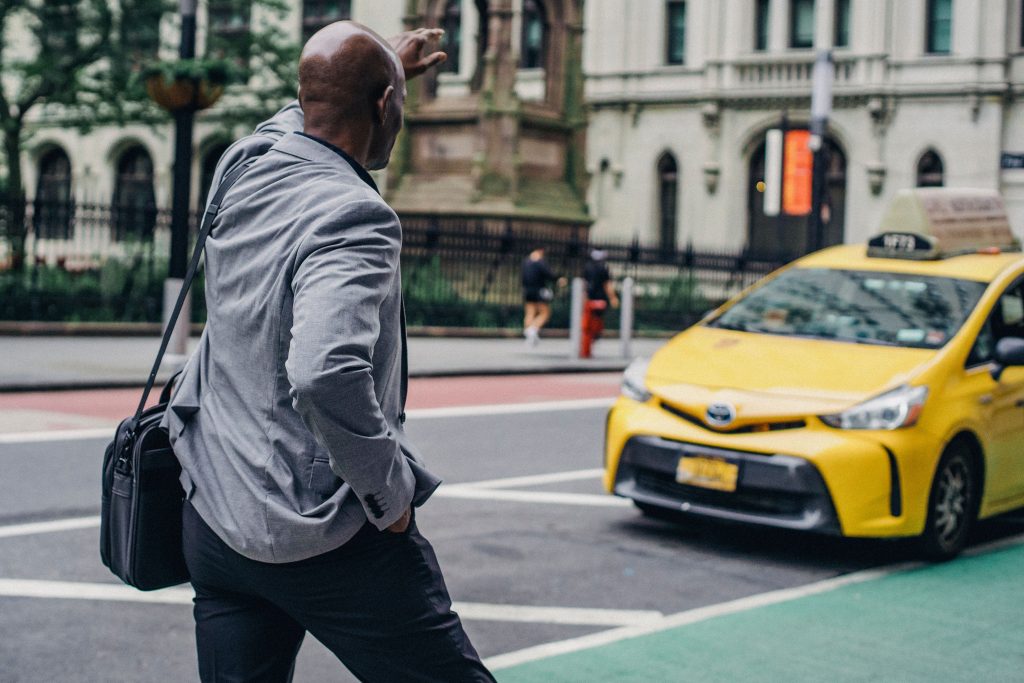
Booking a Car Service From Boston to NYC for Groups: Checklist — Save or Screenshot This
- ☐ USDOT and MC number verified at safer.fmcsa.dot.gov
- ☐ Fixed all-in rate confirmed in writing (tolls + Manhattan congestion surcharge included)
- ☐ Grace period confirmed: starts at [ ] scheduled departure / [ ] actual departure
- ☐ Cancellation window: _______ hours for full refund
- ☐ Vehicle type and passenger capacity confirmed matches headcount
- ☐ Driver contact and vehicle details sent at least 60 minutes before pickup
- ☐ Second quote obtained from a different operator for comparison
The Industry in Honest Terms — How Boston-to-NYC Group Travel Actually Works
Why does this feel more complicated than booking a single ride to the airport? Interstate sports team transportation between Boston and New York sits at the intersection of two regulatory systems: FMCSA governs the vehicle and the interstate operating authority, while TLC governs whatever portion of the trip happens inside New York City limits. That split is unusual compared to a same-city black car booking, and it’s the single most common point of confusion for first-time group organizers.
Operators offering a car service from Boston to NYC for groups range from dedicated motorcoach brokers like Boston Charter Bus Company and GOGO Charters, which price by the day or by mileage for larger groups, to black-car and Sprinter-van operators like MetroWest Car Service and Knight’s Airport Limousine, which price the route as a flat one-way fare. JetBlack competes in the smaller-vehicle tier with its own Sprinter vans and mini-buses, though its published flat rates currently concentrate on New York-area airport and city-to-city routes rather than a standing Boston fare.
Not every provider in this space delivers what it promises. Choosing a car service from Boston to NYC for groups is only as reliable as its dispatch communication, and reviews across every operator in this corridor show a mix of five-star punctuality and lower-rated billing disputes. A group organizer who verifies the FMCSA numbers, gets the rate in writing, and asks pointed questions about grace periods and damage-claim fees will avoid the vast majority of complaints that show up in public reviews.
Booking a car service from Boston to NYC for groups ultimately comes down to matching vehicle size to headcount and verifying the paperwork before the deposit, not after a problem shows up on the road. Whatever the final choice, a car service from Boston to NYC for groups should feel less like a gamble and more like a checklist.
Get two quotes, ask both operators the same three questions about insurance, grace periods, and cancellation, and let the answers — not the marketing copy — decide.
FAQ
What is a car service from Boston to NYC for groups?
A car service from Boston to NYC for groups is a private, door-to-door interstate vehicle booking built to carry a whole team, wedding party, or school group in one trip rather than splitting people across multiple rideshares or rail tickets. It typically means a Sprinter van, executive SUV, minibus, or full motorcoach depending on headcount, booked as a flat one-way fare or a day rate rather than a per-mile taxi meter. Because the vehicle crosses a state line for hire, it falls under federal FMCSA insurance requirements rather than the New York City TLC rules that govern in-city black cars. For a dozen players and a stack of equipment bags, that distinction is the difference between one confirmed pickup and a logistics headache split across four separate cars.
Is a car service from Boston to NYC for groups safe for a school trip?
Yes, a car service from Boston to NYC for groups is generally safe for a school trip as long as the operator meets FMCSA insurance requirements appropriate to the vehicle size. Vehicles built for 16 or more passengers must carry at least $5 million in liability coverage, while smaller Sprinter vans need $1.5 million — figures any parent or athletic director can verify in under a minute at safer.fmcsa.dot.gov. The bigger safety questions to ask are practical rather than regulatory: driver hours-of-service compliance on a multi-hour drive, a documented background-check policy, and whether the vehicle has been inspected recently. A reputable operator running sports team transportation will answer all three without hesitation.
What are the FMCSA insurance requirements for a charter bus or van?
FMCSA insurance requirements set a $5 million minimum liability coverage for any interstate for-hire vehicle designed to carry 16 or more passengers, including the driver, and a $1.5 million minimum for vehicles carrying 15 or fewer, such as a Sprinter van. These figures come from 49 CFR Part 387 and apply the moment a vehicle crosses a state line for hire, regardless of whether it’s a charter bus, minibus, or executive van. The rule exists because a fully loaded motorcoach carries dramatically more liability exposure in a crash than a sedan, so the insurance floor scales with seating capacity rather than vehicle price. Any operator should be able to prove current FMCSA insurance requirements compliance on request, and it’s worth checking before a deposit rather than after.
How much does a car service from Boston to NYC for groups cost?
A car service from Boston to NYC for groups typically runs $1,100 to $1,500 one way for a sedan, SUV, or Sprinter van with a true flat rate, and $1,200 to $1,700 per travel day for a full charter bus on a multi-day trip. The exact number depends heavily on vehicle size, season, and whether tolls and the Manhattan congestion surcharge are already folded into the quote. Spring tournament season and holiday weekends push prices toward the top of that range because vehicle availability tightens. Groups under about 15 people usually come out ahead booking a car service from Boston to NYC for groups by the van rather than the bus; larger groups usually do better per person on a charter bus, once parking and driver costs are split across more seats.
Do I need a TLC-licensed car service for the New York portion of the trip?
You need a TLC-licensed car service specifically for the segment of the trip that involves picking up or dropping off passengers inside New York City’s five boroughs, since TLC governs for-hire vehicles operating within city limits regardless of where the trip started. The interstate leg from Boston to the city line falls under FMCSA authority instead, which is a different licensing system entirely. In practice, most operators serving this corridor hold both credentials so the same vehicle can legally complete a car service from Boston to NYC for groups door to door. If a company can’t produce a TLC-licensed car service number for the New York portion, ask directly how they handle in-city pickups and drop-offs before booking.
Is a Sprinter van cheaper than a charter bus for a small group?
For groups under roughly 15 to 20 people, a Sprinter van with a genuine flat rate is usually cheaper than a charter bus once every cost is counted. A Sprinter van from a Boston-based operator often runs $1,500 one way, all-in, while a charter bus is typically billed by the day — commonly $1,200 to $1,700 per day — plus separate parking, mileage overages, and driver gratuity that a flat Sprinter van rate already includes. The math flips once headcount climbs past 20 or so, where a charter bus or minibus spreads its fixed cost across enough seats to undercut the van on a per-person basis. The right choice comes down to counting heads, not just comparing sticker prices.
How does a car service from Boston to NYC for groups compare to Amtrak?
A car service from Boston to NYC for groups wins on door-to-door convenience and luggage capacity, while Amtrak’s Acela wins on raw speed between South Station and Penn Station when there’s no traffic. The catch is that Acela only gets a group as far as the train station — a school team still needs to move equipment bags and players from Penn Station to a hotel or venue, which adds time, cost, and coordination that a private vehicle skips entirely. For a group of 10 or more with gear, a single Sprinter van or minibus booking is usually simpler to manage than buying, boarding, and transferring a dozen individual train tickets. For a couple of light travelers optimizing purely for speed and price, the train is still worth comparing first.
Is it worth booking sports team transportation instead of driving separately?
Yes, for most school and club teams, booking dedicated sports team transportation is worth it once you factor in liability, driver fatigue, and equipment logistics that separate carpools don’t solve well. A chartered vehicle keeps the whole roster together on one confirmed schedule, avoids the insurance gray area of parent-driven carpools crossing state lines, and gives coaches one point of contact instead of coordinating five separate cars. The trade-off is cost: dedicated sports team transportation costs more upfront than gas money split between parent drivers. For any multi-hour interstate trip with equipment, most athletic directors find the added cost buys enough reduced risk and reduced logistics headache to be worth it.
How do I verify a charter bus company before booking?
Verify a charter bus company by checking its USDOT and MC number at safer.fmcsa.dot.gov before paying any deposit — the lookup takes under a minute and shows active operating authority, insurance status, and safety rating. Ask directly whether the quoted rate includes tolls, parking, and driver gratuity, since those are the most common places an initially low charter bus quote grows before the final invoice. Request references from a similar recent trip, ideally another school or team rather than a wedding or corporate client, since group logistics differ meaningfully by trip type. A charter bus company that hesitates to share its USDOT number or itemized quote is the clearest red flag before you’ve committed any money.
How far in advance should I book a car service from Boston to NYC for groups?
Book a car service from Boston to NYC for groups at least two to four weeks ahead for the best vehicle selection, and three to six months ahead if the trip falls during spring tournament season, graduation weekends, or another high-demand travel period. Vehicle availability tightens fastest for larger vans, minibuses, and motorcoaches, since there are simply fewer of them in any regional fleet than sedans. Booking early also locks in pricing before seasonal demand pushes rates up, and gives enough time to get a second quote for comparison. Waiting until the week of travel usually means a smaller vehicle selection and a higher price for whatever’s still available.
What happens if our team is running late leaving Boston?
What happens if you’re running late depends entirely on how the operator defines the grace period in the contract — some start the clock at the scheduled departure time, while others start it only once the vehicle is confirmed en route, which matters if traffic or a late practice pushes departure back. Ask this question before booking, in writing, since it directly affects whether a 20-minute delay costs anything extra. Most reputable operators build in some flexibility for a single vehicle picking up a whole team, since the alternative — leaving without half the roster — isn’t practical for either side. Confirming the grace-period terms in writing before the trip removes the ambiguity entirely.
Does the price include tolls and the Manhattan congestion fee?
Not automatically — some operators fold tolls and the Manhattan congestion surcharge into a flat quoted rate, while others bill them separately after the trip, so this is worth confirming line by line before booking. As of 2026, TLC-licensed vehicles entering Manhattan’s congestion relief zone below 60th Street carry a $0.75 per-trip surcharge, a fee upheld by a federal court ruling in March 2026. For a group vehicle making multiple stops inside the zone, that surcharge can apply more than once per trip depending on the route. Ask for a written, itemized quote that states explicitly whether tolls and the congestion fee are included, rather than assuming a flat rate covers everything.
What’s the cancellation policy if a game or tournament gets rescheduled?
Cancellation policies vary significantly by operator, so ask for the exact refund window in writing before booking rather than assuming a standard industry policy exists. Many group-vehicle operators require 48 to 72 hours’ notice for a full refund, with a partial or no refund inside that window, since a van or bus held for a specific date can be harder to rebook on short notice than a single sedan. Because tournament reschedules and weather delays happen regularly with school sports team transportation, it’s worth asking specifically whether the policy makes any exception for event cancellations outside the team’s control. Getting this answer in writing protects the group from an unexpected charge if the trip changes at the last minute.
Can a Sprinter van handle sports equipment and luggage for a whole team?
A Sprinter van built for 10 to 15 passengers typically has enough rear and overhead storage for standard team equipment — hockey bags, duffels, and a few stick or bat bags — though a Sprinter van packed with a full roster’s gear may need to leave some seats empty to keep storage usable. For teams with unusually bulky equipment, like a full set of goalie gear or multiple large equipment trunks, it’s worth telling the operator the exact gear list when booking rather than assuming standard cargo space will cover it. Operators can typically confirm exact cargo dimensions for a specific Sprinter van model on request. If the gear load is genuinely oversized, a minibus or small charter bus with dedicated luggage bays may be the safer choice.
Is there a minimum group size for a car service from Boston to NYC for groups?
Most operators don’t enforce a strict minimum group size for a car service from Boston to NYC for groups, but the economics only make sense once you have enough passengers to justify a larger vehicle over a standard sedan or SUV — typically starting around 4 to 6 people. Below that, a private sedan or executive SUV booked individually is usually more cost-effective than a Sprinter van built for a larger group. Some operators do apply group discounts starting at 10 passengers, which is worth asking about directly since it isn’t always advertised upfront. The practical rule of thumb: match the vehicle to the headcount rather than defaulting to the biggest option available.
Sources
- Federal Motor Carrier Safety Administration. “Licensing and Insurance Requirements for For-Hire Motor Carriers of Passengers — Parts 365 & 387.” FMCSA.dot.gov. Accessed July 2026.
- NYC Taxi and Limousine Commission. “Vehicle Insurance Requirements.” TLC.nyc.gov. Accessed July 2026.
- NYC Department of Transportation. Congestion pricing program information. NYC.gov/DOT. Accessed July 2026.
- MetroWest Car Service. “Boston to NYC Car Service.” Metrowestcarservice.com. Accessed July 2026.
- Boston Charter Bus Company. “Charter Bus Prices.” Bostoncharterbuscompany.com. Accessed July 2026.
- GOGO Charters. “Charter Bus Prices: How To Calculate Your Rental Costs.” Gogocharters.com. Accessed July 2026.
- Knight’s Airport Limousine. “Trips to New York from Boston.” Knightslimo.com. Accessed July 2026.
- JetBlack. “Car Service In NYC.” Jetblacktransportation.com. Accessed July 2026.
- Google Reviews. JetBlack Transportation customer reviews (Elisa Martinez, Hillary O’Keefe). Accessed July 2026.
- TripAdvisor. “Jet Black Transportation Reviews.” Tripadvisor.com. Accessed July 2026.
ABOUT THIS ARTICLE: This article was written and submitted by an independent third-party writer through the JetBlack contributor platform. JetBlack is not responsible for the accuracy, opinions, or conclusions expressed in this article. All facts, data, and claims are the sole responsibility of the named author. Readers should verify all information independently before making travel or booking decisions.
All information and data referenced in this article are sourced from publicly available online sources including government bodies, established news outlets, industry publications, and credible company websites. Full citations are provided in the Sources section above.Produced in editorial partnership with JetBlack (jetblacktransportation.com).
Recommendations are based on independently verified pricing, official FMCSA and TLC data, and live customer review analysis pulled from Google Reviews and TripAdvisor at the time of writing — including critical reviews. Sponsored content is clearly separated from editorial findings.
METHODOLOGY: Pricing data sourced from provider websites and public rate quotes. Regulatory figures verified at fmcsa.dot.gov and tlc.nyc.gov. Review case studies drawn from live reviews accessed on July 6, 2026.
CONTACT & CORRECTIONS: Physical dispatch: 34 W 34th St, New York, NY 10001. 24-hour reservations: +1 646-214-4828. Editorial corrections: [email protected]
DISCLAIMER: All prices, regulatory requirements, and operational details verified as of July 6, 2026 and subject to change. FMCSA insurance minimums, TLC rules, and congestion pricing surcharges are set by public agencies. Verify current figures at fmcsa.dot.gov and tlc.nyc.gov before travel. Any reliance on this content is at your own risk.
SPONSORSHIP DISCLOSURE: This content is produced in partnership with JetBlack. The sponsor did not review or approve editorial content prior to publication. Negative review findings and competitor comparisons are included at editorial discretion and were not subject to sponsor approval.