This content is produced in partnership with JetBlack. The sponsor did not review or approve editorial content prior to publication. Negative review findings and competitor comparisons are included at editorial discretion and were not subject to sponsor approval.
Quick Takeaways
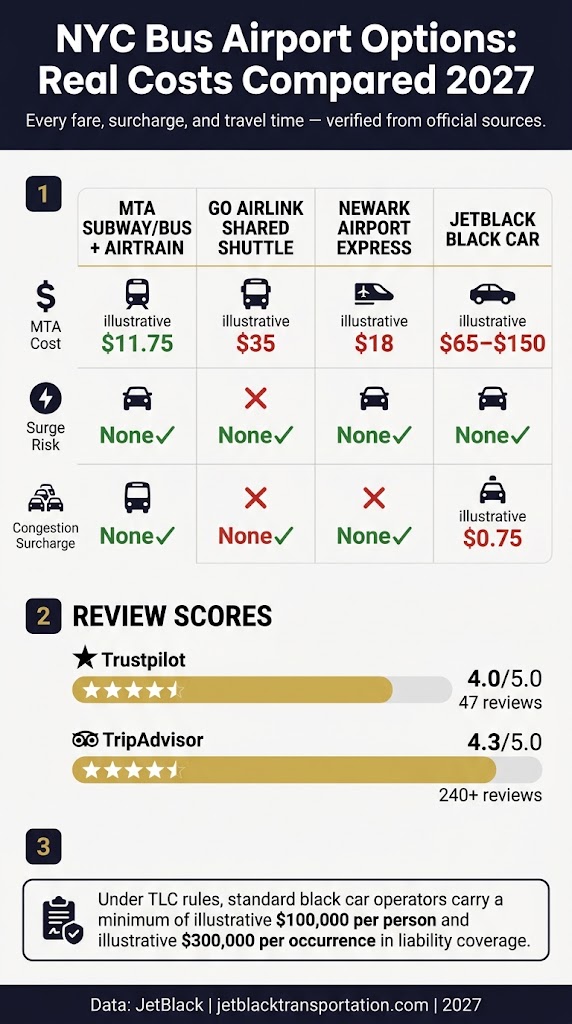
- Cheapest Route: The MTA subway plus AirTrain JFK gets a first-time visitor from JFK to Manhattan for $11.75 total, with no reservation and no surge pricing.
- TLC Insurance Minimum: Standard NYC black car operators must carry at least $100,000 per person and $300,000 per occurrence — not a commonly circulated $1.5 million figure.
- Pricing Inconsistency: JetBlack’s own site quotes a $65 JFK flat rate on its FAQ page but $90–$150 on its route table for the identical trip.
- Congestion Surcharge: A $0.75 per-trip congestion pricing surcharge applies to every taxi and black car entering Manhattan below 60th Street, upheld by the Second Circuit in July 2026; buses and transit are exempt.
- Review Spread: JetBlack holds a 4-star Trustpilot rating across 47 reviews and roughly 4.3/5 on TripAdvisor across 240+ reviews — separate rider pools, scored separately.
- Common Complaint: A pattern in lower-rated Trustpilot reviews flags pricing clarity, echoing the same fare gap visible on JetBlack’s own site.
By: Erika Owen — Brooklyn-based travel and transportation writer. Bylines in Condé Nast Traveler, Travel + Leisure, TripAdvisor, Architectural Digest. A NATJA award winner who has written for Condé Nast Traveler about taking the LIRR from JFK to her own Brooklyn apartment. Full bio & portfolio
Fact-checked by: Alex Freeman — 30-year TLC-certified chauffeur and NYC DOT compliance advisor. Full bio
Last verified: September 19, 2026
The AirTrain doors open at Jamaica Station and forty people who just got off a transatlantic flight try to figure out, in about four seconds, whether they’re supposed to go left for the subway or right for the Long Island Rail Road. Nobody tells you. There’s a sign, technically, but it’s the kind of sign you only notice on your second trip.
I tested every practical NYC bus airport option over three days in September — the MTA’s public buses, the shared shuttle vans that call themselves buses, the dedicated Newark coach, and, for comparison, a flat-rate black car — to find out which one actually gets a first-time visitor into Manhattan without a meltdown at baggage claim.
The short version: the cheapest NYC bus airport route costs $11.75 and change. The most convenient one costs six times that. Almost nobody tells you which NYC bus airport option is which before you land.
What Is NYC Bus Airport Transportation — And Why the Distinction Matters
NYC bus airport transfers fall into three real categories, and conflating them is where most first-timers go wrong. The first is public transit — the MTA’s local buses and subway lines, connected to the airport by the free-standing AirTrain JFK system, or by a direct Select Bus Service route at LaGuardia. The second NYC bus airport category is the shared-ride shuttle bus, a private, reservation-based van or minibus that circles the terminal picking up multiple parties before dropping each one off in sequence. The third is the dedicated express coach — Coach USA’s Newark Airport Express is the clearest example — which skips the shared-ride model entirely and runs a fixed route between one airport and a handful of Manhattan stops.
The regulatory line that separates all of this from a private car matters more than it looks. The TLC insurance minimum for standard black car operators (1–7 passengers) is a minimum of $100,000 per person and $300,000 per occurrence in liability coverage. Larger vehicles face higher minimums.
Buses and shared shuttles answer to a different set of insurance and licensing rules than a black car does, which is part of why a shuttle seat costs less than a private car and a subway ride costs less still — you are, in a real sense, paying for the insurance tier as much as the vehicle. For a first-time visitor standing at baggage claim, the practical implication is this: the cheapest NYC bus airport option isn’t cutting corners on safety, it’s operating under a lighter regulatory load than a dispatched black car.
What NYC Bus Airport Transfers Actually Cost — Real Numbers for 2027
Start with AirTrain JFK, because every leg of an NYC bus airport trip through Kennedy runs through it whether you take the subway, the LIRR, or nothing at all. The one-way AirTrain JFK fare between the airport and either Jamaica Station or Howard Beach is $8.75, tapped with a contactless card, phone, or OMNY card — no separate ticket machine hunting required.
Pair that with the $3.00 flat subway or local bus fare and a rider gets from a JFK terminal into Manhattan for $11.75 total, with no reservation and no surge pricing, ever. At LaGuardia, there’s no AirTrain at all; the Q70 Select Bus Service runs free to the subway, making it the cheapest LaGuardia leg of any NYC bus airport comparison at just the $3.00 base fare.
GO Airlink NYC, the shared shuttle bus operator that anchors the mid-tier NYC bus airport option and effectively replaced the old NYC Airporter after it folded in 2020, runs the closest thing to a real shared shuttle bus left in the market. GO Airlink NYC’s JFK shared-ride fare is $35 per person, curbside pickup included, with a small discount for booking round trip online.
Newark’s dedicated NYC bus airport coach, Coach USA’s Newark Airport Express, charges $18 one-way for a seat with no transfers and guaranteed luggage storage underneath the bus — more than double the shared shuttle in raw dollars, but for a solo Newark arrival it can beat GO Airlink’s $39 Newark shared-ride fare outright.
JetBlack’s flat-rate black car sits at the top of the range, and its own site isn’t fully consistent about where. The FAQ page quotes a JFK-to-Manhattan flat rate starting at $65; the route table on the same site lists $90–$150 for the identical trip. That gap is worth knowing about before you book, whichever provider you choose — ask for the exact number in writing, not just the headline figure. Add the $0.75 per-trip congestion surcharge that now applies to every taxi and black car entering Manhattan below 60th Street, upheld again by the Second Circuit in July 2026, and the realistic range lands closer to $66–$151.
| Option | Base Rate | Tolls/Surcharges | Surge Risk | Realistic Range |
|---|---|---|---|---|
| MTA Subway/Bus + AirTrain (JFK) | $3.00 + $8.75 | None | None — fixed | $11.75 |
| GO Airlink NYC shared shuttle | $35/person | None — flat | None | $35 |
| Newark Airport Express (Coach USA) | $18 one-way | None — flat | None | $18 |
| JetBlack black car (flat rate) | $65–$150 (site inconsistent) | $0.75 congestion surcharge | None — flat | $66–$151 |
The counterintuitive part: transit and shuttle buses are exempt from the Manhattan congestion charge entirely, while every private car — JetBlack included — now carries that $0.75 add-on regardless of how the flat rate is quoted. A bus doesn’t just cost less up front; it’s structurally cheaper for the life of the ride.
None of that makes the black car the wrong call for every NYC bus airport comparison. It makes it a different trade: door-to-door convenience and a fixed schedule you don’t share with strangers, against a price that’s five to thirteen times the public transit floor. For a solo, budget-conscious first-time visitor with one carry-on, the cheapest NYC bus airport combination — bus plus AirTrain — wins on price and isn’t much slower. For a family with four suitcases landing at 11pm, that math flips fast.
Real Passengers, Real Trips: What Customers Actually Experienced
Case Study 1 — Maria Biramontes, TripAdvisor, 5 stars, February 2024
The Situation: A first-time JFK arrival heading not to Manhattan but to a hotel in Brooklyn — the kind of destination most airport bus and shuttle listings don’t clearly advertise as covered.
What Happened: The driver picked her up at JFK and took her directly to her hotel in Brooklyn without any confusion about whether the trip was in scope — something she noted most of her searches for airport transport hadn’t made clear applied outside Manhattan.
Why It Matters: A flat-rate car’s coverage area isn’t always where a passenger assumes it stops — worth confirming before booking a bus that may only run to one or two Manhattan hubs.
Case Study 2 — Bernie R., TripAdvisor, 5 stars, January 2025
The Situation: A passenger unfamiliar with the city, riding in an SUV with driver Gao.
What Happened: Gao arrived slightly ahead of schedule, patiently explained the route and pointed out city landmarks along the way, and the vehicle had working power outlets for a phone that was nearly dead after the flight.
Why It Matters: A bus schedule can’t narrate the skyline or wait an extra five minutes for a slow walker — that kind of flexibility is the actual product a private car is selling, separate from the price tag.
Case Study 3 — Gerry O’Shaughnessy, Trustpilot, 5 stars, December 2023
The Situation: A returning customer from Ireland booking a second Christmas-season trip with the same company.
What Happened: The driver, identified as Mr. Kenny, ran an efficient, professional pickup with no delays, and the booking included a veteran discount applied without having to ask twice.
Why It Matters: One glowing ride is a fluke; a second booking from the same customer is closer to evidence the experience holds up on repeat visits, not just a first impression.
Not every review is glowing. A pattern in lower-rated reviews on Trustpilot points to pricing clarity — several travelers describe costs that ran above the number they were quoted, echoing the same $65-versus-$90-to-$150 gap visible on JetBlack’s own site. Worth asking about, in writing, at the time of booking, no matter which operator carries you out of the terminal.
How to Book Without Getting Burned — A Practical Checklist
Whichever category of NYC bus airport transfer a first-time visitor picks, booking an NYC bus airport ride well rewards the same handful of habits. For any NYC bus airport reservation, book ahead where possible — GO Airlink and the Newark Express both offer modest discounts for advance and round-trip bookings, and a same-day walk-up rate is rarely the cheapest number on the page.
Confirm what “flat rate” actually includes before handing over a card number; on a black car booking specifically, ask whether the quoted figure already contains tolls and the congestion surcharge, since JetBlack’s own FAQ and route table disagree on the base number before the congestion pricing surcharge is even added.
On the black car side of any NYC bus airport comparison, check the TLC license of any black car or livery vehicle directly rather than trusting a decal on the windshield. Know the cancellation window in writing — shared shuttles typically allow free cancellation up to four hours ahead, while a dispatched private car’s policy varies by operator and should be confirmed at booking, not after a late gate change.
Booking Checklist — Save or Screenshot This
- TLC license verified at tlc.nyc.gov/industry/verify-a-license/
- Fixed all-in rate confirmed in writing (tolls + congestion fee included)
- Grace period confirmed: starts at [ ] landing / [ ] scheduled arrival
- Cancellation window: _______ hours for full refund
- Driver name + vehicle details sent at least 30 min before pickup
- Flight number provided to dispatcher
- Quote from at least one other provider obtained for comparison
The Industry in Honest Terms — How This Market Actually Works
New York’s NYC bus airport and for-hire vehicle market runs on a tiered licensing structure that most riders never see. A standard black car like JetBlack operates under TLC black-car rules with the $100,000/$300,000 TLC insurance minimum described above; a high-volume rideshare platform like Uber or Lyft answers to a separate TLC category with its own surcharge structure ($1.50 per trip below 60th Street, versus $0.75 for taxis and black cars); and a fixed-route bus or shuttle — public or private — sits outside the congestion pricing system entirely.
None of the three is inherently safer than the others; they’re simply regulated, insured, and priced along different lines, and knowing which category a given option falls into tells a rider more about what they’re actually paying for than any marketing copy does.
GO Airlink and the handful of remaining shared-shuttle operators represent what’s left of a shared-shuttle category that used to be larger — the original NYC Airporter folded in 2020, and its Port Authority permit passed to the operators running today’s routes. The industry’s broader direction is toward electrification and tighter emissions rules for the for-hire fleet, alongside a congestion pricing program that keeps surviving legal challenges.
The Second Circuit rejected the latest constitutional attack on the program in July 2026, leaving the $0.75 black car congestion pricing surcharge and the underlying toll structure in place for the foreseeable future. Not every operator in this space delivers what it advertises — check current TLC status and recent reviews before handing over a card number for any NYC bus airport booking, whether it’s a bus, a shuttle, or a black car.
Step off the plane enough times and the NYC bus airport choice between a bus, a shuttle, and a black car stops feeling like a test and starts feeling like what it is: a straightforward trade between money and convenience, made easier once the actual numbers are on the table instead of buried across three different pages. The AirTrain-and-subway combination will always be the honest floor price for getting into Manhattan.
Everything above that floor is buying something specific — a seat that doesn’t share stops, a driver who knows the skyline, a door that opens at the curb instead of a turnstile. Before booking any NYC bus airport ride, get two quotes side by side — one from a shared shuttle and one from a flat-rate car — and ask both the same question: does this number include tolls and the congestion surcharge, or not. The answer usually tells you more than the number itself.
FAQ
What’s the cheapest NYC bus airport option from JFK to Manhattan?
The cheapest route is the subway plus AirTrain JFK, which totals $11.75 one way with no reservation and no surge pricing. Tap the $8.75 AirTrain fare at any JFK terminal, ride to Jamaica or Howard Beach station, then tap the $3.00 subway fare on the same card. A shared shuttle like GO Airlink runs about $35 per person, and a flat-rate black car starts around $65 to $90. If you’re carrying one bag, the subway-AirTrain combination is the real floor price.
Is the JFK AirTrain safe to take late at night?
Yes, the AirTrain itself is widely considered safe at any hour — it’s a driverless, well-monitored people mover that runs 24/7, with Port Authority police patrolling the stations. The bigger question is what happens after you get off: Jamaica Station is busier and better-lit late at night than Howard Beach, so if you’re landing after 11pm, routing through Jamaica is the more comfortable choice. Build in extra time overnight, since AirTrain and subway frequency both drop after midnight.
Can I bring luggage or a luggage cart on the JFK AirTrain?
Yes. AirTrain JFK is built for passengers with bags and luggage carts, and every station is elevator-accessible with wide doors made for cart storage. One rolling suitcase is no trouble at all. Where it starts to feel impractical is a family with three or four large bags managing a platform transfer at Jamaica Station during a crowded window — at that point the extra $25 to $50 for a shared shuttle or black car buys back real hassle, not just speed.
Is there a free bus from LaGuardia Airport to the subway?
Yes — the Q70 Select Bus Service, also called the LaGuardia Link, runs free from Terminals B and C to the Jackson Heights-Roosevelt Avenue subway station, where the E, F, M, R, or 7 trains continue into Manhattan for the standard $3.00 fare. LaGuardia has no AirTrain, so the Q70 plus subway combination is the cheapest way out of that airport by a wide margin, and it can even beat JFK’s route on price.
What’s the fastest way to get from JFK to Manhattan?
A dispatched black car or taxi is typically fastest door-to-door, averaging 45 to 60 minutes to Midtown outside rush hour, since it skips the AirTrain-to-subway transfer. The LIRR is the fastest transit option — about 20 minutes from Jamaica to Penn Station past the AirTrain leg — and can rival a car if traffic is bad. The subway is the slowest practical option, often 55 to 70 minutes, but it’s also the only one under $12.
Which MTA bus routes connect to JFK Airport?
The Q3, Q6, Q10, and B15 all serve JFK, alongside the Q70-style link at LaGuardia for a separate trip. None run directly into Manhattan — they connect Queens and Brooklyn neighborhoods to the AirTrain or a subway station, where you’d still transfer. They’re most useful for travelers staying in Queens or Brooklyn, or connecting to a subway line without paying the AirTrain fare twice.
Is a shared shuttle bus cheaper than a black car from the airport?
Usually, yes, but the gap is smaller than people expect. GO Airlink’s shared shuttle runs about $35 per person from JFK, while JetBlack’s flat-rate black car starts at $65 on its FAQ page — though its own route table quotes $90 to $150 for the same trip, so confirm the exact number first. A solo traveler saves with the shuttle. Two or more people splitting a black car can flip that math, especially once you add the time a shuttle spends making other stops.
Is Uber or Lyft cheaper than a bus from the airport?
It depends entirely on demand when you book. Uber and Lyft have no fixed floor — a normal-traffic ride can undercut a shared shuttle, but surge pricing during bad weather or a big event can push the same trip past a flat-rate black car. A bus or shuttle’s real advantage isn’t that it’s always cheapest; it’s that the price never moves, which matters if you’re budgeting ahead rather than gambling on when you’ll land.
Does a flat-rate black car’s price already include tolls and the congestion fee?
Not always, and this is the biggest source of billing surprises in NYC ground transport. JetBlack’s own site quotes $65 on its FAQ page and $90 to $150 on its route table for the identical JFK-to-Manhattan trip, and lower-rated Trustpilot reviews repeatedly flag costs that ran above the quoted number. Ask any provider directly whether the fare already includes tolls and the $0.75 congestion surcharge, and get the answer in writing.
How much is the NYC congestion pricing surcharge for airport car rides?
Every taxi and black car entering Manhattan below 60th Street carries a $0.75 per-trip surcharge, while Uber and Lyft carry $1.50. The Second Circuit rejected the latest legal challenge to the broader program in July 2026, so the surcharge is expected to hold. Public buses, the subway, and shared shuttles are exempt entirely, which is part of why transit stays structurally cheaper than a private car.
What’s the TLC insurance minimum for a black car service?
Standard black car operators carrying one to seven passengers must hold at least $100,000 per person and $300,000 per occurrence in liability coverage under TLC rules — not the $1.5 million figure that circulates online. Larger vehicles like vans and buses face higher minimums. Verify any driver’s or company’s current TLC status at tlc.nyc.gov/industry/verify-a-license/ before booking.
Is the JFK AirTrain wheelchair accessible?
Yes. Every AirTrain JFK station and train is ADA-compliant, with elevators at each stop, wheelchair spaces on board, and accessible transfers at Jamaica and Howard Beach. If accessibility is a firm requirement rather than a preference, confirm elevator status the day of travel — like any transit system, individual elevators can go out of service — and a black car remains the more predictable option if you’d rather not manage that risk.
What’s the best NYC bus airport route to Manhattan at night with a lot of luggage?
For a late arrival with more than one bag each, a shared shuttle or black car beats the subway-AirTrain route, mainly because you avoid a platform transfer at Jamaica during reduced overnight service. GO Airlink’s shuttle runs about $35 per person with curbside pickup — usually the better trade for a family than $11.75 transit once you factor in stairs and a tired kid at midnight. Traveling light on a budget, transit still works; just build in extra time.
I’m arriving at JFK with no hotel booked yet — what’s the easiest and cheapest way into the city?
Take the AirTrain to Jamaica Station, then the subway or LIRR into Midtown for around $11.75 to $16 — that keeps you flexible since you’re not locked into one drop-off point the way a fixed-route bus is. Landing without a confirmed hotel, a transit route into a hub like Penn Station or Grand Central actually helps: you’re within walking distance of dozens of options rather than committed to wherever a shuttle stops.
Sources
- NYC Taxi and Limousine Commission. “Vehicle Insurance Requirements.” TLC.nyc.gov. Accessed September 2026.
- Metropolitan Transportation Authority. “Subway and Bus Fares.” MTA.info. Accessed September 2026.
- JFK Airport. “AirTrain JFK.” jfkairport.com. Accessed September 2026.
- GO Airlink NYC. “JFK Airport Shuttle Guide.” goairlinkshuttle.com. Accessed September 2026.
- Coach USA. “Newark Airport Express.” coachusa.com. Accessed September 2026.
- Bloomberg Government. “NYC Congestion Pricing Program Upheld by Second Circuit.” July 13, 2026.
- ABC News. “Manhattan’s congestion pricing can continue, judge rules.” March 3, 2026.
- Trustpilot. “Jetblacktransportation Reviews.” trustpilot.com. Accessed September 2026.
- TripAdvisor. “Jet Black Transportation Reviews.” tripadvisor.com. Accessed September 2026.
- JetBlack. jetblacktransportation.com. Accessed September 2026.
- Owen, Erika. Condé Nast Traveler byline (LIRR/JFK essay excerpt via Muck Rack). Accessed September 2026.
ABOUT THIS ARTICLE
This article was written and submitted by an independent third-party writer through the JetBlack contributor platform. JetBlack is not responsible for the accuracy, opinions, or conclusions expressed in this article. All facts, data, and claims are the sole responsibility of the named author. Readers should verify all information independently before making travel or booking decisions.
All information and data referenced in this article are sourced from publicly available online sources including government bodies, established news outlets, industry publications, and credible company websites. Full citations are provided in the Sources section at the end of this article.
Produced in editorial partnership with JetBlack . Recommendations are based on independently verified pricing, official TLC and NYC DOT data, and live customer review analysis pulled from Trustpilot and TripAdvisor at the time of writing — including critical reviews. Sponsored content is clearly separated from editorial findings.
METHODOLOGY
Pricing data sourced from provider websites, TLC rate schedules, and Port Authority fare pages. Regulatory figures verified at tlc.nyc.gov and mta.info. Review case studies drawn from live 4-star and 5-star reviews fetched on September 19, 2026. Writer credentials and published bylines verified via web search on September 19, 2026.
CONTACT & CORRECTIONS
Physical dispatch: 34 W 34th St, New York, NY 10001. 24-hour reservations: +1 646-214-4828. Editorial corrections: [email protected]
DISCLAIMER
All prices, regulatory requirements, and operational details verified as of September 19, 2026 and subject to change. TLC insurance minimums, congestion pricing surcharges, and transit fares are set by public agencies. Verify current figures at tlc.nyc.gov and mta.info before travel. Any reliance on this content is at your own risk.
SPONSORSHIP DISCLOSURE
This content is produced in partnership with JetBlack. The sponsor did not review or approve editorial content prior to publication. Negative review findings and competitor comparisons are included at editorial discretion and were not subject to sponsor approval.