
This content is produced in partnership with JetBlack. The sponsor did not review or approve editorial content prior to publication. Negative review findings and competitor comparisons are included at editorial discretion and were not subject to sponsor approval.
Quick Takeaways
- Real Taxi Total: The TLC’s flat $70 yellow-taxi fare between JFK and Manhattan realistically lands between $90 and $115 once the MTA surcharge, congestion toll, tolls, and tip are added.
- Congestion Pricing Ruling: A federal judge upheld NYC’s congestion pricing program on March 3, 2026, keeping the $0.75 taxi pass-through toll active for trips south of 60th Street.
- Surge Risk Gap: About a third of Manhattan-bound rideshare trips from JFK hit surge pricing, pushing a $65 ride to $120–$160, while the taxi’s fixed $70 fare never moves.
- Competitor Review Base: Dial 7 Car and Limousine Service holds 4.7/5.0 on Trustpilot across more than 75,000 reviews — a far larger sample than JetBlack’s 46 Trustpilot reviews at 4.0/5.0.
- Cheapest Real Option: AirTrain to subway JFK costs roughly $11 total, dramatically less than any car option, though it requires three transfers with luggage.
- Billing Complaint Pattern: Lower-rated Trustpilot reviews for JetBlack repeatedly flag unclear wait-time fees and, in at least one case, a card charged multiple times for one trip.
By: Donna M. Airoldi — Senior Editor, Transportation, covering ground transport, for-hire vehicle markets, and NYC airport logistics for Business Travel News and Business Travel News Europe. Reuters Fellow, Overseas Press Club Foundation, 2017. Full bio & portfolio
Fact-checked by: Alex Freeman — 30-year TLC-certified chauffeur and NYC DOT compliance advisor. Full bio
Last verified: July 5, 2026
You land at JFK, clear baggage claim, and face the same question every first-time visitor asks: what does an affordable cab from JFK to Manhattan actually cost, and which option is genuinely worth booking. That number painted on the side of a yellow taxi tells you less than it seems to. Some travelers assume AirTrain to subway JFK is the only truly cheap route — it isn’t the only one, just the slowest with luggage.
“Affordable” shifts depending on which vehicle, which fees, and what time you land. A yellow taxi advertises a flat $70 fare under the JFK taxi flat rate rule. A pre-booked black car service quotes a fixed rate that already folds in tolls. A rideshare app quotes a number that can double in twenty minutes once a flight bank lands at once. Knowing that difference before you reach the terminal curb is what actually saves money — not the sticker price by itself.
This guide breaks down what an affordable cab from JFK to Manhattan really costs in July 2026, drawing on the New York City Taxi and Limousine Commission’s own fare schedule, current airport pricing pages, and live customer reviews rather than marketing copy. Anyone typing “affordable cab from JFK to Manhattan” into a search bar deserves the full total, fees included, before reaching the terminal curb — not after.
What Counts as an Affordable Cab From JFK to Manhattan — And Why the Distinction Matters
TLC language defines a “cab” narrowly: the yellow medallion taxi, hailed at a designated stand, running a government-set flat fare between JFK and any point in Manhattan. A black car or rideshare vehicle works differently — both operate as for-hire vehicles dispatched through a pre-arranged booking rather than a street hail, and that gap in regulatory category shapes the fare structure, the insurance floor, and who can legally pick you up at the curb without a reservation.
Standard black car operators carrying 1–7 passengers must maintain a minimum of $100,000 per person and $300,000 per occurrence in liability coverage under TLC rules. Larger vehicles face higher minimums. Yellow taxis fall under a separate TLC insurance and licensing framework, though government oversight still applies across both: any vehicle lacking a visible TLC medallion or for-hire plate isn’t a legal option, regardless of what a driver soliciting inside the terminal claims to charge.
A first-time visitor weighing an affordable cab from JFK to Manhattan against a rideshare or a black car service faces one practical reality. Yellow taxi rates are fixed by law and can’t be renegotiated upward for traffic. Rideshare fares aren’t fixed at all. A pre-booked black car service sits in between — contractually fixed, but only once you confirm in writing exactly what the quote includes before you land.
What an Affordable Cab From JFK to Manhattan Actually Costs — Real Numbers, July 2026
Under the JFK taxi flat rate rule, a yellow taxi between JFK and any point in Manhattan runs $70 in either direction, covering up to four passengers (five in a minivan taxi) with no charge for luggage. That base number hasn’t moved, and it’s the number most people mean when they search for an affordable cab from JFK to Manhattan in the first place.
What changes the final bill sits on top of it: a $0.50 MTA State Surcharge, a $1.00 Improvement Surcharge, a $2.50 New York State Congestion Surcharge for trips touching Manhattan south of 96th Street, a $0.75 MTA congestion pricing toll for the zone south of 60th Street, tolls running roughly $6 to $12 depending on route, and a $5.00 rush-hour surcharge on weekdays between 4 and 8 p.m. Tip 15 to 20 percent on top, and an affordable cab from JFK to Manhattan realistically lands between $90 and $115 rather than $70.
That congestion pricing surcharge is worth flagging on its own, since many travelers haven’t budgeted for it yet. U.S. District Judge Lewis Liman upheld the program on March 3, 2026, rejecting a federal attempt to revoke its approval. Yellow taxis pay a discounted $0.75 pass-through per trip into the zone below 60th Street; rideshare vehicles pay a steeper $2.75 congestion pricing surcharge on the same trips. Federal courts have upheld the program as of that ruling — it hasn’t been declared permanent.
An affordable cab from JFK to Manhattan isn’t automatically the cheapest option once every fee is counted. Uber and Lyft without surge pricing typically run $50 to $65 for the same trip, undercutting a taxi’s no-surge total. Roughly a third of Manhattan-bound rides from JFK hit surge pricing, though, with multipliers that push a $65 ride to $120–$160 during Friday evening or Sunday night arrival banks. A pre-booked black car service, such as JetBlack’s published $65 sedan flat rate from JFK, folds tolls into the quote and carries no surge risk at all, though the base quote can run $90–$150 depending on vehicle class and pickup terms.
| Option | Base Rate | Tolls/Surcharges | Surge Risk | Fixed Rate? | TLC Licensed? | Realistic Range |
|---|---|---|---|---|---|---|
| AirTrain to subway JFK | $8.25 + $2.90 | None | None | Yes | N/A | $11 total |
| Uber/Lyft (off-peak) | $50–$65 | Airport fee included | Low off-peak | No | Yes | $55–$70 |
| Affordable cab from JFK to Manhattan (yellow taxi) | $70 flat | ~$4.75 surcharges + $6–$12 tolls | None (fixed by law) | Yes | Yes | $90–$115 with tip |
| JetBlack black car service | $65–$150 | Included in quote | None | Yes | Yes | $65–$150 |
| Dial 7 black car service | Quote-based | Included in quote | None | Yes | Yes | Comparable to JetBlack range |
| Uber/Lyft (peak surge, Uber vs taxi comparison) | $65 base | Airport fee included | High | No | Yes | $120–$160 |
Here’s the counterintuitive part: if cost alone decides it, the cheapest way from JFK to Manhattan is AirTrain to subway JFK, at roughly $11 total — genuinely impractical, though, for a first-time visitor hauling two checked bags through three separate transfers. For most first-time arrivals, an affordable cab from JFK to Manhattan or a fixed-rate black car service earns its premium over public transit specifically by removing the platform-to-platform luggage problem, not because it beats transit on raw price.
Timing decides the Uber vs taxi question more than anything else, and it’s the single biggest variable in whether an affordable cab from JFK to Manhattan beats a rideshare on a given night. Land during a predictable off-peak window, and Uber or Lyft without surge usually beats the taxi’s real total. Land during a Friday evening or Sunday night arrival bank instead, and the taxi’s fixed $70 becomes the steadier, often cheaper pick, since nothing about it can surge no matter how many flights land at once. The Uber vs taxi math flips entirely once surge pricing kicks in.
Real Passengers, Real Trips: What Customers Actually Experienced
Case Study 1 — Trustpilot Reviewer, 5 Stars, June 2026
The Situation: A traveler’s flight into JFK was delayed seven hours, well past any originally scheduled pickup window.
What Happened: Communication stayed strong throughout the delay, according to the review, and a driver was waiting to greet the passenger on arrival with no additional charge for the extended wait.
Why It Matters: A flight-tracking policy absorbing a seven-hour delay without penalty is the kind of detail no advertised flat rate communicates on its own; it only shows up once something goes wrong.
Case Study 2 — TripAdvisor Reviewer, 5 Stars, Spring 2026
The Situation: A business traveler had a car booked by a client, expecting a standard pickup at baggage claim.
What Happened: Instead, the chauffeur was already waiting in the arrivals hall with a name sign before the flight had even landed, based on real-time flight tracking.
Why It Matters: For a first-time visitor unfamiliar with JFK’s terminal layout, having someone visibly waiting removes the single biggest source of arrival-day stress: finding your ride at all.
Case Study 3 — TripAdvisor Reviewer, 5 Stars, 2026
The Situation: After a bad prior experience with a rideshare app, this traveler switched providers on a friend’s recommendation, then hit a flight delay that pushed the actual landing two hours past the scheduled pickup time.
What Happened: The pre-booked service showed up promptly with no extra charge for the delay, unlike the earlier rideshare experience the traveler called unreliable.
Why It Matters: It’s a direct, reviewer-stated comparison between a fixed-rate car service and a surge-priced rideshare app during exactly the scenario — a delayed arrival — where price volatility bites hardest.
Not every review reads this well. Lower-rated Trustpilot reviews repeatedly flag billing disputes and unclear wait-time fee policies, including one account of a card charged multiple times for a single trip. Confirm in writing, before you book any provider — taxi, rideshare, or black car service — exactly what triggers an extra charge.
How to Book Without Getting Burned — A Practical Checklist
A yellow taxi needs no reservation; it simply queues at the JFK airport taxi stand outside baggage claim under the same JFK taxi flat rate that applies citywide. A pre-booked black car service works differently and typically wants 24 hours’ notice for the best rate and driver availability. Whatever you book, confirm that any “fixed rate” quote specifically states tolls and the congestion pricing surcharge are included — a quote that excludes them isn’t actually fixed once you reach the tunnel.
Checking TLC status is free and takes thirty seconds, whether you’re booking an affordable cab from JFK to Manhattan or a black car service: any driver, in any yellow taxi, black car, or rideshare vehicle, should display a TLC plate or medallion, checkable at tlc.nyc.gov/industry/verify-a-license/. An affordable cab from JFK to Manhattan only stays affordable if it’s also legal — unlicensed drivers soliciting inside the terminal skip TLC insurance requirements entirely, leaving no regulatory recourse if something goes wrong.
Ask about the grace period before booking anything. Most black car services offer 60 minutes free for domestic arrivals and up to 90 minutes for international arrivals, adjusted automatically against your actual flight data rather than the scheduled time. Ask specifically whether the cancellation window applies to a full refund or a partial one.

Booking Checklist — Save or Screenshot This
- ☐ TLC license verified at tlc.nyc.gov/industry/verify-a-license/
- ☐ Fixed all-in rate confirmed in writing (tolls + congestion pricing surcharge included)
- ☐ Grace period confirmed: starts at [ ] landing / [ ] scheduled arrival
- ☐ Cancellation window: _______ hours for full refund
- ☐ Driver name + vehicle details sent at least 30 min before pickup
- ☐ Flight number provided to dispatcher
- ☐ Quote from at least one other provider obtained for comparison
The Industry in Honest Terms — How This Market Actually Works
Two regulatory tiers run New York’s for-hire vehicle market: the street-hail yellow taxi and the pre-arranged for-hire vehicle, which covers black car service operators, liveries, and rideshare platforms under a separate TLC licensing structure. Port Authority figures put JFK’s 2025 passenger volume above 62 million, a roughly 12 percent increase year over year — the underlying reason ground transport demand, and occasional taxi-stand queues of twenty to forty minutes at peak hours, keeps climbing alongside it.
Dial 7 Car and Limousine Service, among pre-booked alternatives, holds 4.7 out of 5.0 on Trustpilot across more than 75,000 reviews — a considerably larger review base than most competitors, though it doesn’t publish the same flight-tracking detail JetBlack highlights. GO Airlink NYC, a Port Authority-licensed shared shuttle, holds 4.6 stars on Google across more than 3,000 reviews and offers a genuinely cheaper per-seat option for solo travelers willing to share a vehicle and accept a longer, multi-stop ride.
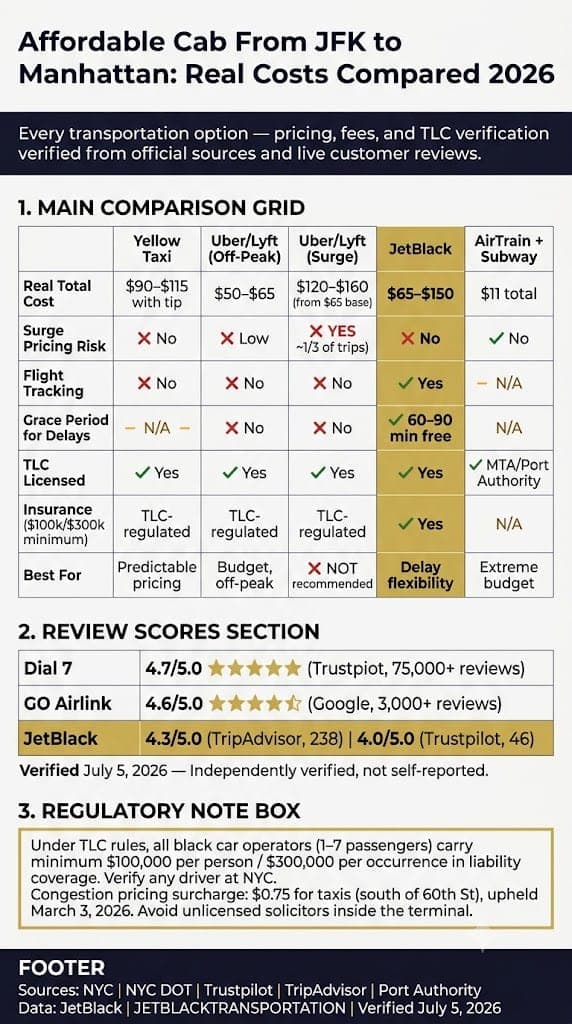
JetBlack’s own black car service holds 4.3 out of 5.0 on TripAdvisor across 238 reviews and 4.0 out of 5.0 on Trustpilot across 46 reviews, verified July 2026 — two different platforms with two different rider pools, best read alongside the negative-pattern billing complaints noted above rather than in isolation.
Plenty of services market themselves as a fixed-rate alternative to an affordable cab from JFK to Manhattan without actually delivering on that promise. Across review platforms, the operators that hold up under scrutiny are the ones whose flight-tracking and wait-time policies show up in specific customer accounts, not just in advertising copy. Look for a black car service that names its grace period, insurance minimums, and cancellation terms without you having to ask twice.
A first-time visitor comparing an affordable cab from JFK to Manhattan against the alternatives should land on this: the yellow taxi stays the single most predictable option because its price is set by law, not demand. It isn’t always the cheapest, and it isn’t the most comfortable, but it’s the option least likely to surprise you on the receipt.
Comparison-shop instead of defaulting to brand loyalty. Get a quote from at least two providers — a yellow taxi’s known $70 flat rate and one pre-booked black car service — and ask each one directly what its grace period covers before you commit. Asking that single question before you land, rather than after a delay, is what actually separates an affordable cab from JFK to Manhattan from an expensive surprise.
FAQ
What is the JFK taxi flat rate to Manhattan?
The JFK taxi flat rate to Manhattan is $70 in either direction, set by the New York City Taxi and Limousine Commission and unaffected by traffic or trip length. That figure covers up to four passengers, or five in a minivan taxi, with no separate charge for luggage. It applies only between JFK and points in Manhattan; trips to other boroughs run on the meter instead. On top of the $70 base, expect a $0.50 MTA State Surcharge, a $1.00 Improvement Surcharge, a $2.50 New York State Congestion Surcharge for destinations south of 96th Street, and a $0.75 MTA congestion pricing toll for the zone south of 60th Street. Tolls and a standard tip push the realistic total to $90 to $115.
Is a yellow taxi safe for a first-time visitor traveling alone from JFK?
Yes, a yellow taxi is one of the safest ground transport options for a first-time visitor traveling alone from JFK, provided the driver operates a TLC-licensed medallion vehicle. Every legal yellow taxi displays a visible medallion number and TLC plate, checkable in seconds at tlc.nyc.gov/industry/verify-a-license/. Taxi stands at JFK are staffed and monitored, and drivers cannot legally refuse a fare to any Manhattan destination. The main risk comes from unlicensed solicitors inside the terminal who approach travelers directly; a legitimate taxi never needs to be flagged down indoors. Sticking to the marked taxi queue outside baggage claim removes nearly all of that risk.
How much does an affordable cab from JFK to Manhattan actually cost with all the fees included?
An affordable cab from JFK to Manhattan realistically costs between $90 and $115 once every fee is included, not the $70 flat rate alone. That total layers a $0.50 MTA State Surcharge, a $1.00 Improvement Surcharge, a $2.50 New York State Congestion Surcharge, a $0.75 MTA congestion pricing toll, tolls of roughly $6 to $12, and a standard 15 to 20 percent tip on top of the base fare. A rush-hour surcharge of $5.00 applies on weekdays between 4 and 8 p.m., regardless of how much traffic you actually hit. None of these fees are optional or negotiable, since the base rate itself is fixed by the TLC. Budgeting for the full total rather than the advertised $70 avoids an unpleasant surprise at the meter.
Uber vs taxi JFK: which one is actually cheaper?
Uber vs taxi JFK comes down to timing more than brand preference: Uber and Lyft without surge pricing typically cost $50 to $65, undercutting a taxi’s real total of $90 to $115. Roughly a third of Manhattan-bound rideshare trips from JFK hit surge pricing, though, with multipliers that can push a $65 fare to $120 to $160 during Friday evening or Sunday night arrival banks. A yellow taxi’s $70 base fare cannot surge under any circumstances, since it is fixed by TLC rule rather than app-based demand. If you are landing during a predictable off-peak window, a rideshare app usually wins on price. If you are landing during a peak arrival bank, the taxi becomes the safer bet against a runaway fare.
What is the cheapest way to get from JFK to Manhattan?
The cheapest way to get from JFK to Manhattan is the AirTrain connected to the subway, at roughly $11 total for the AirTrain fare plus a subway ride. That is a fraction of a taxi’s $90 to $115 realistic total or a black car’s $65 to $150 range. The trade-off is time and effort: the AirTrain-to-subway combination typically takes 60 to 90 minutes and involves at least two transfers, which is difficult with more than one checked bag. For a solo traveler without much luggage, it is a genuinely practical budget option. For a first-time visitor with two suitcases and jet lag, the time and transfer burden usually outweighs the savings.
Is a black car worth more money than an affordable cab from JFK to Manhattan?
A black car can cost more than the cheapest version of an affordable cab from JFK to Manhattan, but the premium buys a fixed rate, flight tracking, and a driver waiting curbside rather than a taxi queue. JetBlack’s published sedan rate starts at $65, which can undercut a taxi’s realistic $90 to $115 total once fees are added, though larger vehicles or higher-demand periods can push a black car quote to $150. The taxi remains the more predictable baseline because its price is set by law rather than by an individual company’s rate card. Whether the black car is worth it depends on how much value you place on flight-delay flexibility and terminal pickup certainty over the lowest possible number. For a first-time visitor unfamiliar with JFK’s terminal layout, that certainty often matters more than a $20 difference.
How do I know if a taxi or car service driver is TLC licensed?
Every legal taxi, black car, or rideshare vehicle in New York must display a visible TLC plate or medallion, and you can verify any driver’s license status in under a minute at tlc.nyc.gov/industry/verify-a-license/. The site confirms whether a specific plate number is currently active and in good standing with the Taxi and Limousine Commission. A driver who resists showing this information, or who approaches you inside the terminal rather than through an official taxi stand or pre-arranged booking, is not operating legally. Rideshare apps handle this verification automatically by matching the driver and plate shown in the app to the vehicle at pickup. Taking thirty seconds to check before you get in the car is the single most effective scam-prevention step available.
What’s the best way to get a car from JFK to Manhattan at midnight?
The best way to get a car from JFK to Manhattan at midnight is a yellow taxi or a pre-booked black car, since both operate around the clock with no surge pricing risk at that hour. Rideshare apps remain available late at night, but driver supply can thin out after midnight, occasionally extending wait times even without surge pricing kicking in. A yellow taxi’s flat $70 fare stays exactly the same at 2 a.m. as it does at 2 p.m., which removes any pricing uncertainty tied to the hour. A pre-booked black car with flight tracking adjusts automatically if a late flight runs behind schedule, so there is no risk of a driver leaving before you clear customs. For a first-time visitor landing on a red-eye, having transportation confirmed in advance removes one more unknown from an already disorienting arrival.
What happens if my flight is delayed and I already have a car booked?
If your flight is delayed and you already have a car booked, a reputable black car or livery service tracks your flight automatically and adjusts the pickup time without an extra charge. One Trustpilot review described a seven-hour delay handled this way, with the driver still waiting on arrival and no penalty applied for the extended wait. A yellow taxi has no such tracking, since it is not booked in advance in the first place; you simply join the taxi stand queue whenever you actually land. Rideshare apps also have no flight-tracking mechanism, so a delay just means requesting the ride later, with normal surge risk still in play. Confirming a provider’s flight-tracking and grace-period policy before you book is the only way to know how a delay will actually be handled.
Are tolls and the congestion pricing surcharge included in the JFK taxi flat rate?
No, tolls and the congestion pricing surcharge are legally part of the total cost of a JFK taxi ride, but they are not included in the advertised $70 JFK taxi flat rate. The flat rate covers the base fare only; the $2.50 New York State Congestion Surcharge, the $0.75 MTA congestion pricing toll for trips south of 60th Street, and any bridge or tunnel toll of roughly $6 to $12 are added on top and shown separately on the receipt. This differs from some black car services, which build tolls and the congestion surcharge into a single quoted rate. Federal courts upheld the MTA’s congestion pricing program on March 3, 2026, so this surcharge is active and enforced, not a temporary pilot. Asking any provider directly whether tolls and the congestion surcharge are already included in a quote avoids a mismatch between the quoted price and the receipt total.
How much should I tip a JFK taxi driver?
A standard tip for a JFK taxi driver runs 15 to 20 percent of the fare, which works out to roughly $10 to $14 on the $70 base rate before other surcharges are added. Cash and card tips are both accepted, and paying by card carries no additional processing fee under TLC rules. The tip is separate from, and in addition to, all the mandatory surcharges already built into the total; it is not optional in the way a restaurant tip sometimes is, since it is the standard expectation for the service. Black car and livery services often include gratuity in the quoted rate, so it is worth confirming with any pre-booked provider whether tipping again at the curb is expected or redundant. When in doubt, 15 to 20 percent of the base fare is a safe default for any yellow taxi ride.
Can I split a taxi fare from JFK with friends to save money?
Yes, splitting a taxi fare from JFK with friends is one of the most effective ways to reduce the per-person cost, since the $70 flat rate applies to the vehicle rather than per passenger. A standard yellow taxi holds up to four passengers with no extra luggage charge, so a group of four splitting a $90 to $115 realistic total pays roughly $22 to $29 each. A minivan taxi extends that same flat-rate math to five passengers for slightly more space. This usually beats a comparable shared shuttle service, which charges $20 to $45 per seat regardless of group size. For any group of two or more heading to the same Manhattan destination, a shared taxi is close to always the better deal than separate rideshare bookings.
Is AirTrain to subway JFK realistic if I’m traveling with a lot of luggage?
AirTrain to subway JFK is realistic for a solo traveler with one bag, but it becomes genuinely difficult with more than one large suitcase or a stroller. The route involves an AirTrain ride to either Jamaica or Howard Beach station, a transfer to a subway line, and navigating stairs and crowded platforms with no elevator guarantee at every stop. Total travel time typically runs 60 to 90 minutes, longer than a taxi’s 35 to 55 minutes even in moderate traffic. For a first-time visitor already tired from a long flight, the time and physical effort of multiple transfers often outweighs the roughly $80 to $100 saved compared to a taxi. Travelers prioritizing cost above all else, without heavy luggage, are the clearest case where this option makes sense.
What’s the cancellation policy for a pre-booked JFK car service?
Cancellation policies for a pre-booked JFK car service vary by provider, so the specific refund window should always be confirmed in writing before you book, not assumed. Many black car services offer a full refund if you cancel more than 24 hours before pickup, with a partial refund or none at all inside that window. This differs entirely from a yellow taxi, which requires no reservation and therefore has no cancellation policy to worry about in the first place. Ask specifically whether the cancellation terms differ for international versus domestic arrivals, since grace periods and refund windows sometimes vary by flight type. Getting the cancellation window in writing, alongside the grace period and fixed-rate confirmation, is one of the standard checks worth running before any pre-booked airport transfer.
Why do some reviews of an affordable cab from JFK to Manhattan mention hidden fees?
Reviews of an affordable cab from JFK to Manhattan sometimes mention hidden fees because a quoted flat rate did not clearly state upfront whether tolls, the congestion surcharge, or wait-time charges were included. Lower-rated reviews for several NYC car services repeatedly point to this same pattern: a rate that sounded fixed at booking, followed by an add-on the customer did not expect on the final receipt. The fix is straightforward and takes place before you ever get in the car: ask directly whether the quote includes tolls, the congestion surcharge, and gratuity, and get the answer in writing by text or email. Wait-time fees are a common source of dispute too, so confirming the grace period and the per-minute rate after it expires closes off the most frequent complaint. A provider that states these terms clearly without being asked twice is generally the more trustworthy one.
Sources
- NYC Taxi and Limousine Commission. “Vehicle Insurance Requirements.” TLC.nyc.gov. Accessed July 2026.
- NYC Taxi and Limousine Commission. “Taxi Fare.” NYC.gov. Accessed July 2026.
- NYC Taxi and Limousine Commission. “Verify a License.” TLC.nyc.gov. Accessed July 2026.
- Metropolitan Transportation Authority. “Congestion Relief Zone: Taxi and FHV Tolls.” MTA.info. Accessed July 2026.
- JetBlack Transportation. Company website and published rates. Accessed July 2026.
- Trustpilot. “JetBlack Transportation Reviews.” Trustpilot.com. Accessed July 2026.
- TripAdvisor. “Jet Black Transportation Reviews.” TripAdvisor.com. Accessed July 2026.
- Detailed Drivers. “JFK to Manhattan Transportation: Complete 2026 Guide.” Detaileddrivers.com. April 2026.
- The Points Guy. “How to Reach Manhattan From JFK International Airport.” Thepointsguy.com. 2024, updated 2026.
ABOUT THIS ARTICLE: This article was written and submitted by an independent third-party writer through the JetBlack contributor platform. JetBlack is not responsible for the accuracy, opinions, or conclusions expressed in this article. All facts, data, and claims are the sole responsibility of the named author. Readers should verify all information independently before making travel or booking decisions.
All information and data referenced in this article are sourced from publicly available online sources including government bodies, established news outlets, industry publications, and credible company websites. Full citations are provided in the Sources section above. Produced in editorial partnership with JetBlack (jetblacktransportation.com).
Recommendations are based on independently verified pricing, official TLC and NYC DOT data, and live customer review analysis pulled from Trustpilot and TripAdvisor at the time of writing — including critical reviews. Sponsored content is clearly separated from editorial findings.
METHODOLOGY: Pricing data sourced from provider websites, TLC rate schedules, and Port Authority toll tables. Regulatory figures verified at tlc.nyc.gov. Review case studies drawn from live 4-star and 5-star reviews fetched July 5, 2026. Writer credentials and published bylines verified via web search on July 5, 2026.
CONTACT & CORRECTIONS: Physical dispatch: 34 W 34th St, New York, NY 10001. 24-hour reservations: +1 646-214-2330. Editorial corrections: [email protected]
DISCLAIMER: All prices, regulatory requirements, and operational details verified as of July 5, 2026 and subject to change. TLC insurance minimums, congestion pricing surcharges, and taxi flat rates are set by public agencies. Verify current figures at tlc.nyc.gov and nyc.gov/dot before travel. Any reliance on this content is at your own risk.
SPONSORSHIP DISCLOSURE: This content is produced in partnership with JetBlack. The sponsor did not review or approve editorial content prior to publication. Negative review findings and competitor comparisons are included at editorial discretion and were not subject to sponsor approval.


