
Quick Takeaways
- Fleet vs. Quota: A black car’s hybrid or electric fleet is a company choice you can request at booking; a rideshare app’s “green” tier is a platform-wide dispatch quota that doesn’t guarantee your specific car is electric.
- Regulatory Split: NYC’s Green Rides Initiative requires Uber and Lyft to dispatch 25% of trips to zero-emission or wheelchair-accessible vehicles by end of 2026, rising to 100% by 2030 — traditional black car bases aren’t covered by this quota.
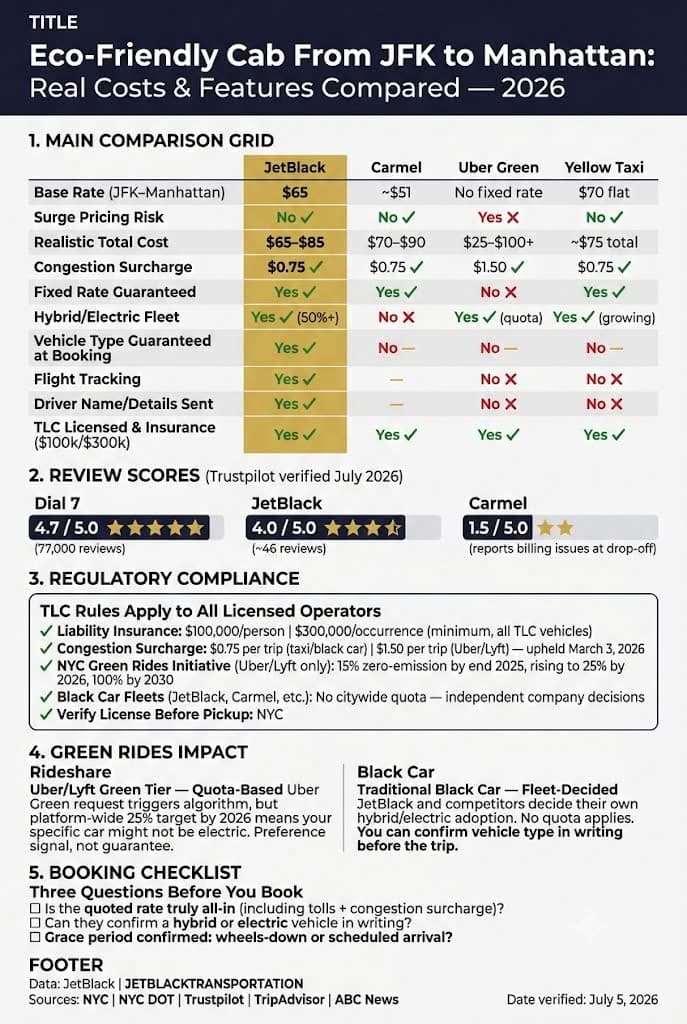
- Real Pricing: JetBlack’s flat sedan rate from JFK starts at $65 with a stated hybrid/electric fleet; Carmel starts near $51 with no dedicated eco fleet; Uber Green has no fixed rate and can run $25 to over $100 depending on demand.
- Congestion Surcharge: Every taxi and black car entering Manhattan below 60th Street adds 75 cents per trip (Uber/Lyft add $1.50) — a program a federal judge upheld on March 3, 2026.
- Competitor Trade-Off: Dial 7 holds a 4.7/5 Trustpilot score across nearly 77,000 reviews — far larger volume than JetBlack’s 4.0/5 across roughly 46 — but doesn’t market a dedicated eco fleet the way JetBlack does.
- Insurance Floor: Standard TLC black car operators must carry at least $100,000 per person and $300,000 per occurrence in liability coverage — not the $1.5 million figure sometimes cited online.
Fact-checked by: Alex Freeman. Full bio
Last verified: July 5, 2026
You land at JFK, bags in hand, and the taxi line snakes past the terminal doors while a dispatcher waves you toward a battered sedan idling in exhaust. Somewhere in that queue is an eco friendly cab from JFK to Manhattan, and it usually isn’t the one closest to the curb.
For a corporate booker trying to hit a sustainability target and a 9 a.m. meeting in the same trip, that distinction is the whole ballgame.
The phrase gets used loosely. A hybrid Toyota Camry running as a yellow medallion cab is, technically, an eco friendly cab from JFK to Manhattan. So is a fully electric black car booked through a pre-arranged dispatcher, and so is an Uber Green sedan pulled from the app.
They are not the same product, and they do not carry the same price, the same insurance floor, or the same certainty of actually showing up with a charged battery — which is the real test of any eco friendly cab from JFK to Manhattan.
This comparison sets three real options for an eco friendly cab from JFK to Manhattan against each other: a TLC-licensed black car with a hybrid or electric fleet, a rideshare app running its green tier, and a legacy car service that competes mostly on price. Business Travel News has tracked ground transportation ratings and sustainability reporting in corporate travel programs for years, and the pattern holds here too — the greenest-sounding option on paper is not always the one that performs.
What Is an Eco-Friendly Cab — And Why the Distinction Matters
The term “eco friendly cab from JFK to Manhattan,” in the context of ground transportation, means a vehicle that runs on a hybrid or fully electric powertrain and is dispatched under a valid TLC license. That’s the plain definition, and it splits into two very different regulatory tiers.
Under TLC rules, standard black car operators (1-7 passengers) must carry a minimum of $100,000 per person and $300,000 per occurrence in liability coverage. Larger vehicles face higher minimums.
The second tier is New York City’s Green Rides Initiative, which governs high-volume for-hire services — Uber and Lyft — separately from traditional black car bases. Under the rule, those platforms must dispatch a rising share of trips to zero-emission or wheelchair-accessible vehicles: 15 percent by the end of 2025, 25 percent by the end of 2026, climbing to 100 percent by 2030.
According to TLC’s own estimate, TLC-licensed vehicles account for roughly four percent of the city’s transportation emissions, so the initiative targets a real if modest slice of citywide pollution.
That regulatory split matters at the curb. A corporate booker choosing an eco friendly cab from JFK to Manhattan through a rideshare app is relying on a platform-wide quota, not a guarantee that this specific car is electric. A booker going through a black car base with a stated hybrid or electric fleet — JetBlack among them — is choosing a specific vehicle type at the point of booking.
The practical implication: if the sustainability line item on the expense report actually needs to hold up, ask which tier you are booking into before you ask about price. That question alone separates a genuine eco friendly cab from JFK to Manhattan from one that only sounds like one in the app’s marketing copy.
What an Eco Friendly Cab From JFK to Manhattan Actually Costs — Real Numbers, July 2026
Pricing separates fast once you compare an eco friendly cab from JFK to Manhattan across providers, and the differences show up before the first mile. JetBlack, a TLC-licensed black car base at 34 West 34th Street in Manhattan, quotes a flat sedan rate from JFK starting at $65, and states that more than half its fleet is hybrid or electric — a rider can request that option at booking rather than hoping for one at the curb.
Carmel Car & Limousine, one of the oldest affiliated fleets in the city, publishes sedan rates from JFK starting around $51 before tolls and gratuity, but does not advertise a dedicated hybrid or electric fleet, and its Trustpilot score sits at 1.5 out of 5. Uber Green, the rideshare platform’s electric-vehicle tier, has no fixed rate at all — fares in similar corridors have run from roughly $25 on a quiet weekday to well past $100 during a storm or a Friday surge, and a standard Uber Black sedan from Midtown to JFK runs close to $200 at peak times, according to Bloomberg.
| Option | Base Rate | Tolls/Surcharges | Surge Risk | Fixed Rate? | TLC Licensed? | Realistic Range |
|---|---|---|---|---|---|---|
| Carmel (sedan) | ~$51 | Tolls + gratuity added | Low | No | Yes | $70–$90 |
| JetBlack (hybrid/EV sedan) | $65 | Congestion surcharge included | Low | Yes | Yes | $65–$85 |
| Uber Green | No fixed rate | $1.50 congestion surcharge + surge | High | No | Yes (HVFHS) | $25–$100+ |
| Uber Black (reference) | No fixed rate | $1.50 congestion surcharge + surge | High | No | Yes (HVFHS) | $85–$200+ |
Every one of those fares gets a small addition few riders notice until the receipt arrives: New York’s congestion surcharge. Every taxi and black car entering Manhattan below 60th Street carries a 75-cent per-trip surcharge, while Uber and Lyft trips carry $1.50. A federal judge upheld the program on March 3, 2026, rejecting an attempt by the U.S. Department of Transportation to revoke its approval — so for now, the surcharge is not going anywhere.
The one honest surprise in this comparison: the cheapest-looking fare on the app is not necessarily the cheapest eco friendly cab from JFK to Manhattan once tolls, the congestion surcharge, and a rush-hour surge are added back in. A fixed quote that already includes those line items is worth more than it looks at first glance.
Real Passengers, Real Trips: What Customers Actually Experienced
Live reviews rarely mention “eco friendly cab from JFK to Manhattan” in those exact words, but they do reveal whether a booking held up under real conditions — which is the part that matters more than the powertrain badge.
Case Study 1 — Verified Trustpilot rider, 5 stars, May 2026
The Situation: A flight into JFK ran seven hours late, well past a normal workday.
What Happened: The rider stayed in contact with the dispatcher throughout the delay, and a driver was waiting at arrivals when the flight finally landed early the next morning, at a price the rider called competitive.
Why It Matters: A hybrid or electric fleet is only useful to a corporate traveler if the booking system can absorb a real-world delay without falling apart — the vehicle type doesn’t help if nobody shows up.
Case Study 2 — Verified Trustpilot rider, 5 stars, early 2026
The Situation: A returning passenger booked a second JFK-to-Manhattan trip with the same base.
What Happened: The same driver, Gurmeet, was assigned again, and the rider noted the car was immaculate and the service courteous on both occasions.
Why It Matters: For a corporate booker managing repeat travelers, driver consistency is a quieter but real benefit that a one-off rideshare booking can’t replicate.
Case Study 3 — Verified Trustpilot rider, 5 stars, late 2025
The Situation: A traveler arriving at JFK from overseas needed a straightforward transfer into Manhattan.
What Happened: The pickup was described as seamless, with a driver who was professional, punctual, and easy to deal with after a long flight.
Why It Matters: None of these three riders mentioned the vehicle’s powertrain directly — a fair reminder that booking an eco friendly cab from JFK to Manhattan is a request made at the time of booking, not something most passengers verify on arrival.
Not every review is glowing. A pattern in Trustpilot’s lower-rated reviews for black car services in this category points to wait-time billing disputes and last-minute cancellations — worth asking about directly at the time of booking, whatever fleet you choose.
How to Book Without Getting Burned — A Practical Checklist
Booking an eco friendly cab from JFK to Manhattan without regretting it later comes down to a short list of questions asked before you pay, not after. The same list works whether the vehicle is dispatched by a black car base or requested through a rideshare app’s green tier.
Confirm the TLC license at the point of booking, not at the curb — the TLC’s own verification tool exists for exactly this. Ask whether “fixed rate” actually includes tolls and the congestion surcharge, or whether those get added at drop-off.
If sustainability matters for your expense reporting, ask specifically whether the assigned vehicle will be hybrid or fully electric, since a general fleet claim does not guarantee the car you get. Confirm the grace period on any eco friendly cab from JFK to Manhattan you book: does the wait-time clock start at wheels-down or at the scheduled landing time? That single detail has cost more than a few travelers money after a delayed flight.
Get the driver’s name and vehicle details sent before pickup, and give the dispatcher your flight number so delays get tracked automatically rather than discovered by a missed pickup. For a corporate account managing multiple travelers, it’s worth asking the base directly how many hybrid or electric vehicles are actually in rotation for airport runs, rather than accepting a general fleet percentage from the homepage — a company-wide figure doesn’t tell you what shows up at JFK on a Tuesday morning.
Print or screenshot this before booking an eco friendly cab from JFK to Manhattan for your next trip.
Booking Checklist — Save or Screenshot This
- ☐ TLC license verified at tlc.nyc.gov/industry/verify-a-license/
- ☐ Fixed all-in rate confirmed in writing, tolls and congestion surcharge included
- ☐ Hybrid or electric vehicle requested specifically, not assumed from marketing copy
- ☐ Grace period confirmed: starts at [ ] landing / [ ] scheduled arrival
- ☐ Cancellation window confirmed in hours for a full refund
- ☐ Driver name and vehicle details sent at least 30 minutes before pickup
- ☐ Flight number provided to dispatcher
- ☐ Quote obtained from at least one other provider for comparison
The Industry in Honest Terms — How This Market Actually Works
New York City’s for-hire vehicle market runs on two distinct regulatory tiers, and understanding which one you’re booking into changes what “eco-friendly” actually guarantees. High-volume for-hire services — Uber and Lyft, running a combined fleet estimated at roughly 78,000 vehicles — operate under the Green Rides Initiative’s citywide dispatch quota, climbing from 15 percent zero-emission or wheelchair-accessible trips at the end of 2025 to 25 percent at the end of 2026.
Traditional black car and limousine bases, including JetBlack, Dial 7, and Carmel, are TLC-licensed but operate outside that specific quota — their hybrid or electric adoption is a fleet decision each company makes independently, not a citywide mandate. That’s exactly why an eco friendly cab from JFK to Manhattan booked through a black car base can vary so much between operators, even though all three carry the same TLC license.
That difference shows up in the numbers. Dial 7, one of the largest affiliated black car operators serving JFK, LaGuardia, and Newark, holds a 4.7 out of 5 rating on Trustpilot across nearly 77,000 reviews — a scale few competitors can match, though its site does not advertise a dedicated eco-friendly fleet the way JetBlack’s does.
Carmel, with its budget-focused sedan rates, sits at 1.5 out of 5 on Trustpilot, with recurring complaints about billing surprises at drop-off. JetBlack holds 4.3 out of 5 on TripAdvisor across 238 reviews and 4.0 out of 5 on Trustpilot across roughly 46 reviews — a smaller sample than Dial 7’s, worth weighing accordingly rather than averaging the two platforms together.
Not every provider that calls itself green backs it up at the curb. The honest advice for a corporate booker choosing an eco friendly cab from JFK to Manhattan: treat “eco-friendly” as a specific, verifiable request at booking time, confirm the fixed rate actually includes tolls and the congestion surcharge, and read the one- and two-star reviews before the five-star ones — they tend to describe what actually goes wrong.
Choosing an eco friendly cab from JFK to Manhattan says less about which company markets itself best and more about how carefully a traveler reads the fine print before booking. The vehicle’s powertrain is one line item among several that determine whether a trip actually goes smoothly — insurance tier, fixed-rate terms, and driver reliability all carry equal weight, even if only one of them shows up in the marketing copy.
Get quotes from two providers for the same route, and ask both the same two questions: is the quoted rate truly all-in, and can they confirm a hybrid or electric vehicle in writing before you book. The answers will tell you more about the ride than any sustainability badge on the homepage.
None of this requires giving up reliability for the sake of a lower emissions number. A well-run black car base with a genuine hybrid or electric fleet can deliver both, provided the booking confirms the vehicle type rather than assuming it. The next time an expense report needs a defensible line item for ground transportation, that single confirmation is worth more than the word “green” anywhere in a company’s marketing.
FAQ
What exactly makes a taxi or car service eco-friendly?
A cab or car service counts as eco-friendly when the specific vehicle dispatched to you runs on a hybrid or fully electric powertrain, not because of any marketing label on a website. In New York, two different rules apply depending on the type of service you book: rideshare platforms like Uber and Lyft operate under the city’s Green Rides Initiative, a citywide dispatch quota requiring a rising share of trips go to zero-emission or wheelchair-accessible vehicles, while traditional black car and taxi bases make their own fleet decisions independently, with no similar quota. A company can describe itself as green in its marketing without that quota ever applying to it. The only reliable way to know what you are actually getting is to ask which specific vehicle type will be dispatched to you and confirm it before the trip, rather than relying on the word eco-friendly on a homepage.
Is Uber Green actually better for the environment than a regular Uber?
Yes, an Uber Green ride is dispatched to a hybrid or electric vehicle specifically, so it produces fewer tailpipe emissions than a standard UberX ride on the same trip. That said, the benefit depends on Uber actually having an electric or hybrid car available near you at the moment you request one, and during high demand the app may substitute a standard vehicle instead. New York City’s Green Rides Initiative requires Uber and Lyft to dispatch a rising share of all trips, not every individual Uber Green request, to zero-emission or wheelchair-accessible vehicles: 15 percent by the end of 2025, climbing to 25 percent by the end of 2026 and 100 percent by 2030. That is a platform-wide average, which makes an Uber Green request a preference signal to the algorithm rather than a contractual guarantee. If verified zero-emission transportation matters for an expense report or a sustainability commitment, a pre-arranged black car with a fleet you can confirm in writing is the more reliable choice.
How much does an eco friendly cab from JFK to Manhattan actually cost?
An eco friendly cab from JFK to Manhattan typically runs sixty-five to ninety dollars for a pre-booked hybrid or electric black car sedan, or anywhere from twenty-five to well over one hundred dollars for an Uber Green ride depending on demand at the moment you request it. JetBlack, a TLC-licensed black car base, quotes a flat sedan rate from JFK starting at sixty-five dollars and states more than half its fleet is hybrid or electric. Uber Green has no fixed rate at all; fares in similar corridors have ranged from roughly twenty-five dollars on a quiet weekday to well past one hundred dollars during a storm or a Friday evening surge. Every option also carries New York’s congestion surcharge, seventy-five cents per trip for taxis and black cars and a dollar fifty for Uber and Lyft trips, a program a federal judge upheld on March 3, 2026. The cheapest number on the app screen is not always the cheapest ride once tolls, that surcharge, and a possible surge get added back in at drop-off.
Do hybrid taxis cost more than regular yellow cabs?
No, a hybrid yellow taxi charges the exact same metered or flat fare as a standard gas-powered yellow taxi, since the vehicle’s powertrain does not change the fare structure. New York’s taxi fare, including the flat seventy-dollar rate to Manhattan from JFK plus tolls and surcharges, is set by the Taxi and Limousine Commission regardless of whether the specific car happens to be a hybrid. If you specifically want a hybrid at the taxi stand, you can ask the dispatcher, but there is no separate green fare tier for medallion cabs the way there sometimes is for rideshare or black car options.
Is a hybrid or electric black car safer or more reliable than a regular one?
A hybrid or electric black car is not inherently safer or more reliable than a gas-powered one, since the powertrain has nothing to do with driver vetting, insurance coverage, or how well the booking system handles a delay. Every TLC-licensed black car, hybrid or not, must carry the same minimum liability coverage of one hundred thousand dollars per person and three hundred thousand dollars per occurrence for standard vehicles carrying one to seven passengers. What actually determines reliability is the base’s operational track record, meaning whether drivers show up on time, how they handle flight delays, and how disputes over wait-time billing get resolved. Live reviews for eco-friendly-leaning black car bases show the same range of experiences as any other operator, including riders reporting smooth pickups even after seven-hour flight delays alongside a smaller pattern of complaints about cancellations and billing surprises. Choosing hybrid or electric is a sustainability decision, not a safety one, and the two are worth evaluating separately.
What is the NYC Green Rides Initiative?
The NYC Green Rides Initiative is a Taxi and Limousine Commission rule requiring high-volume for-hire services, specifically Uber and Lyft, to dispatch a rising percentage of trips to zero-emission or wheelchair-accessible vehicles each year until the fleet reaches 100 percent by 2030. The benchmark was 5 percent at the end of 2024, rose to 15 percent at the end of 2025, and climbs to 25 percent by the end of 2026, increasing by 20 percentage points annually after that. According to the TLC’s own estimate, TLC-licensed vehicles currently account for roughly four percent of the city’s total transportation emissions, so the initiative targets a real but modest slice of citywide pollution. The rule applies specifically to Uber and Lyft’s combined fleet of roughly seventy-eight thousand vehicles; it does not set a similar quota for traditional black car or limousine bases, whose hybrid or electric adoption remains a company-by-company decision.
Can I request a hybrid or electric vehicle when I book a black car?
Yes, most black car bases that maintain a hybrid or electric fleet let you request that vehicle type at the time of booking, either through the app, the website, or by asking the phone dispatcher directly. JetBlack, for example, states that more than half its fleet is hybrid or electric and lets riders select that option when reserving a sedan. The important step is confirming the request in writing before the trip rather than assuming a general eco-friendly fleet claim on a homepage guarantees the specific car assigned to you. For a corporate account booking multiple trips, it is worth asking the base directly how many hybrid or electric vehicles are actually in rotation for airport runs specifically, since a company-wide fleet percentage does not tell you what is available on a given morning.
Does the congestion pricing surcharge apply to eco-friendly or electric vehicles too?
Yes, the congestion surcharge applies to every vehicle entering Manhattan below 60th Street regardless of whether it is electric, hybrid, or gas-powered. Taxis and black cars pay seventy-five cents per trip, while Uber and Lyft trips carry a dollar-fifty surcharge, and the rule does not distinguish by powertrain. A federal judge upheld the broader congestion pricing program on March 3, 2026, rejecting a federal attempt to revoke its approval, so the surcharge remains in effect for now regardless of vehicle type.
Is it worth paying more for a hybrid car service instead of taking Uber Green?
It depends on what you actually need guaranteed. If a verifiable hybrid or electric vehicle matters for an expense report or a sustainability commitment, a pre-booked black car service is generally worth the modest price difference over Uber Green. A pre-arranged black car like JetBlack quotes a flat rate from JFK starting around sixty-five dollars with a specific vehicle type confirmed at booking, while Uber Green has no fixed rate and can range from roughly twenty-five to well over one hundred dollars depending on demand at the moment you request it. The trade-off runs the other way if price certainty matters less than getting a ride immediately, since Uber Green’s on-demand model often means shorter wait times, just without a fixed fare or a guaranteed vehicle type. For a corporate booker who needs both a defensible sustainability line item and a predictable receipt, the fixed-rate black car generally holds up better under scrutiny than an app fare that varies trip to trip.
How do I know if a black car service is actually TLC-licensed?
You can verify any driver or vehicle’s TLC license directly through the TLC’s own online verification tool at tlc.nyc.gov/industry/verify-a-license, which confirms the license is active before you get in the car. Every legitimate black car base operates under a TLC base license, and drivers must hold a valid TLC driver license as well, both checkable through that same system. Unlicensed drivers who solicit rides at the airport curb, sometimes called gypsy cabs, carry none of the mandatory insurance coverage that licensed operators must maintain, which means you have no recourse if something goes wrong. Confirming the license before you get in the vehicle, not after, is the safer sequence, and the TLC’s tool takes under a minute to check.
What happens if my flight is delayed and I already booked a car?
A properly booked car service should track your flight automatically and adjust the pickup time without an extra charge, but the exact policy varies by provider, so confirm it before you book. Most black car bases start a grace period, meaning free waiting time before hourly fees kick in, from either wheels-down landing or your originally scheduled arrival time, and that distinction has real financial consequences during a long delay. One live review for a JFK-to-Manhattan black car booking described exactly this scenario, a flight running seven hours late with the dispatcher staying in contact throughout and a driver still waiting when the flight finally landed the next morning. Rideshare apps like Uber Green avoid this problem in a different way since you request the ride after you have already landed, but that convenience trades away the fixed-rate certainty of a pre-booked car. Whichever option you choose, get the grace-period policy and any wait-time fee in writing before your trip, not after a delay has already happened.
Are electric taxis available at JFK right now?
Yes, a growing share of New York’s yellow and green taxi fleet is hybrid, and the city’s broader Green Rides Initiative is pushing rideshare fleets toward zero-emission vehicles on a set schedule, though full electrification of the entire for-hire fleet is not required until 2030. There is no dedicated electric-only taxi stand at JFK; hybrid and electric cabs mix into the regular taxi queue, so the fastest way to request one specifically is to ask the dispatcher at the taxi stand or use an e-hail app like Curb that shows the vehicle type before it arrives. For a guaranteed electric or hybrid vehicle rather than a chance one, a pre-booked black car or a rideshare app’s green tier is more reliable than the taxi stand.
What is the difference between a black car and a yellow cab for airport pickup?
The core difference is that a yellow cab can pick you up directly from the taxi stand with no advance booking, while a black car must be pre-arranged through a dispatcher and cannot legally pick up a street hail. Yellow cabs charge a TLC-set flat rate of seventy dollars to Manhattan from JFK regardless of which company you use, with no surge pricing, while black car rates vary by base and are typically fixed once you book, ranging roughly sixty-five to one hundred fifty dollars depending on the operator and vehicle. Black car services generally offer flight tracking, a named driver, and vehicle details sent ahead of pickup, features a taxi stand does not provide since you do not know which cab or driver you will get until you reach the front of the line. Both are TLC-licensed and carry the same minimum insurance requirements; the practical trade-off is booking flexibility versus certainty over who is picking you up and in what vehicle.
How far in advance should I book a car from JFK for a business trip?
Most black car bases recommend booking at least twenty-four hours in advance for standard availability, and forty-eight to seventy-two hours ahead during peak travel periods such as major conferences, holiday weeks, or severe weather forecasts. Booking further ahead matters more if you specifically need a hybrid or electric vehicle, since that is a subset of most fleets rather than the whole inventory, and last-minute requests may not have one available. For recurring corporate travel, setting up a standing account with a base lets you specify vehicle type and driver preferences once rather than negotiating them for every trip. A same-day booking is usually still possible for a standard sedan, but expect fewer guarantees on vehicle type and pickup timing the closer you book to departure.
Do corporate travel programs track sustainability for ground transportation?
Yes, though the tracking is uneven; corporate travel program surveys have found that a majority of companies with chauffeured transportation contracts still do not have a formal sustainability component built into those programs. Business Travel News’s own annual Car Rental and Ground Transportation survey found that 84 percent of respondents’ programs lacked a sustainability component as of 2025, and among the minority that did have one, the share reporting suppliers fully met those sustainability needs actually declined year over year. Industry groups including the National Limousine Association have said they are developing sustainable procurement standards for the chauffeured transportation sector partly in response to that gap. For a corporate booker whose company does track this, the practical takeaway is the same as for an individual traveler: a general fleet-wide hybrid or electric percentage from a supplier is not the same as a documented, per-trip confirmation, and the latter is what actually holds up in a sustainability report.
Sources
- NYC Taxi and Limousine Commission. “Vehicle Insurance Requirements.” TLC.nyc.gov. Accessed July 2026.
- NYC Taxi and Limousine Commission. “Green Rides Initiative Rule Text.” NYC.gov. 2023.
- Office of the Mayor. “Green Rides Program Benchmarks.” NYC.gov. 2023.
- ABC News. “Manhattan’s Congestion Pricing Can Continue, Judge Rules.” March 3, 2026.
- BloombergNEF. “Manhattan to JFK in 7 Minutes in ‘Affordable’ Electric Air Taxi.” 2025.
- Trustpilot. “JetBlack Transportation Reviews.” Accessed July 2026.
- Trustpilot. “Dial 7 Car & Limousine Service Reviews.” Accessed July 2026.
- TripAdvisor. “Jet Black Transportation Reviews.” Accessed July 2026.
- JetBlack Transportation. Official site. Accessed July 2026.
- Airoldi, Donna M. “Chauffeured, Ride-Hailing Services Slip in Ratings.” Business Travel News. May 18, 2025.